
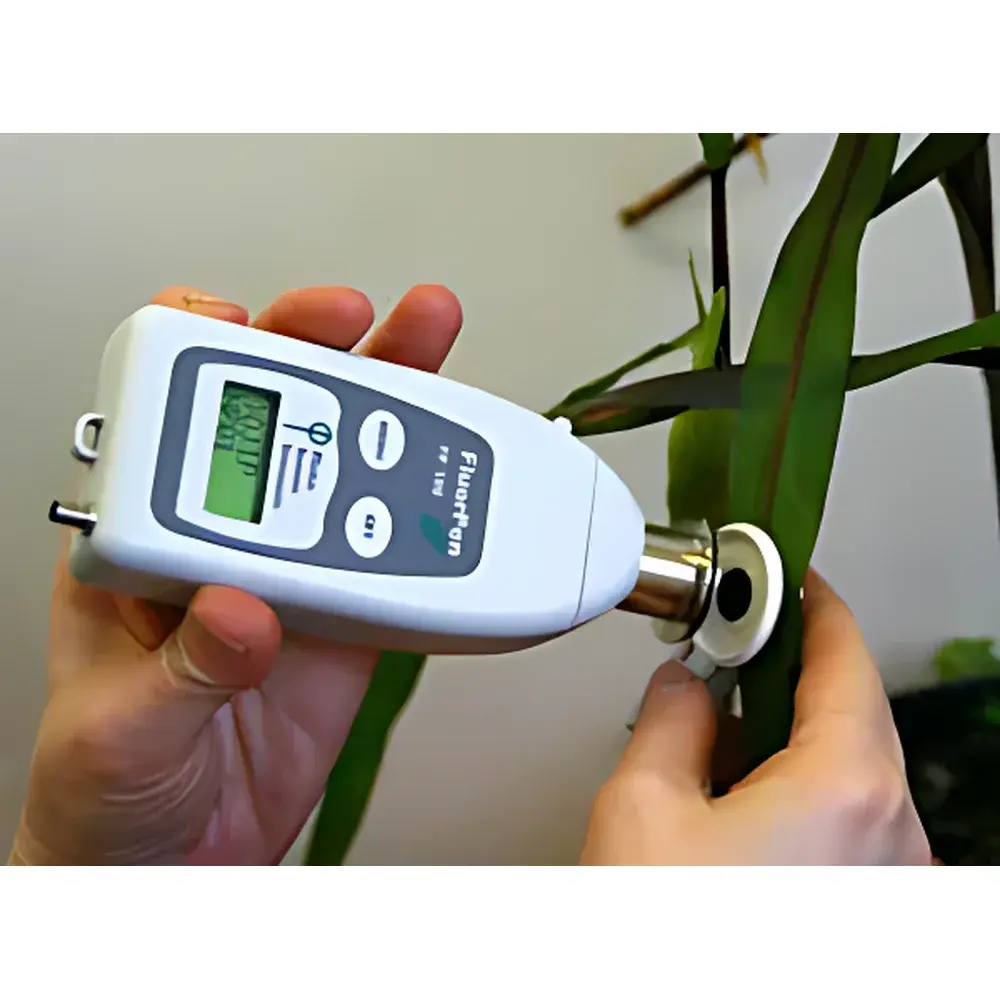
Photon Systems Instruments FluorPen FP 100 Portable Chlorophyll Fluorometer with Detachable Leaf Clip
| Origin | Czech Republic |
|---|---|
| Manufacturer Type | Authorized Distributor |
| Origin Category | Imported Instrument |
| Model | FluorPen FP 100 |
| Pricing | Upon Request |
| Measurement Principle | Modulated Chlorophyll Fluorescence (PAM-based) |
| Time Resolution | 10 µs (100,000 measurements/sec) |
| Fluorescence Detection Range | 697–750 nm |
| Excitation Wavelength | Standard 470 nm blue LED (optional custom wavelengths available) |
| PAR Sensor Range | 400–700 nm, resolution 1 µmol(photon)·m⁻²·s⁻¹ |
| Saturation Pulse Intensity | 0–3000 µmol(photon)·m⁻²·s⁻¹ |
| Actinic Light Intensity | 0–1000 µmol(photon)·m⁻²·s⁻¹ |
| Data Storage Capacity | 100,000 data points (4 MB internal memory) |
| Dimensions | 120 × 57 × 30 mm |
| Weight | 180 g |
| Power Supply | 4 × AAA batteries (70 h typical operation) |
| Operating Temperature | 0–55 °C |
| Relative Humidity | 0–95% RH (non-condensing) |
| Communication | USB or Bluetooth (optional) |
| GPS Module | Optional, time-stamped georeferenced output |
Overview
The Photon Systems Instruments FluorPen FP 100 is a field-deployable, high-resolution chlorophyll fluorescence analyzer engineered for quantitative assessment of photosynthetic performance in intact plant leaves. Based on the pulse-amplitude modulation (PAM) principle, it delivers laboratory-grade fluorescence kinetics under ambient light conditions using a compact, battery-powered architecture. The instrument applies precisely timed, low-intensity measuring light pulses and saturating actinic illumination to probe photochemical efficiency, electron transport dynamics, and non-photochemical energy dissipation mechanisms within Photosystem II (PSII). Its core measurement capability centers on transient OJIP kinetics—capturing fluorescence rise from 10 µs to 1 s—with full parameterization of J- and I-step inflections, enabling detection of early-stage photoinhibition, donor-side limitations, and reaction center integrity. Designed for both controlled experiments and large-scale ecological surveys, the FP 100 supports dark-adapted (Fo, Fm, Fv/Fm, PIAbs) and light-adapted (Fm′, QYII, NPQ, Rfd, qP) protocols compliant with established conventions in plant physiology (Strasser et al., 2004; Maxwell & Johnson, 2000).
Key Features
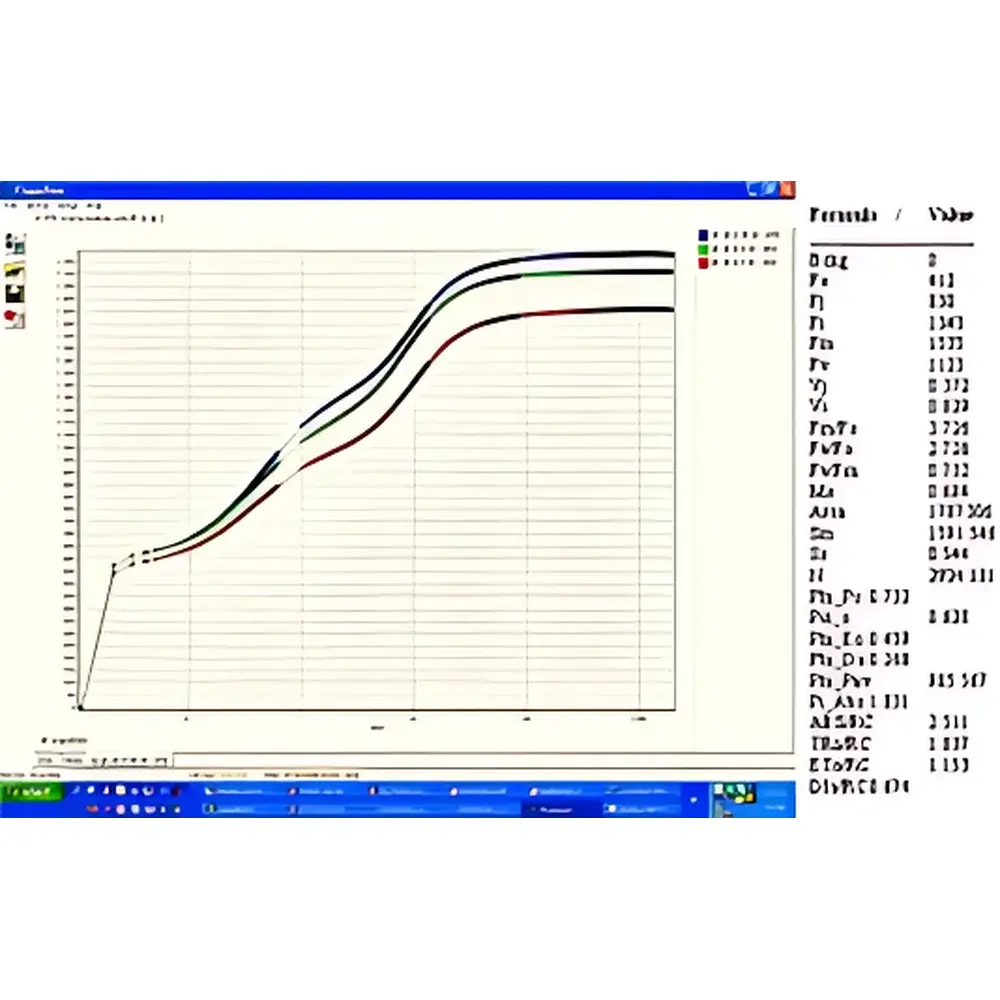
- Ultra-high temporal resolution: 10 µs sampling interval enables accurate reconstruction of OJIP transients and derivation of 26 standardized biophysical parameters including Mo, Sm, Area, ABS/RC, TRo/RC, and PIAbs
- Integrated PAR sensor with spectral response calibrated to 400–700 nm, reporting real-time photon flux density alongside fluorescence metrics
- Detachable leaf clip design allows simultaneous dark adaptation of multiple samples in daylight conditions—critical for diurnal stress profiling and high-throughput screening
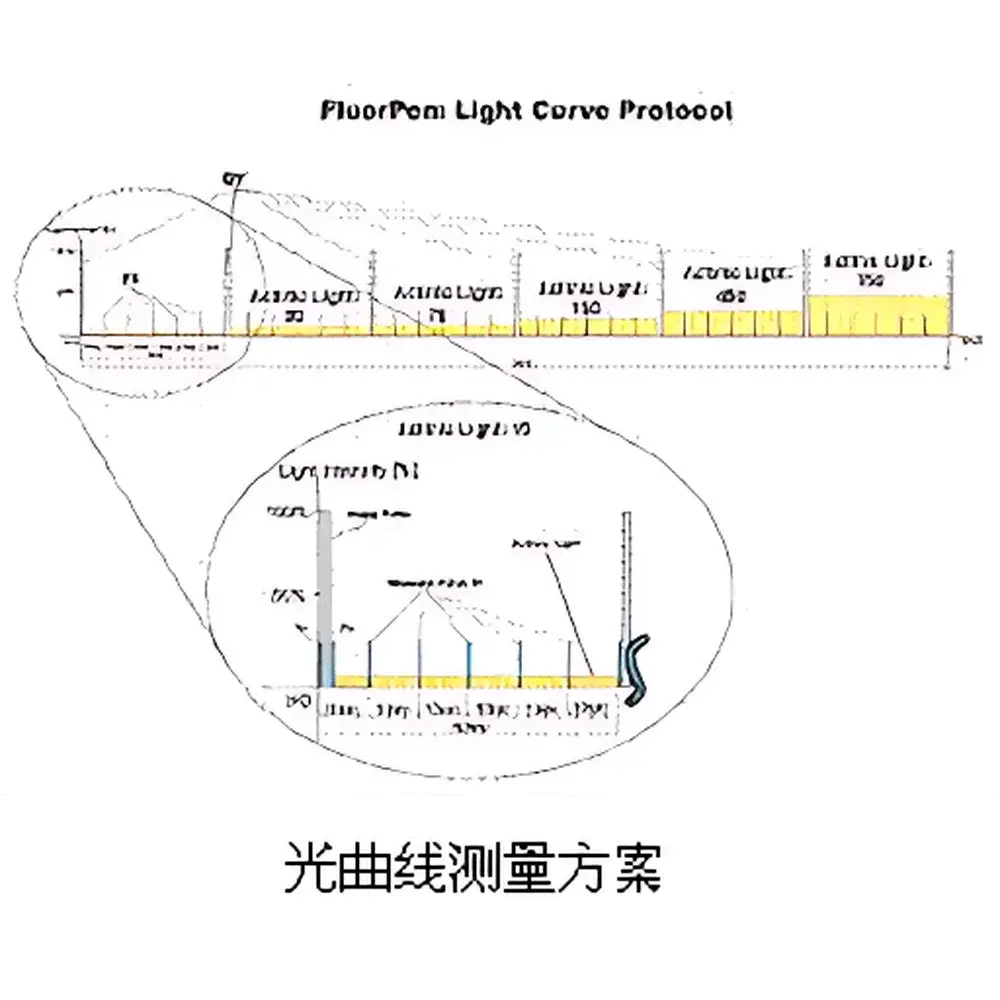
- Three programmable light-response curve protocols (including rapid light curves and multipoint irradiance series) and two fluorescence quenching analysis modes (NPQ and qP kinetics)
- Onboard storage for up to 100,000 data points; dual-interface support (USB and Bluetooth) for seamless transfer to FluorPen PC software
- Compact form factor (120 × 57 × 30 mm), lightweight construction (180 g), and 70-hour battery life enable extended field campaigns without external power
- Optional GPS module provides geotagged, time-synchronized metadata for spatial mapping of photosynthetic heterogeneity across landscapes or experimental plots
Sample Compatibility & Compliance
The FluorPen FP 100 accommodates a broad range of leaf morphologies via interchangeable clip configurations: standard fixed clips for rapid single-leaf assays, detachable dark-adaptation clips for synchronized multi-sample preparation, and transparent clips for non-invasive measurements under ambient illumination. It has been validated across monocots (e.g., wheat, maize), dicots (e.g., Arabidopsis, soybean), and perennial species (e.g., grapevine, oak), with minimal clamping pressure to avoid artifact-inducing mechanical stress. All fluorescence parameters adhere to the Minimal Fluorescence Protocol (MFP) definitions endorsed by the International Society of Photosynthesis Research (ISPR) and align with ISO 10211:2018 guidelines for optical biosensor validation. Data acquisition workflows support audit trails required under GLP-compliant environmental monitoring frameworks, and optional GPS timestamping satisfies FAO’s CropWatch protocol requirements for phenotyping traceability.
Software & Data Management
FluorPen PC Software (v4.2+) provides native support for raw OJIP waveform visualization, automated parameter extraction, batch processing of multi-sample datasets, and export to CSV, Excel, or MATLAB-compatible formats. The software implements standardized calculation algorithms per Strasser’s OJIP theory and includes built-in quality control flags for signal-to-noise ratio, saturation fidelity, and baseline drift correction. Remote control functionality permits synchronized triggering of measurements across distributed instruments in networked field trials. Data files embed instrument firmware version, calibration date, operator ID, and environmental metadata (PAR, temperature, humidity if externally logged), fulfilling documentation requirements for ISO/IEC 17025-accredited laboratories. Exported reports comply with FDA 21 CFR Part 11 when paired with user-authenticated login and electronic signature modules.
Applications
- Photosynthetic phenotyping in crop breeding programs: early detection of drought, heat, or salinity-induced PSII impairment prior to visible symptom onset
- Evaluation of herbicide mode-of-action and resistance development through kinetic shifts in QYII and NPQ recovery dynamics
- Ecophysiological monitoring of forest canopies and restoration sites using spatially referenced fluorescence gradients
- Validation of CRISPR/Cas9-edited photosynthetic mutants via comparative OJIP parameter profiling (e.g., altered ABS/RC or DIo/RC ratios)
- Biomonitoring of soil and water contamination using stress-sensitive bioindicator species (e.g., Lemna minor, Populus tremula) as living sensors
- Teaching laboratory applications: hands-on instruction in quantum yield theory, light acclimation responses, and stress physiology modeling
FAQ
What is the minimum leaf thickness compatible with the detachable leaf clip?
The detachable clip accommodates leaves ranging from 0.1 mm (e.g., moss gametophytes) to 3.5 mm (e.g., mature citrus or avocado leaves), with adjustable spring tension to minimize compression artifacts.
Can the FluorPen FP 100 be used underwater or in high-humidity environments?
While not submersible, the instrument operates reliably at up to 95% relative humidity (non-condensing); optional conformal coating is available for extended deployment in tropical field stations.
How does the OJIP analysis differ from conventional Fv/Fm screening?
OJIP provides time-resolved insight into electron transport bottlenecks (e.g., impaired QB site function reflected in elevated Vj), whereas Fv/Fm only indicates overall maximum quantum yield—making OJIP essential for mechanistic diagnosis of stress type and severity.
Is firmware update supported in the field?
Yes—firmware updates are delivered via FluorPen PC Software and applied over USB or Bluetooth without requiring return to service centers.
Are calibration certificates traceable to NIST standards available?
Factory calibration reports include traceability to SI units for PAR irradiance (via NIST-traceable spectroradiometer) and fluorescence intensity (via calibrated neutral density filters), with optional annual recalibration services.




