
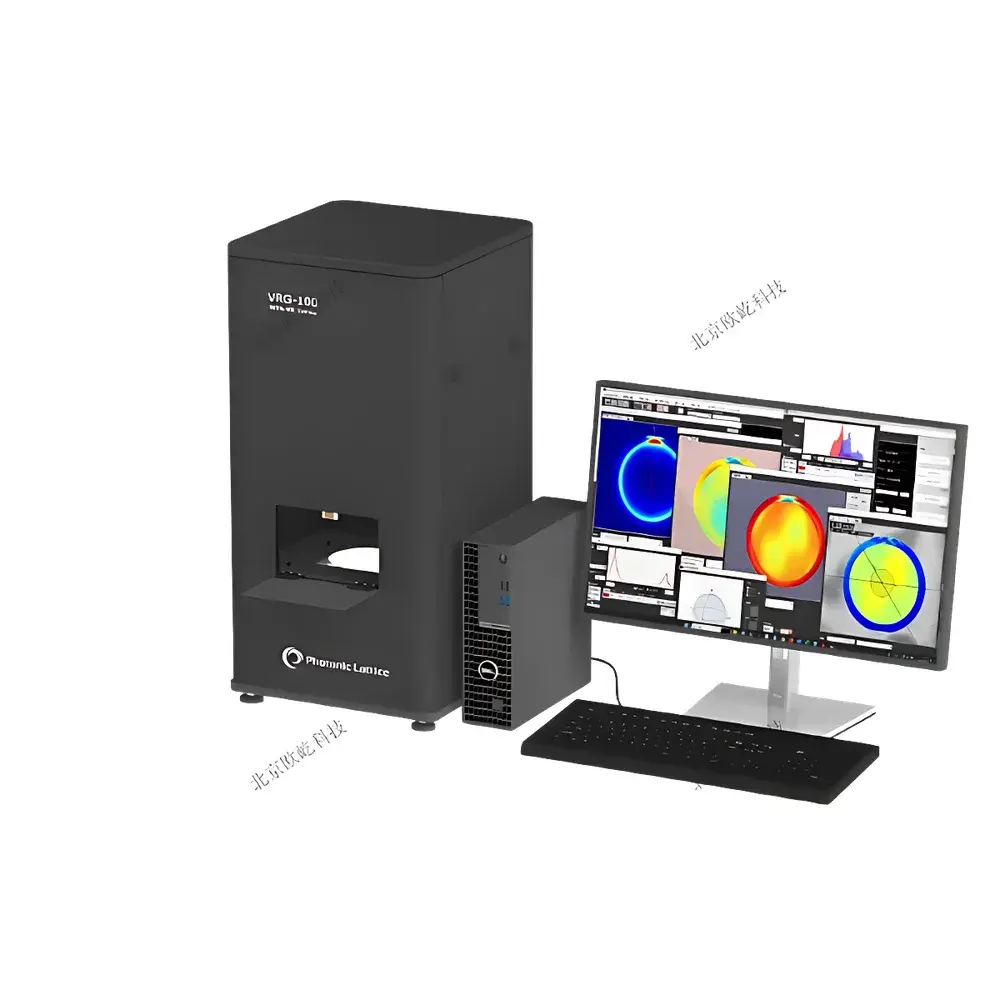
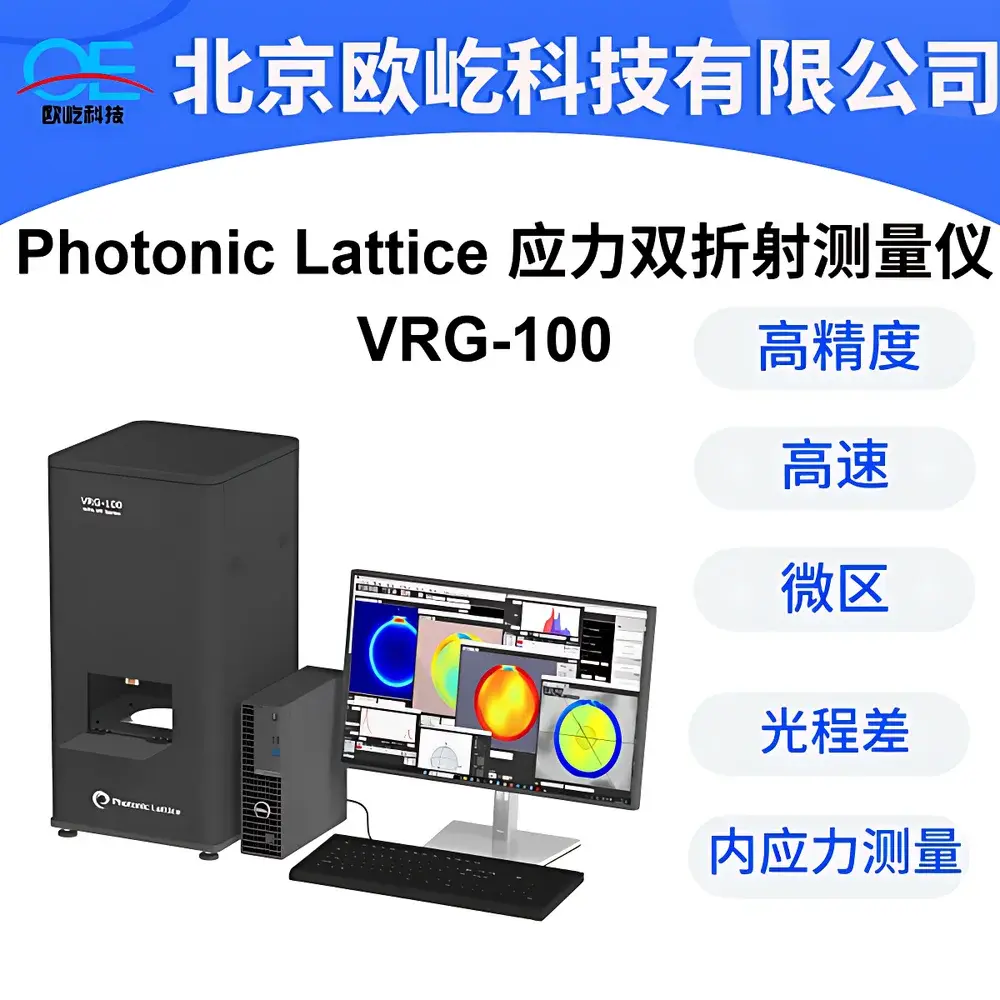
Photonic Lattice VRG-100 Polarizing Stress Measurement System for VR/AR Pancake Lenses
| Brand | Photonic Lattice |
|---|---|
| Origin | Japan |
| Manufacturer Status | Authorized Distributor |
| Origin Category | Imported |
| Model | VRG-100 |
| Wavelengths | 466 nm, 543 nm, 650 nm (customizable) |
| Retardation Range | 0–λ/2 (supports Quarter-Wave Plate measurement) |
| Measurable Parameters | Wavelength-resolved retardation and ellipticity (circular/elliptical polarization degree) per RGB channel |
| Sample Compatibility | Polarizer-integrated optics and QWP-stacked assemblies |
| Angular Resolution | Real-time relative angle measurement between polarizer and QWP |
Overview
The Photonic Lattice VRG-100 Polarizing Stress Measurement System is a purpose-built optical metrology platform engineered for quantitative evaluation of birefringent stress distribution in virtual reality (VR) and augmented reality (AR) optical components—particularly pancake lens assemblies. Unlike conventional photoelastic or full-field retardation analyzers, the VRG-100 implements multi-wavelength, polarization-resolved phase-difference detection based on precision rotating compensator ellipsometry principles. It directly measures spatially resolved retardation (Γ) and azimuthal orientation (ψ) across the lens aperture under controlled illumination at three primary visible wavelengths (466 nm, 543 nm, and 650 nm), enabling wavelength-dependent stress mapping critical for minimizing ghost image formation, chromatic retardation mismatch, and polarization-dependent modulation transfer function (MTF) degradation. The system operates non-destructively and without contact, making it suitable for both R&D prototyping validation and high-throughput inline quality assurance in cleanroom environments.
Key Features
- Triple-wavelength LED illumination (466 nm, 543 nm, 650 nm) with optional customization to support spectral alignment with display backlight profiles (e.g., microLED or OLED emission spectra)
- Full retardation range from 0 to λ/2, compatible with quarter-wave plate (QWP) characterization and calibration verification
- Simultaneous acquisition of retardation magnitude and ellipticity (degree of circular/elliptical polarization) per RGB channel—essential for evaluating polarization crosstalk in stacked metasurface or multilayer anti-reflective coatings
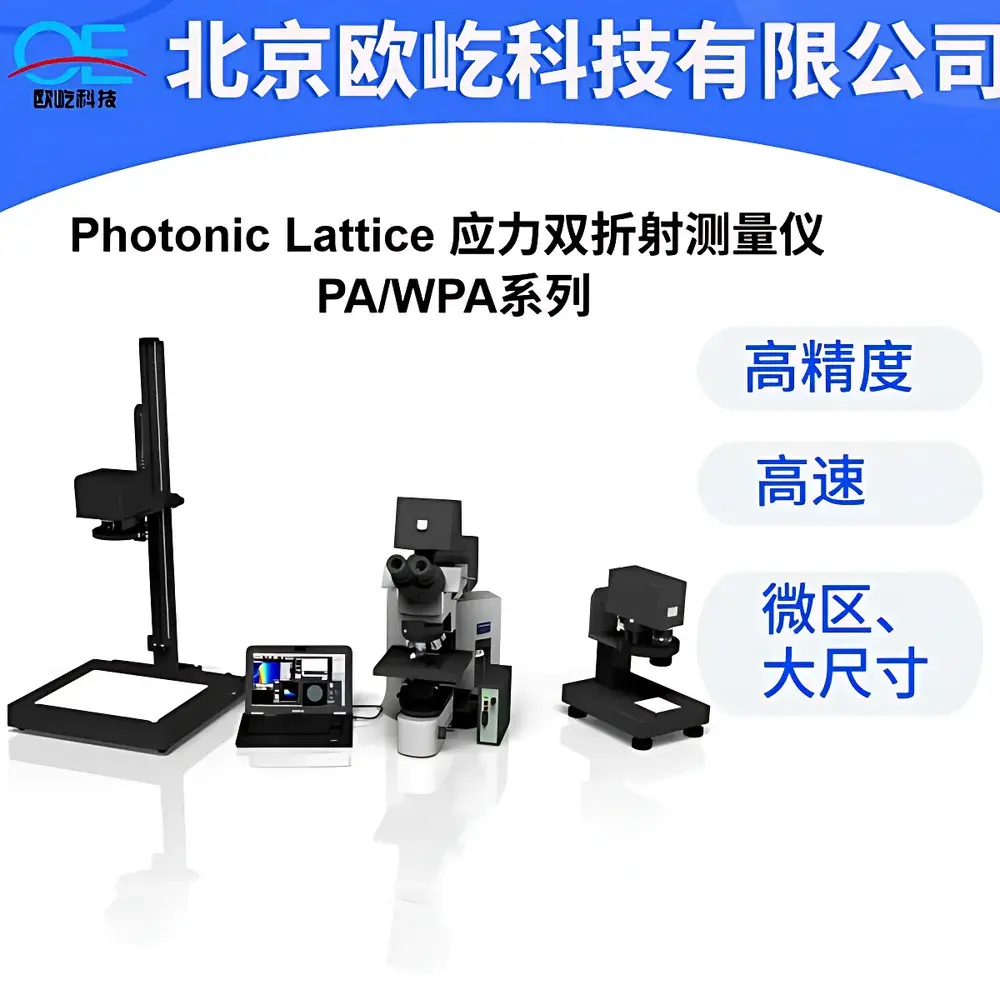
- Dedicated optical path design accommodating polarizer-integrated lenses and hybrid QWP-polarizer laminates—structures inaccessible to traditional WPA-series instruments due to fixed analyzer geometry
- Real-time angular registration between embedded polarizers and downstream QWPs, enabling dynamic alignment tolerance assessment during thermal cycling or mechanical mounting validation
- Motorized XY stage with sub-micron repeatability and programmable field-of-view scanning for automated stress profiling across curved or aspheric lens surfaces
Sample Compatibility & Compliance
The VRG-100 accommodates plano-convex, meniscus, and freeform VR lens substrates up to Ø80 mm diameter and 25 mm thickness. It supports direct measurement of bonded assemblies containing linear polarizers, cholesteric liquid crystal layers, and polymer-based QWPs—materials commonly used in pancake optical stacks. All optical components comply with ISO 9022-3 (environmental testing of optical instruments) and JIS B 7153 (retardation measurement accuracy standards). Data acquisition protocols are structured to support GLP-compliant documentation workflows, including instrument calibration traceability to NIST-traceable waveplate standards and timestamped audit logs for each measurement session.
Software & Data Management
The proprietary VRG Control Suite v3.2 provides intuitive GUI-driven operation with scriptable batch measurement sequences, region-of-interest (ROI) masking, and export of calibrated retardation maps in TIFF and HDF5 formats. Integrated analysis modules compute stress-induced birefringence Δn using standard photoelastic coefficients for common lens materials (e.g., polycarbonate, MR-8, and OKP4). Software supports FDA 21 CFR Part 11 compliance via electronic signature capture, role-based user access control, and immutable audit trails—including operator ID, environmental sensor readings (temperature/humidity), and hardware configuration snapshots. Raw interferometric data is stored with metadata compliant with FAIR principles (Findable, Accessible, Interoperable, Reusable).
Applications
- Quantitative stress mapping of pancake lens stacks to correlate birefringence gradients with ghost image intensity and positional offset
- Process validation of injection molding parameters (mold temperature, packing pressure, cooling rate) against residual stress thresholds defined by optical performance specifications
- Comparative evaluation of adhesive bonding methods (UV-curable vs. thermoset epoxies) on interfacial birefringence development
- Thermal stress profiling during accelerated aging tests (e.g., 85°C/85% RH per JEDEC JESD22-A101)
- Alignment tolerance analysis of polarizer-QWP angular misregistration in folded optical paths
- Supporting ASTM F3311-22 (Standard Guide for Optical Testing of AR/VR Head-Mounted Displays) and ISO/IEC 17025-accredited laboratory reporting
FAQ
Is the VRG-100 compatible with curved or aspheric VR lenses?
Yes—the system includes motorized Z-focus compensation and tilt-adjustable sample holders designed for ±15° surface normal deviation, enabling repeatable measurements on high-curvature pancake lens elements.
Can it measure stress in multi-layer bonded assemblies containing both polarizers and QWPs?
Yes—its dual-rotating compensator architecture eliminates analyzer extinction constraints, allowing unambiguous decomposition of overlapping retardation contributions from sequential anisotropic layers.
Does the system provide traceable calibration certificates?
Each unit ships with a factory calibration report referencing NIST-traceable quartz waveplates and includes annual recalibration services with documented uncertainty budgets per ISO/IEC 17025 requirements.
What software licenses are included with purchase?
The base package includes perpetual licenses for VRG Control Suite v3.2, stress analysis module, and PDF report generator. Optional add-ons include API integration SDK and remote monitoring dashboard.
Is technical support available outside Japan?
Yes—Photonic Lattice maintains authorized service centers in North America, Germany, and China, with 24-hour remote diagnostics and on-site engineering support under extended warranty agreements.





