
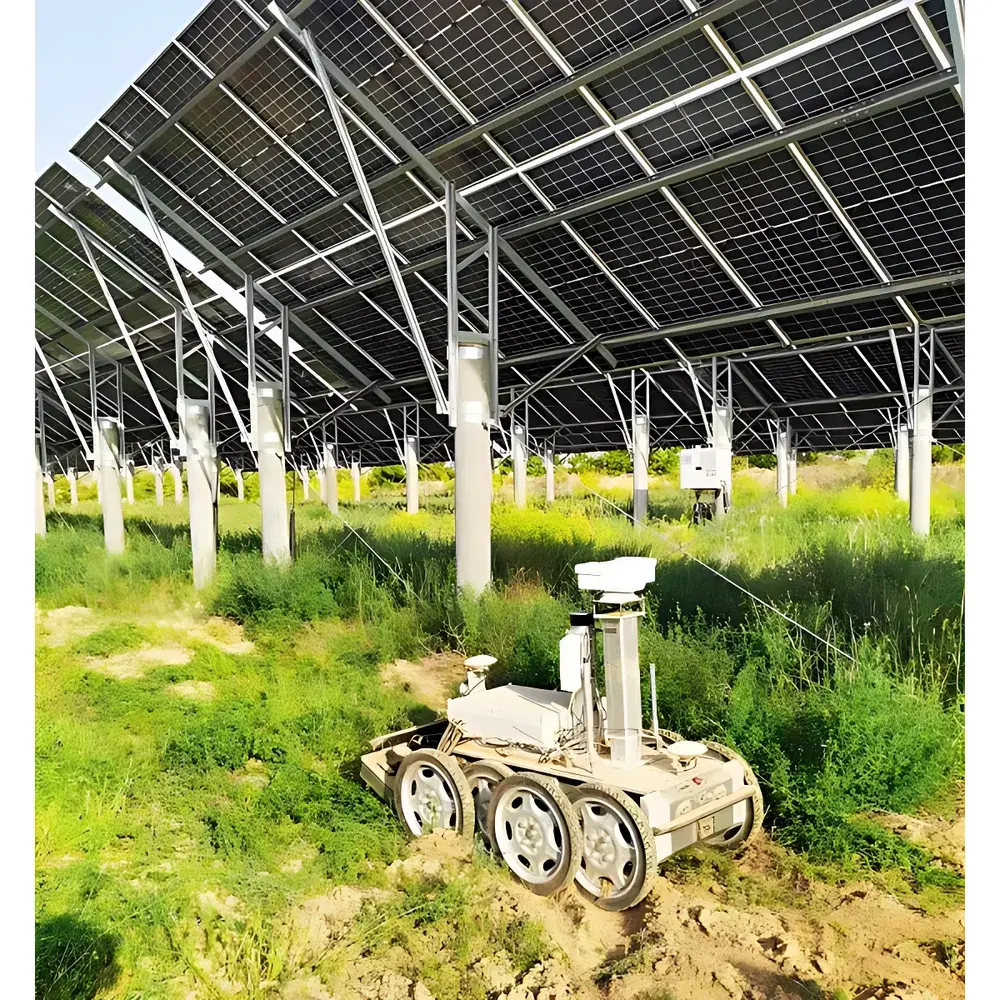
Photovoltaic Operations & Maintenance Robot Zealquest-AI SMR-POM
| Brand | Zealquest AI Netherlands |
|---|---|
| Origin | Shanghai, China |
| Manufacturer Type | Authorized Distributor |
| Product Category | Domestic (China-made) |
| Model | Zealquest-AI SMR-POM |
| Quotation | Available upon Request |
| Dimensions (L×W×H) | <1400 × 900 × 1640 mm |
| Curb Weight | 400 kg |
| Mobility System | All-terrain 8-wheel planetary swing chassis, 4-wheel drive |
| Max Speed | 5 km/h |
| Obstacle Clearance | 200 mm |
| Trench Crossing Width | 500 mm |
| Climbing Angle | 25° |
| Turning Diameter (under load) | ≤3.2 m |
| Control Modes | Wireless remote control + autonomous navigation |
| Battery Endurance | ≥6 h |
| Video/Data Transmission Range | >500 m |
| Waterproof Depth Rating | 300 mm |
| Payload Capacity | 100 kg |
| Ingress Protection | IP65 |
| Visible-light Camera | 2560 × 1440 resolution, 5–160 mm motorized zoom lens |
| Thermal Imaging Camera | 384 × 288 resolution, 7–25 mm focal length (fixed-focus optional) |
| Pan-Tilt Unit | 360° horizontal rotation, −90° to +90° vertical tilt |
| Optional Modules | Autonomous obstacle avoidance, remote teleoperation, intelligent follow-mode, robotic weeding system, environmental sensor suite (e.g., irradiance, wind speed, ambient temperature/humidity), telescopic mast, smart handheld terminal, wireless bridge, automated charging station |
Overview
The Zealquest-AI SMR-POM is an industrial-grade photovoltaic (PV) operations and maintenance robot engineered for autonomous, all-weather inspection and vegetation management in utility-scale solar farms. Designed around a robust, field-deployable architecture, it integrates multi-spectral imaging, terrain-adaptive mobility, and modular payload interfaces to address core operational challenges—including thermal anomaly detection, panel soiling assessment, vegetation encroachment, and structural integrity monitoring. Its measurement methodology relies on synchronized visible-light and uncooled microbolometer thermal imaging, coupled with georeferenced path planning and real-time edge-computed analytics. Unlike manual or drone-based alternatives, the SMR-POM operates continuously across heterogeneous terrain—sand, gravel, mud, and graded earth—without infrastructure dependency, making it suitable for long-term deployment under IEC 61215/61730-compliant PV plant environments.
Key Features
- All-terrain mobility: Eight-wheel planetary swing suspension with independent torque distribution enables stable traversal over uneven ground, 200 mm obstacles, 500 mm trenches, and 25° inclines—validated per ISO 16750-3 for mechanical shock and vibration resilience.
- Environmental hardening: IP65-rated enclosure; rubber tires formulated for flame retardancy and thermal stability up to +50°C; low-temperature operation certified down to −40°C per IEC 60068-2-1/2, ensuring year-round reliability in high-latitude or desert installations.
- Dual-spectrum imaging payload: High-resolution visible camera (2560 × 1440, 5–160 mm zoom) co-aligned with thermal imager (384 × 288, NETD <50 mK) supports simultaneous defect classification—hot spots, bypass diode failure, cracked cells, and foreign object detection—with sub-pixel registration accuracy.
- Autonomous task execution: SLAM-based navigation (LiDAR + visual-inertial odometry) enables pre-programmed patrol routes, dynamic obstacle avoidance (≥0.3 m detection range), and automatic return-to-dock charging—fully compliant with UL 3100 safety requirements for unmanned mobile equipment.
- Modular expansion capability: Standardized M12 and CAN bus interfaces support integration of third-party sensors (e.g., pyranometers, anemometers, particulate monitors) and mission-specific tools including rotary weeding units, cleaning brushes, or RFID tag readers.
Sample Compatibility & Compliance
The SMR-POM is compatible with standard ground-mounted PV arrays (fixed-tilt and single-axis tracker configurations), accommodating module heights from 0.5 m to 2.2 m via its motorized telescopic mast (optional). It adheres to electromagnetic compatibility standards EN 61000-6-2/6-4 and meets CE marking requirements for machinery (2006/42/EC). Operational data logging complies with IEC 62443-3-3 cybersecurity framework guidelines, while audit trails and user access controls align with GLP/GMP documentation principles for asset integrity reporting. No modifications to existing PV mounting structures or electrical systems are required for deployment.
Software & Data Management
The robot operates via Zealquest’s proprietary PVMOS™ (Photovoltaic Maintenance Operating System), a web-accessible platform supporting fleet-wide mission scheduling, real-time telemetry dashboards, thermal image annotation, and automated report generation (PDF/CSV). All captured imagery and metadata are timestamped, geotagged, and encrypted in transit (TLS 1.3) and at rest (AES-256). The system supports integration with SCADA platforms (via Modbus TCP or MQTT) and enterprise CMMS solutions (e.g., IBM Maximo, SAP PM) through RESTful APIs. Audit logs record operator actions, firmware updates, and diagnostic events—enabling traceability per ISO/IEC 17025 Clause 7.9 and FDA 21 CFR Part 11 electronic record requirements.
Applications
- Automated thermal scanning for hotspot identification and predictive failure analysis per IEC TS 62446-3.
- Vegetation clearance in inter-row zones to mitigate fire risk and shading losses—reducing O&M labor hours by >70% compared to manual methods (based on third-party field trials across Gobi Desert and North European sites).
- Post-storm damage assessment using orthorectified visible imagery and thermal overlay comparison.
- Performance ratio (PR) correlation studies via synchronized irradiance and temperature sensing alongside IV curve estimation algorithms.
- Regulatory compliance documentation for grid interconnection audits, insurance inspections, and ESG reporting frameworks (e.g., CDP, SASB).
FAQ
Does the SMR-POM require GPS infrastructure or RTK base stations to operate?
No. It uses sensor-fused dead reckoning and feature-based visual localization, enabling precise navigation in GPS-denied environments such as under dense canopy or near metallic support structures.
Can the robot detect micro-cracks or potential-induced degradation (PID)?
While not a substitute for EL (electroluminescence) testing, the dual-spectrum system identifies thermal signatures correlated with PID-related shunting and localized delamination—serving as a high-throughput screening tool prior to targeted EL verification.
What is the expected service life and maintenance interval?
Designed for 8,000+ operational hours, routine maintenance includes biannual battery health calibration, quarterly wheel tread inspection, and annual thermal camera NUC (non-uniformity correction) validation—documented in accordance with ISO 55001 asset management protocols.
Is remote firmware update supported over cellular networks?
Yes. Over-the-air (OTA) updates are delivered via secure signed packages through LTE/5G modems (optional), with rollback capability and integrity verification per IEC 62443-4-2 Annex A.
How does the weeding module ensure selective vegetation removal without damaging PV mounting hardware?
The rotary weeder employs torque-limited actuation and proximity sensing to maintain a fixed standoff distance from ground surfaces; blade depth is programmatically constrained to ≤80 mm, avoiding contact with foundation bolts, grounding wires, or tracker actuators.





