
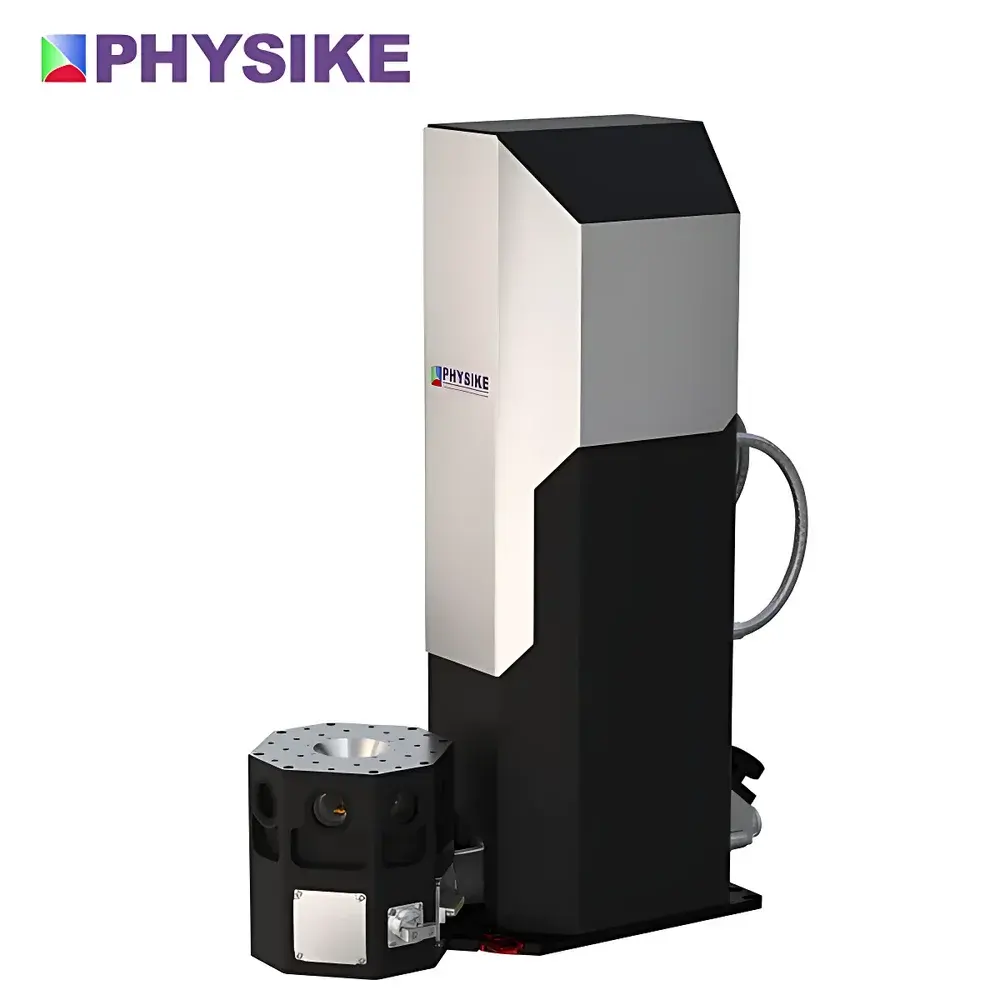
PHYSIKE CryoAce-100 Ultra-High-Stability Optical Microscopy Cryogenic Thermostat
| Brand | PHYSIKE |
|---|---|
| Origin | Beijing, China |
| Manufacturer Type | Direct Manufacturer |
| Country of Origin | China |
| Model | CryoAce-100 |
| Cooling Medium | Helium Gas |
| Base Plate Diameters | 5 cm, 10 cm, 15 cm, 20 cm |
| Nominal Vibration Amplitude | 6–12 nm (RMS, dependent on base plate size and operating temperature) |
| Base Temperature Range | 2.4 K – 3.2 K |
| Standard Configuration | Top and/or Side Optical Windows, Vacuum Gauge, Calibrated Platinum Resistance Thermometer (PRT) |
| Integrated Cryo-Pumping | Multi-stage低温 adsorption pumps |
| Compressor Type | Air-Cooled Helium Compressor |
| Power Supply | Single-Phase AC, Low Power Consumption |
| Footprint | Compact Desktop Form Factor |
| Vacuum Maintenance | Self-Sustaining High Vacuum Without Continuous External Pumping |
Overview
The PHYSIKE CryoAce-100 is an ultra-stable, desktop-integrated optical microscopy cryogenic thermostat engineered for quantum optics, nanoscale spectroscopy, and low-temperature solid-state physics experiments. It operates on a closed-cycle helium refrigeration principle, utilizing a high-efficiency Gifford-McMahon or pulse-tube cold head coupled with PHYSIKE’s proprietary suspended cold head vibration isolation architecture. This multi-stage mechanical decoupling—comprising active suspension mounts, low-resonance composite support struts, and vacuum-encapsulated thermal anchoring—reduces transmitted mechanical noise to sub-12 nm RMS displacement across the full operational temperature range (2.4 K to 3.2 K), enabling stable optical alignment and diffraction-limited imaging at cryogenic temperatures. Unlike traditional bath-based or flow-cooled systems, the CryoAce-100 integrates cooling, vacuum, and optical access into a single self-contained unit, eliminating the need for external liquid cryogens, water-cooled compressors, or custom vibration-isolation infrastructure.
Key Features
- Sub-12 nm RMS vibration performance at base temperature (2.4–3.2 K), validated via laser Doppler vibrometry and spectral analysis in both time and frequency domains
- Modular cold plate design with four standard diameters: 5 cm, 10 cm, 15 cm, and 20 cm—each optimized for thermal mass, stiffness, and modal damping
- Integrated air-cooled helium compressor; no external chiller, no three-phase power, and minimal floor space requirement (< 0.5 m²)
- Hermetic vacuum chamber with built-in multi-stage cryo-adsorption pumps—maintains 72 hours without continuous external pumping
- Dual optical access configuration: interchangeable top-view and side-view fused silica or CaF₂ windows (AR-coated options available), compatible with high-NA objectives and confocal scanning geometries
- Factory-calibrated Pt-100/Pt-25 resistance thermometer traceable to NIST standards, plus integrated capacitance manometer for real-time vacuum monitoring
- Thermal anchoring interface supports direct mounting of commercial nanopositioning stages (e.g., Attocube ANPxyz series), piezo scanners, and fiber-coupled photonic probes
Sample Compatibility & Compliance
The CryoAce-100 accommodates a broad spectrum of low-temperature optical samples, including but not limited to diamond NV⁻ centers, semiconductor quantum dots (InAs, CdSe), 2D materials (WSe₂, hBN), superconducting resonators, and molecular monolayers on insulating substrates. Its modular sample stage allows for electrical feedthroughs (up to 24 DC/RF lines), optical fiber ports, and coaxial microwave routing—fully configurable per experimental requirements. The system complies with ISO 14644-1 Class 5 cleanroom handling protocols during assembly and is designed for GLP-compliant operation: all temperature and vacuum logs are timestamped and exportable in CSV/JSON format. While not certified to IEC 61000-6-2/6-4, its EMI profile has been characterized per CISPR 11 Group 1, Class B limits for laboratory instrumentation.
Software & Data Management
CryoAce-100 is controlled via PHYSIKE’s CryoControl™ v3.2 software suite (Windows/Linux), which provides synchronized regulation of temperature ramp rate (0.01–5 K/min), vacuum sequencing, compressor status, and alarm logging. All sensor data—including PRT resistance, thermistor voltage, vacuum pressure, and compressor discharge temperature—are sampled at 10 Hz and stored with microsecond-precision timestamps. Audit trails meet FDA 21 CFR Part 11 requirements for electronic records, including user authentication, session locking, and immutable log export. Optional Python API (pyCryoAce) enables integration with LabVIEW, MATLAB, or custom quantum control stacks (QCoDeS, QICK). Raw vibration spectra (PSD) and thermal transient curves are exportable in HDF5 format for post-acquisition modal analysis.
Applications
- Single-emitter spectroscopy of NV centers under magnetic field sweeps (ODMR, T₁/T₂ mapping)
- Resonant fluorescence and photon antibunching measurements from epitaxial quantum dots
- Cryogenic Raman and photoluminescence mapping of van der Waals heterostructures
- Low-temperature scanning probe microscopy (STM/AFM) combined with optical excitation
- Development and calibration of cryogenic single-photon detectors (SNSPDs, MKIDs)
- In-situ optical characterization of superconducting qubit test structures
FAQ
What base temperature can be achieved with the CryoAce-100?
The system achieves a minimum base temperature between 2.4 K and 3.2 K, depending on cold plate diameter, thermal load, and ambient conditions. Smaller plates (5 cm) typically reach ≤2.5 K under no-load conditions.
Is liquid helium or liquid nitrogen required?
No. The CryoAce-100 is a fully dry, closed-cycle system using compressed helium gas as the working fluid. No cryogen refills or dewar handling is necessary.
Can the system be integrated with commercial confocal microscopes?
Yes. Standard top- and side-access optical paths accommodate Nikon, Olympus, and Zeiss microscope bodies. Custom flange adapters and kinematic mirror mounts are available upon request.
How is vacuum integrity maintained during long-duration experiments?
Integrated cryo-adsorption pumps (activated charcoal + zeolite layers cooled to 96 hours after initial pump-down.
Does the CryoAce-100 support electrical measurements?
Yes. The standard configuration includes 12-pin low-noise feedthroughs. High-frequency RF/microwave variants (SMA/K-type, up to 40 GHz) and filtered DC feedthroughs are optional.



