
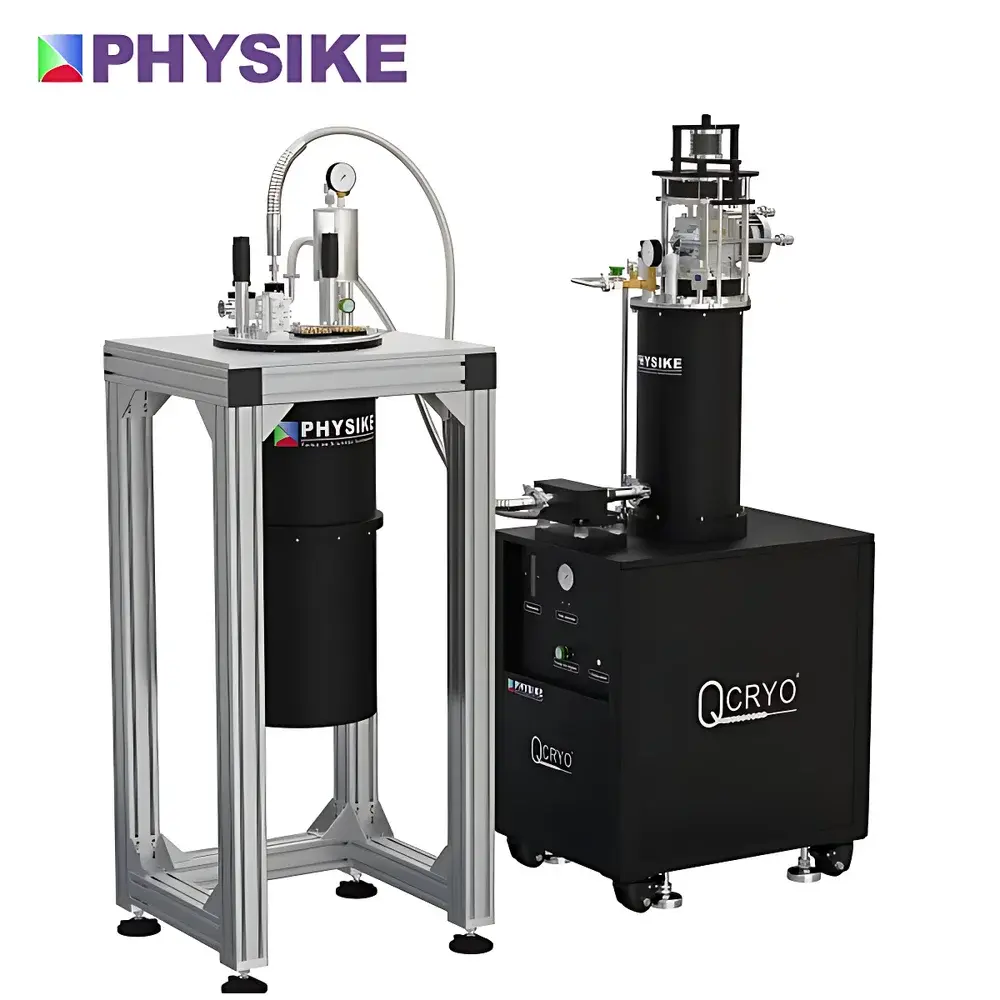
PHYSIKE Cryocloud-400 Split-System Single-Shot He-3 Cryostat
| Brand | PHYSIKE |
|---|---|
| Origin | Beijing, China |
| Manufacturer Type | Direct Manufacturer |
| Product Category | Domestic |
| Model | Cryocloud-400 |
| Pricing | Upon Request |
Overview
The PHYSIKE Cryocloud-400 is a split-system, single-shot helium-3 cryostat engineered for ultra-low-temperature physics experiments requiring stable, low-vibration operation below 300 mK. Unlike conventional closed-cycle refrigerators or integrated 4 K pulse-tube-based He-3 systems, the Cryocloud-400 decouples the primary cooling stage from the He-3 refrigeration unit via flexible superinsulated transfer lines. It relies on an external, low-vibration helium recirculation cryogenic system (Qcryo®) to supply sub-4 K superfluid helium—typically at ~2.5 K—to condense gaseous 3He in the integrated reservoir. Subsequent adsorption pumping within the internal 3He pot enables passive cooldown to a base temperature of ≤270 mK, sustained for tens of hours without active gas handling or external circulation infrastructure. This architecture eliminates mechanical coupling between compressor-driven cold heads and the experimental stage—a critical design feature for scanning probe microscopy (STM/AFM), quantum sensing, and near-field optical spectroscopy where sub-nanometer stability is mandatory.
Key Features
- Split-system configuration isolates vibration-sensitive experimental platforms from compressor and cold-head dynamics using flexible, vacuum-jacketed superfluid helium transfer lines
- Integrated 3He reservoir, condensation pot, and低温 adsorption pump housed within a single vacuum-tight cryostat body
- Base temperature ≤270 mK with thermal hold time exceeding 40 hours at minimum temperature (dependent on thermal load and vacuum integrity)
- UHV-compatible construction with all-metal seals; bakeable to 150 °C for achieving <1×10⁻¹⁰ mbar base pressure
- No external 3He gas recirculation loop required—eliminates complex plumbing, valves, and associated failure modes
- Modular flange interface (CF150 or custom) supports integration with commercial STM, AFM, and quantum transport measurement platforms
Sample Compatibility & Compliance
The Cryocloud-400 accommodates standard cryogenic sample holders (e.g., PCB-mounted chips, MEMS devices, SQUID arrays, TES bolometers) and supports direct mounting of optical components including fiber-coupled detectors and nanophotonic waveguides. Its UHV-rated stainless-steel body complies with ISO-UHV (ISO 10110-7) and ASTM E576 standards for vacuum integrity and outgassing performance. All internal surfaces are electropolished and passivated per ASTM A967 to minimize particulate generation and hydrogen diffusion. The system is compatible with GLP/GMP-aligned lab environments when paired with validated temperature logging and vacuum monitoring subsystems. While not intrinsically FDA 21 CFR Part 11 compliant, its digital I/O interface supports third-party audit-trail-capable data acquisition systems meeting regulatory requirements for traceable low-temperature calibration.
Software & Data Management
The Cryocloud-400 operates via RS-485 or Ethernet-connected controller firmware supporting LabVIEW, Python (PyVISA), and MATLAB instrument drivers. Real-time monitoring includes 3He pot temperature (Cernox™ or RuO2 sensor), cold-stage temperature, vacuum pressure (ion gauge + capacitance manometer), and helium transfer line status. All readings are timestamped with microsecond resolution and stored locally on an embedded SD card (optional cloud sync). Firmware implements configurable thermal ramp profiles, automatic hold-point stabilization, and alarm-triggered emergency venting protocols. Data export conforms to HDF5 and CSV formats, ensuring compatibility with analysis pipelines used in condensed matter physics and quantum device characterization.
Applications
- Scanning tunneling microscopy (STM) and atomic force microscopy (AFM) under ultra-low-noise conditions
- Quantum transport measurements in 2D materials, topological insulators, and moiré superlattices
- Single-photon detection using superconducting nanowire single-photon detectors (SNSPDs) and transition-edge sensors (TES)
- Angle-resolved photoemission spectroscopy (ARPES) with sub-meV energy resolution
- Magnetic susceptibility studies via de Haas–van Alphen oscillations and quantum Hall effect metrology
- Low-temperature X-ray and neutron scattering sample environments requiring long-duration thermal stability
FAQ
What distinguishes the Cryocloud-400 from integrated single-shot He-3 cryostats?
It uses an external Qcryo® helium recirculation system instead of an onboard 4 K pulse-tube cooler—removing vibration sources from the experimental chamber.
Is the Cryocloud-400 compatible with existing dilution refrigerator infrastructure?
No—it is not a dilution refrigerator; it is a standalone single-shot He-3 system requiring only a Qcryo®-class helium supply at ≤2.5 K.
Can the system be upgraded to support continuous He-3 operation?
Not natively; continuous-cycle He-3 operation requires fundamentally different hardware, including external compressors and gas-handling manifolds.
What vacuum specifications does the Cryocloud-400 meet?
Standard configuration achieves ≤1×10⁻¹⁰ mbar after 150 °C bakeout; optional ion-pump integration supports dynamic UHV maintenance.
How is temperature calibrated and verified at sub-300 mK?
Factory calibration uses NIST-traceable Cernox™ sensors; users may perform in-situ verification with ruthenium oxide thermometers referenced to known superconducting transitions (e.g., In, Sn, Pb).



