
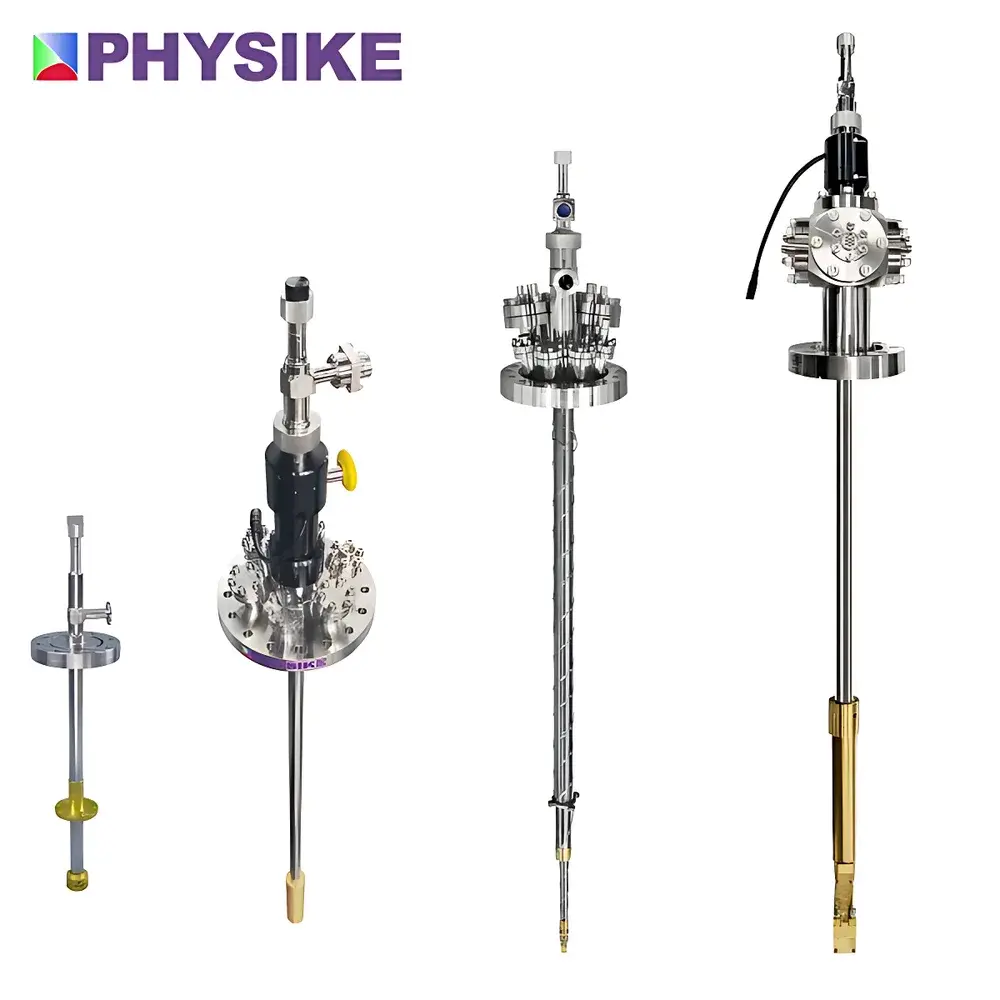
Physiké Scryo-S-400 UHV Cryogenic Insert
| Brand | Physiké |
|---|---|
| Origin | Beijing, China |
| Manufacturer Type | Direct Manufacturer |
| Product Origin | Domestic (China) |
| Model | Scryo-S-400 |
| Pricing | Upon Request |
Overview
The Physiké Scryo-S-400 UHV Cryogenic Insert is an ultra-high vacuum (UHV)-compatible, cryogenically cooled sample stage engineered for precision surface science and quantum materials characterization. Operating on the principle of liquid helium (LHe) transfer through a high-efficiency, low-heat-leak transfer line to an integrated vaporizer, the Scryo-S-400 achieves stable, programmable temperature control across a broad range from 1.8 K to 420 K. Its design adheres strictly to UHV engineering standards: all wetted components are constructed from oxygen-free high-conductivity (OFHC) copper, stainless steel 316L, and aluminum alloys certified for UHV service; the entire assembly is bakeable to 250 °C to ensure ultimate base pressure (<1×10⁻¹⁰ mbar) in compatible chambers. Unlike conventional cryostats with external heaters or conductive thermal shunts, the Scryo-S-400 employs a thermally decoupled internal resistive heater—physically isolated from the UHV chamber walls and cold stage—to eliminate outgassing transients and preserve vacuum integrity during rapid thermal cycling.
Key Features
- UHV-compliant construction: All materials meet ASTM F880 and ISO 10179 specifications for UHV compatibility; fully bakeable to 250 °C.
- Wide operational temperature range: 1.8 K (with optional Qcryo® integration) to 420 K, with stability better than ±5 mK over 1 hour at setpoint.
- Modular mechanical interface: Standard CF35 knife-edge flange; custom flange options (CF63, CF100, KF40) and cold-finger-to-flange lengths available upon specification.
- Low-mass, high-cooling-power architecture: Optimized thermal mass distribution enables <60 min cooldown from 300 K to 4 K under typical LHe flow conditions.
- Multi-axis motion compatibility: Designed to integrate seamlessly with UHV-rated 3D translation stages, differential-pumping rotation stages, tilt platforms, and motorized goniometers.
- Electrical feedthrough options: Up to 48-channel UHV-compatible ceramic or glass-metal sealed electrical penetrations (DC/low-frequency), rated to 10⁻¹¹ mbar.
Sample Compatibility & Compliance
The Scryo-S-400 accommodates standard sample holders (e.g., 10 mm × 10 mm, 12.7 mm diameter discs) and supports direct mounting of custom substrates via kinematic or clamped interfaces. It is routinely deployed in ARPES, STM, AFM, magneto-optical Kerr effect (MOKE), ferromagnetic resonance (FMR), and time-resolved infrared spectroscopy systems. The insert complies with international UHV safety and material outgassing protocols per ISO 14644-1 Class 1 cleanroom handling guidelines and meets ASTM E1557 requirements for vacuum system component qualification. When paired with the Qcryo® closed-cycle helium recondensation system, it satisfies GLP-relevant traceability requirements for cryogenic temperature calibration (NIST-traceable Pt100 and Cernox™ sensors optional).
Software & Data Management
Temperature control is managed via a dedicated PID-based digital controller (optional LabVIEW™ or Python API support), featuring real-time logging of sensor voltages, heater power, and stage status. All controllers support IEEE-488 (GPIB), RS-232, and Ethernet (TCP/IP) interfaces. Audit trails—including setpoint history, calibration events, and alarm logs—are timestamped and exportable in CSV or HDF5 format. Optional firmware modules enable 21 CFR Part 11–compliant electronic signatures and user-access-level management for regulated environments (e.g., academic core facilities operating under NIH or DOE instrumentation grants).
Applications
- Angle-resolved photoemission spectroscopy (ARPES) of strongly correlated electron systems (high-Tc superconductors, heavy fermions, topological insulators).
- Scanning tunneling microscopy (STM) and atomic force microscopy (AFM) requiring sub-picometer thermal drift stability and <2.5 K base temperature.
- In situ infrared reflection-absorption spectroscopy (IRRAS) and surface-enhanced vibrational spectroscopy under UHV and cryogenic conditions.
- Ferromagnetic resonance (FMR) and spin-wave spectroscopy in epitaxial thin films under applied magnetic fields up to 12 T (when integrated with split-pair or vector magnets).
- Time-resolved laser-induced fluorescence and pump-probe measurements of phonon dynamics and carrier relaxation at cryogenic temperatures.
FAQ
What vacuum level is required for optimal operation of the Scryo-S-400?
The Scryo-S-400 is designed for ultra-high vacuum environments with base pressures ≤1×10⁻¹⁰ mbar after 250 °C bakeout.
Can the Scryo-S-400 be used without liquid helium?
Yes—when coupled with the optional Qcryo® closed-cycle helium recondensation system, it operates as a dry, non-consumptive cryogenic platform with continuous cooling down to <2.5 K (standard) or <1.8 K (with enhanced condenser).
Is vibration isolation integrated into the design?
The Scryo-S-400 itself does not include active damping, but its low-thermal-mass cold finger and rigid OFHC copper heat sink minimize microphonic coupling; it is compatible with external passive and active vibration isolation platforms meeting ISO 2631-2 criteria.
Are calibration-grade temperature sensors included?
Standard configuration includes two calibrated Pt100 sensors (IEC 60751 Class A); optional Cernox™ CX-1050 or RuO₂ sensors with NIST-traceable calibration certificates are available.
How is electrical noise minimized in UHV feedthroughs?
All feedthroughs utilize double-shielded coaxial construction with grounded outer shields and individually guarded inner conductors, achieving >120 dB common-mode rejection ratio (CMRR) up to 1 MHz.



