
Physike Ucryo-100 Split-Configuration Sub-Kelvin Cryogenic Thermostat
| Brand | Physike |
|---|---|
| Origin | Beijing, China |
| Manufacturer Type | Direct Manufacturer |
| Country of Origin | China |
| Model | Ucryo-100 |
| Pricing | Available Upon Request |
Overview
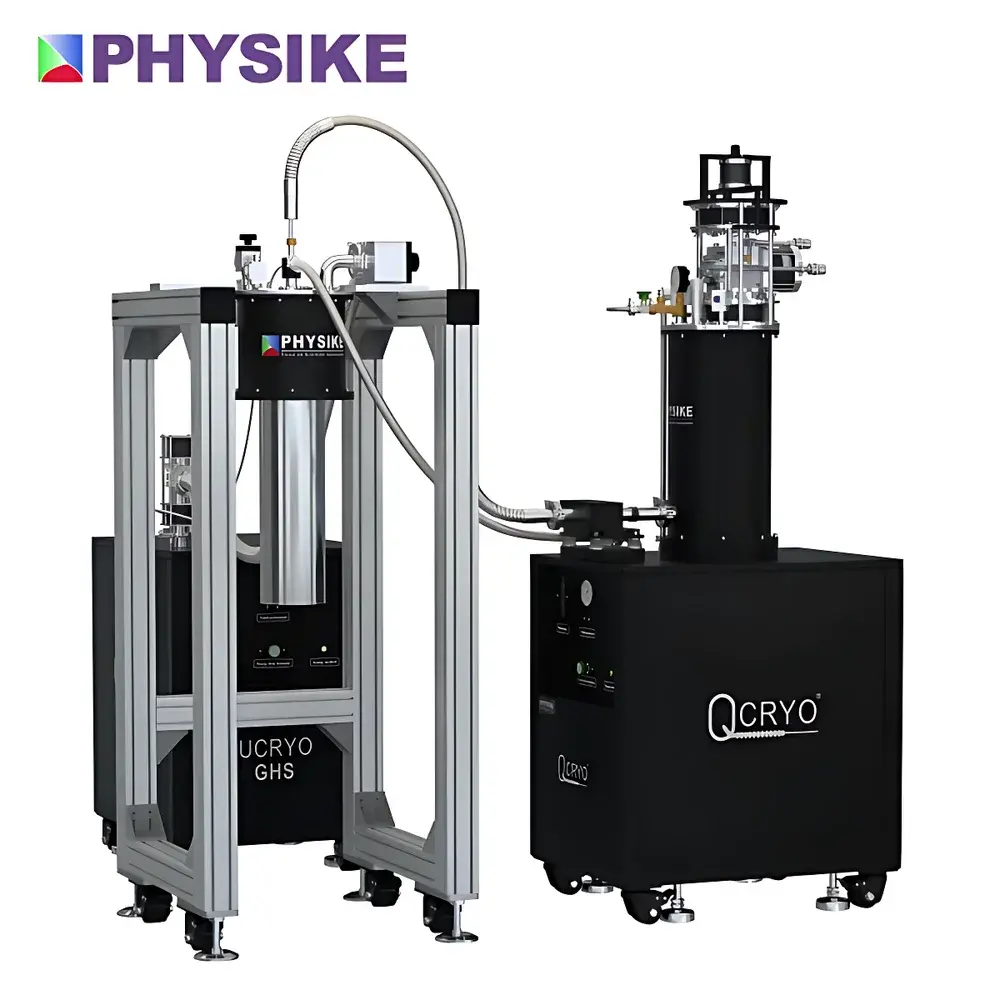
The Physike Ucryo-100 is a split-configuration, continuous-flow sub-kelvin cryogenic thermostat engineered for ultra-low-temperature experiments requiring exceptional mechanical stability and thermal reproducibility. Unlike integrated cryocooler systems, the Ucryo-100 decouples the 4 K cold head and helium gas compressor from the sub-kelvin stage via flexible, super-insulated transfer lines—enabling physical isolation of vibration sources from the experimental platform. Its operational principle relies on a closed-cycle helium refrigeration architecture: a Qcryo®-series helium liquefaction system generates sub-cooled helium at ~4 K, which is then delivered through vacuum-jacketed, low-conductance transfer lines to condense a secondary helium loop circulating within the Ucryo-100’s mixing chamber. This two-stage helium circulation—primary liquefaction (Qcryo®) and secondary evaporation/condensation (Ucryo-100)—enables stable, continuous operation below 850 mK, with optional configurations achieving base temperatures <800 mK under optimized pumping conditions.
Key Features
- Split-configuration design: Complete mechanical decoupling between the 4 K cold head/compressor unit and the sub-kelvin sample stage via flexible super-insulated helium transfer lines
- Continuous sub-kelvin operation: Stable base temperature ≤850 mK (standard configuration); down to <800 mK with high-capacity external vacuum pump package and enlarged gas handling tubing
- Vibration-sensitive compatibility: Engineered for applications demanding nanometer-scale positional stability—including scanning tunneling microscopy (STM), atomic force microscopy (AFM), scanning electron microscopy (SEM) cryo-stages, and near-field optical spectroscopy
- Modular vacuum and gas handling: External vacuum pump group and helium recirculation circuit minimize in-chamber heat load and simplify maintenance
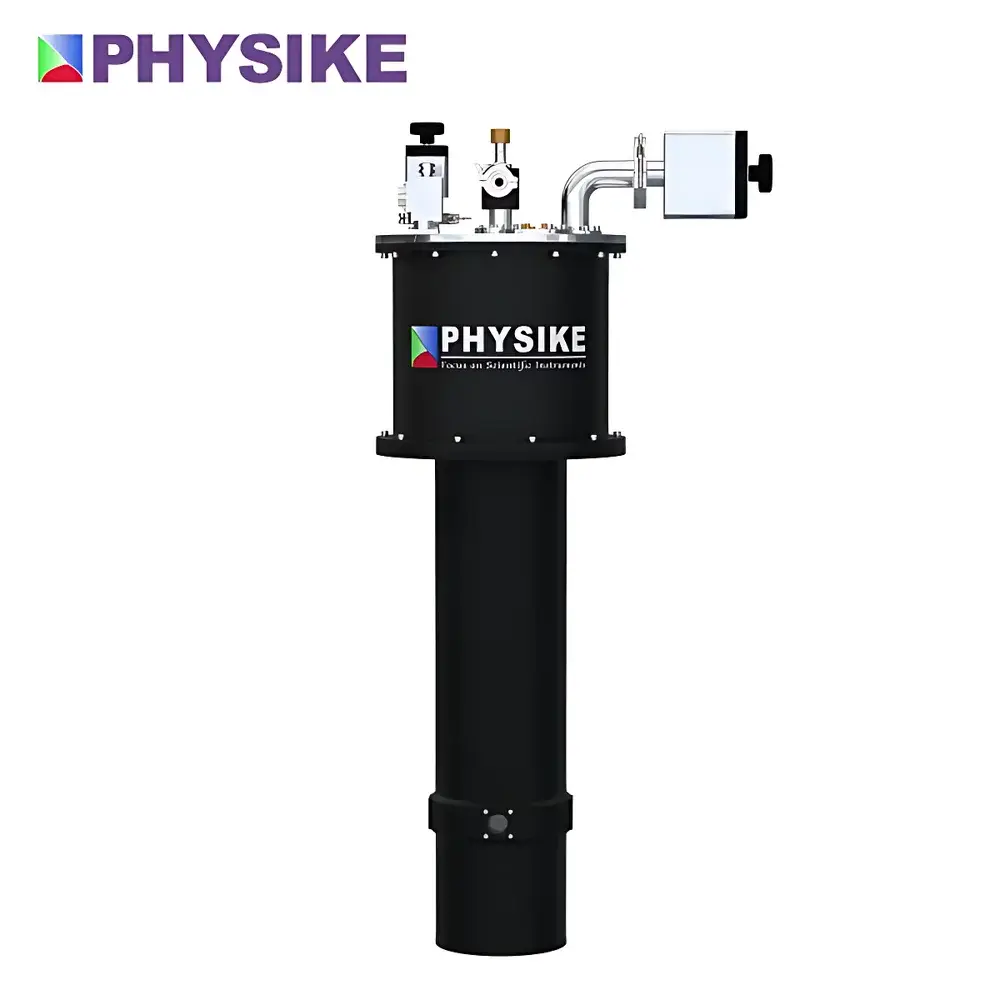
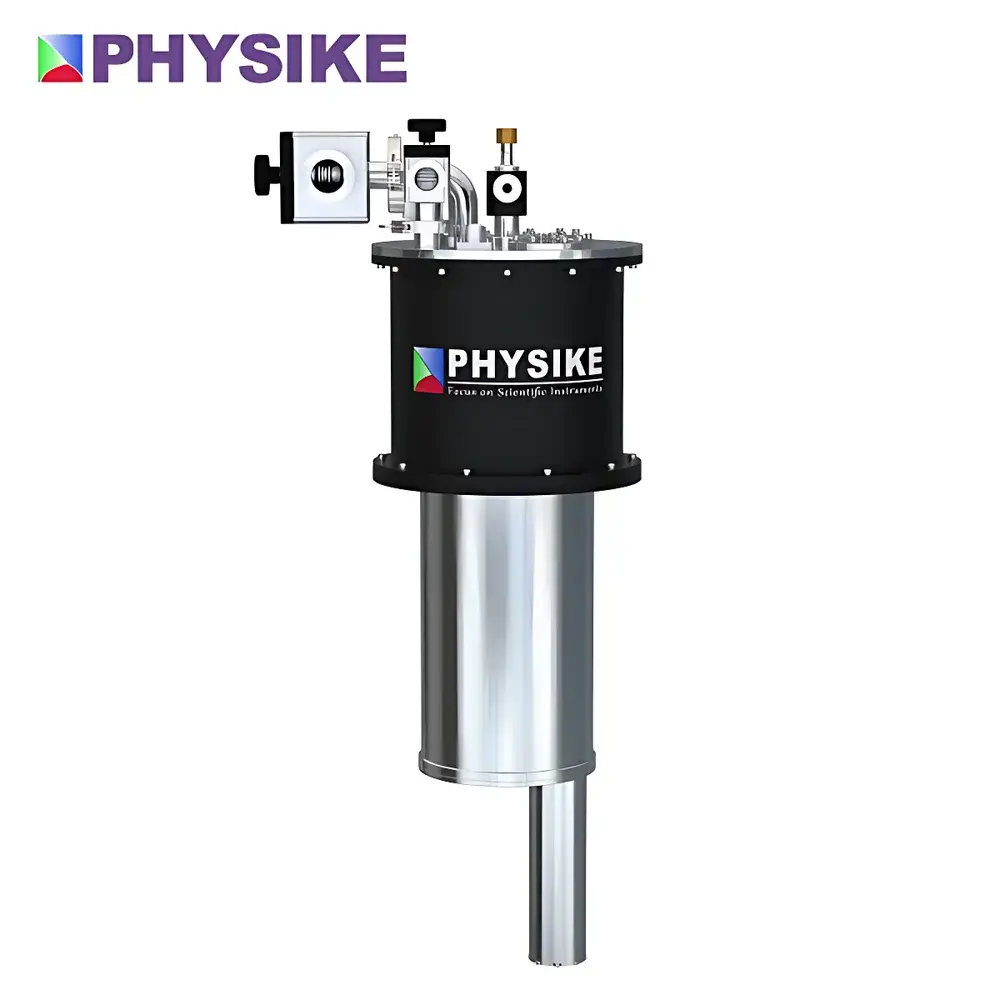
- Customizable optical and electromagnetic integration: Optional side and top optical viewports (quartz or sapphire), RF semi-rigid coaxial feedthroughs, single-mode fiber ports, and integrated nano-positioning stages
- Ultra-high vacuum (UHV)-compatible construction: All internal surfaces electropolished; standard flanges conform to ISO-KF and CF standards; bake-out rated to 150 °C
Sample Compatibility & Compliance
The Ucryo-100 accommodates diverse experimental payloads—including cryogenic probe stations, superconducting quantum interference devices (SQUIDs), quantum dot heterostructures, single-photon avalanche diodes (SPADs), and ARPES (angle-resolved photoemission spectroscopy) analyzers. Its modular tail section enables direct integration with room-temperature-bore superconducting magnets (up to 9 T), preserving magnetic field homogeneity while maintaining sub-kelvin base temperature. The system complies with ISO 27327 (cryogenic equipment safety), adheres to IEC 61000-6-2/6-3 for electromagnetic compatibility, and supports GLP/GMP-aligned operation when paired with validated data logging and audit-trail-enabled control software. Vacuum integrity meets ASTM E595 outgassing specifications for space-qualified components.
Software & Data Management
Control and monitoring are performed via Physike’s CryoControl™ v3.2 software suite, running on Windows-based industrial PCs. The interface provides real-time visualization of helium pressure differentials, mixing chamber temperature (via calibrated RuO₂ and Cernox™ sensors), 4 K stage temperature, vacuum levels (capacitance manometers and ion gauges), and compressor status. All sensor readings are time-stamped with microsecond resolution and stored in HDF5 format for post-acquisition analysis. The software supports 21 CFR Part 11-compliant user access controls, electronic signatures, and immutable audit trails—essential for regulated research environments. Remote operation is enabled via TLS-secured Ethernet (TCP/IP) or optional fiber-optic link for EMI-immune communication.
Applications
- Scanning probe microscopy: STM, AFM, and MFM at sub-1 K with sub-angstrom thermal drift
- Cryogenic electron microscopy: In-situ SEM sample cooling with minimized beam-induced vibration
- Quantum transport measurements: High-resolution magneto-transport in 2DEGs, graphene, and topological insulators
- Single-photon detection: Operation of superconducting nanowire single-photon detectors (SNSPDs) and transition-edge sensors (TES)
- Angle-resolved photoemission spectroscopy (ARPES): Low-temperature band structure mapping with reduced thermal broadening
- Quantum optics: Integration with cryogenic confocal microscopes for quantum dot photoluminescence and cavity QED
FAQ
What is the lowest achievable base temperature with the standard Ucryo-100 configuration?
The standard configuration achieves a continuous base temperature of ≤850 mK under typical laboratory vacuum conditions (≤1×10⁻⁷ mbar) and nominal helium flow rates.
Can the Ucryo-100 be integrated with a superconducting magnet?
Yes—optional tail sections are available for direct coupling to room-temperature-bore superconducting magnets, maintaining field access while preserving sub-kelvin thermal performance.
Is the system compatible with ultra-high vacuum (UHV) environments?
All standard Ucryo-100 units are UHV-compatible, with all-metal seals, electropolished internal surfaces, and outgassing rates certified per ASTM E595.
How is vibration isolation achieved in the split-configuration design?
Vibration isolation results from the physical separation of the 4 K cold head and helium compressor (mounted on independent passive damping platforms) from the sub-kelvin stage, linked only by flexible, low-thermal-conductance helium transfer lines.
What types of optical access are available?
Standard configurations include one top viewport and four side viewports; materials include UV-grade fused silica, IR-transparent sapphire, or custom AR-coated options for specific wavelength bands.



