
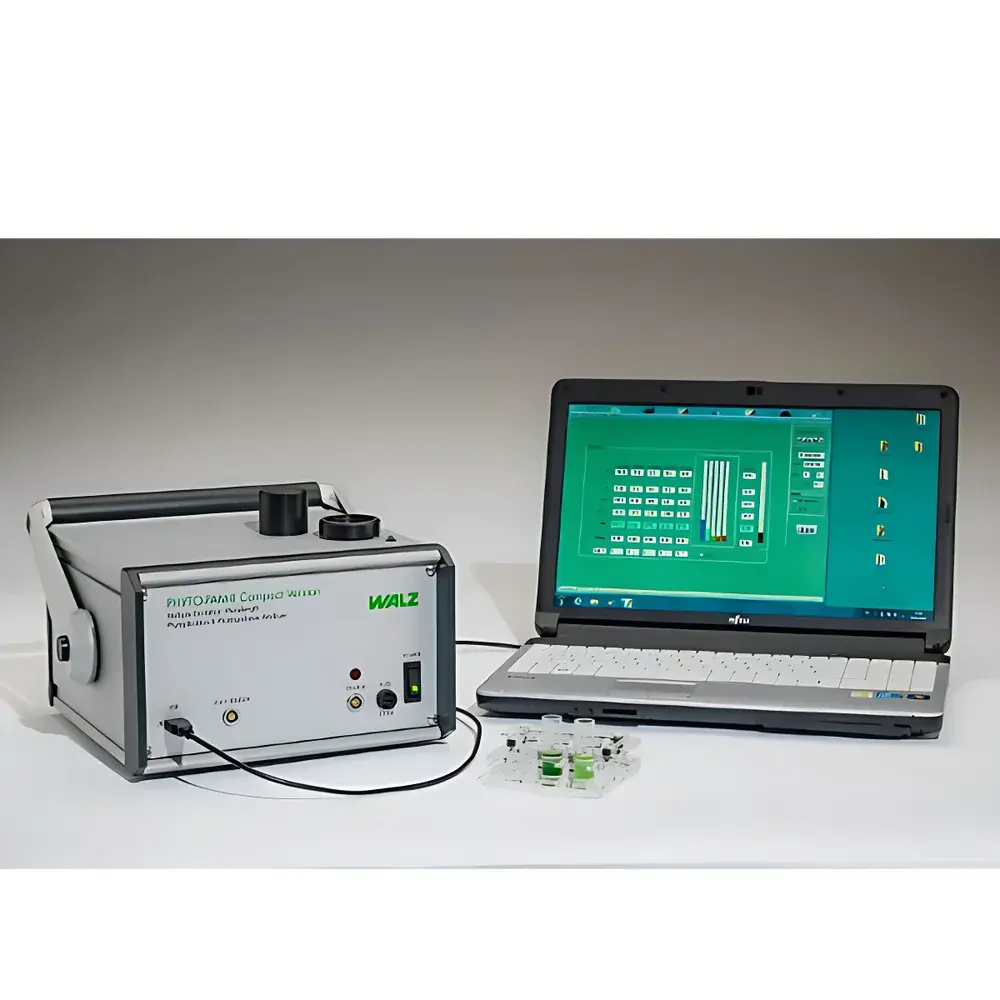
PHYTO-PAM-II Advanced Phytoplankton Classification Fluorometer by WALZ
| Brand | WALZ |
|---|---|
| Origin | Germany |
| Model | PHYTO-PAM-II |
| Measurement Principle | Pulse-Amplitude-Modulated (PAM) Chlorophyll-a Fluorescence Spectroscopy with Multi-Wavelength Excitation |
| Detection Limit | 0.1 µg/L Chl-a |
| Measurement Light Wavelengths | 440, 480, 540, 590, 625 nm (5-channel pulsed LED) |
| Actinic Light Wavelengths | 440, 480, 540, 590, 625 nm + broadband white (420–640 nm) |
| Far-Red Light | 725 nm LED |
| Signal Detection | H-10720 Photomultiplier Module with >650 nm long-pass filter |
| Max Actinic Irradiance | 1400 µmol·m⁻²·s⁻¹ (continuous), 7000 µmol·m⁻²·s⁻¹ (flash), 5000 µmol·m⁻²·s⁻¹ (saturation pulse) |
| Modulation Frequencies | 8 settings |
| Measurement Light Intensity | 2 levels |
| High-Speed Kinetics Mode | O–I₁ fluorescence rise (ms-scale) enabled |
| Functional Absorption Cross-Section of PSII (σPSII) | Quantifiable via multi-wavelength actinic excitation |
| Reference Spectra Standardization | FluoRed™ calibration protocol for inter-instrument spectral interoperability |
Overview
The PHYTO-PAM-II Advanced Phytoplankton Classification Fluorometer is a laboratory- and field-deployable instrument engineered for high-resolution, non-invasive assessment of photosynthetic physiology in natural phytoplankton assemblages. Built upon the foundational principles of pulse-amplitude-modulated (PAM) chlorophyll a fluorescence spectroscopy, the PHYTO-PAM-II extends classical PAM methodology through five independently controllable, narrow-band LED measurement light sources and a six-wavelength actinic array—including broadband white light—enabling differential excitation of distinct photosynthetic pigment-protein complexes. This architecture permits simultaneous discrimination and quantification of four major phytoplankton functional groups—cyanobacteria, green algae, diatoms/dinoflagellates, and cryptophytes—based on their characteristic absorption and energy transfer signatures. Unlike conventional single- or dual-wavelength fluorometers, the PHYTO-PAM-II resolves taxon-specific photochemical efficiency (Y(II)), electron transport rate (ETR), functional absorption cross-section of Photosystem II (σPSII), and photoprotective capacity without requiring prior culturing or pigment extraction. Its detection limit of 0.1 µg/L chlorophyll a, achieved via a high-gain H-10720 photomultiplier module and optimized optical filtering (>650 nm long-pass), ensures reliable operation with low-biomass environmental samples—critical for early-stage bloom detection and oligotrophic water monitoring.
Key Features
- Five-wavelength pulsed measurement light system (440, 480, 540, 590, 625 nm) enabling selective excitation of phycobiliproteins, chlorophyll b, chlorophyll c, and fucoxanthin-associated antenna systems
- Six-channel actinic light source (including 420–640 nm broadband white LED) supporting wavelength-specific induction of non-photochemical quenching (NPQ), state transitions, and rapid O–I₁ fluorescence kinetics
- Integrated far-red (725 nm) LED for complete PSI-driven re-oxidation of QA⁻, ensuring accurate Fm′ and Y(II) determination under all physiological states
- Automated, user-configurable protocols for rapid light curves (RLCs), saturation pulse analysis, dark relaxation kinetics, and millisecond-scale O–I₁ fluorescence rise measurements
- FluoRed™ reference spectrum standardization protocol—calibrated using traceable fluorescent standards—ensuring spectral data portability across instruments and laboratories
- Compact, ruggedized metal housing with integrated sample chamber, optics, and electronics; compatible with both benchtop and portable configurations
- Built-in σPSII calculation engine leveraging multi-wavelength actinic irradiance and concurrent fluorescence yield to derive functional absorption cross-sections per taxon
Sample Compatibility & Compliance
The PHYTO-PAM-II accepts native, unfiltered water samples (0.5–5 mL) in standard quartz or borosilicate cuvettes, accommodating both freshwater and marine matrices without chemical pre-treatment. It supports direct measurement of suspended phytoplankton communities—including colonial, filamentous, and motile forms—as well as cultured isolates. All optical components comply with IEC 61000-6-3 (EMC emissions) and IEC 61000-6-2 (immunity) standards. Data acquisition and storage adhere to GLP-aligned metadata logging, including timestamped irradiance calibration (via integrated spherical quantum sensor), temperature, and operator-defined sample identifiers. While not FDA 21 CFR Part 11-certified out-of-the-box, audit-trail-ready software export modes support integration into validated environmental monitoring workflows compliant with ISO 14001, ASTM D5257 (algal biomass estimation), and EU Water Framework Directive Annex V phytoplankton assessment protocols.
Software & Data Management
Control and analysis are performed via the proprietary PhytoWin software suite (Windows-based), which provides real-time visualization of raw fluorescence transients, kinetic parameter fitting (e.g., exponential decay of NPQ, hyperbolic RLC modeling), and automated taxon classification using embedded spectral deconvolution algorithms. All raw intensity/time series data are stored in HDF5 format with embedded metadata (wavelength, intensity, modulation frequency, sensor calibration coefficients). Batch processing supports parallel analysis of multi-sample time-series datasets, with export options for CSV, MATLAB .mat, and netCDF4—facilitating interoperability with ecological modeling platforms (e.g., GOTM, ERSEM) and statistical environments (R, Python). Reference spectra generated via FluoRed™ calibration are saved as portable XML files, enabling cross-platform validation and inter-laboratory comparison without hardware recalibration.
Applications
- Early-warning monitoring of cyanobacterial and dinoflagellate harmful algal blooms (HABs) through real-time shifts in taxon-specific Y(II) and σPSII
- Quantifying in situ primary productivity by coupling ETR-derived carbon fixation estimates with depth-resolved PAR profiles
- Assessing phytoplankton photophysiological responses to UV-B exposure, nutrient limitation (N/P/Si), trace metal stress (e.g., Fe, Cu), and ocean acidification gradients
- Validating remote-sensing algorithms (e.g., OCI, OCx) by linking surface-layer fluorescence signatures to community composition and functional status
- Supporting microalgal biotechnology workflows—e.g., screening mutant libraries for altered light-harvesting efficiency or photoprotective capacity
- Long-term ecological research in limnological and marine observatories where standardized, reproducible fluorescence phenotyping is required
FAQ
What distinguishes PHYTO-PAM-II from earlier PHYTO-PAM models?
The PHYTO-PAM-II introduces five independent measurement wavelengths (vs. four), six actinic channels (vs. one), on-board FluoRed™ spectral calibration, σPSII quantification capability, and millisecond-scale O–I₁ kinetics—none of which are supported by the original PHYTO-PAM.
Is the spherical quantum sensor mandatory for operation?
Yes. The latest PHYTO-PAM-II firmware requires calibration against the integrated spherical sensor to normalize actinic irradiance values and ensure FluoRed™-compatible reference spectra. This enables quantitative comparability across instruments and field sites.
Can the instrument measure samples in turbid or colored waters?
It can—but accuracy depends on optical path length and absorption interference. For highly CDOM-rich or sediment-laden samples, dilution or filtration may be necessary to avoid inner-filter effects; the 0.1 µg/L detection limit assumes minimal non-algal absorption at excitation/emission wavelengths.
Does PHYTO-PAM-II support GMP/GLP-compliant data archiving?
While the hardware and software do not include built-in electronic signature or role-based access control, raw HDF5 files contain full provenance metadata, and export workflows integrate with third-party LIMS and document management systems meeting 21 CFR Part 11 requirements.
What accessories are essential for routine lab use?
The WATER-S magnetic stirrer with WATER-R stirring rods is strongly recommended for homogeneous suspension of benthic or colonial algae; the spherical quantum sensor and calibration kit are mandatory for all configurations.




