
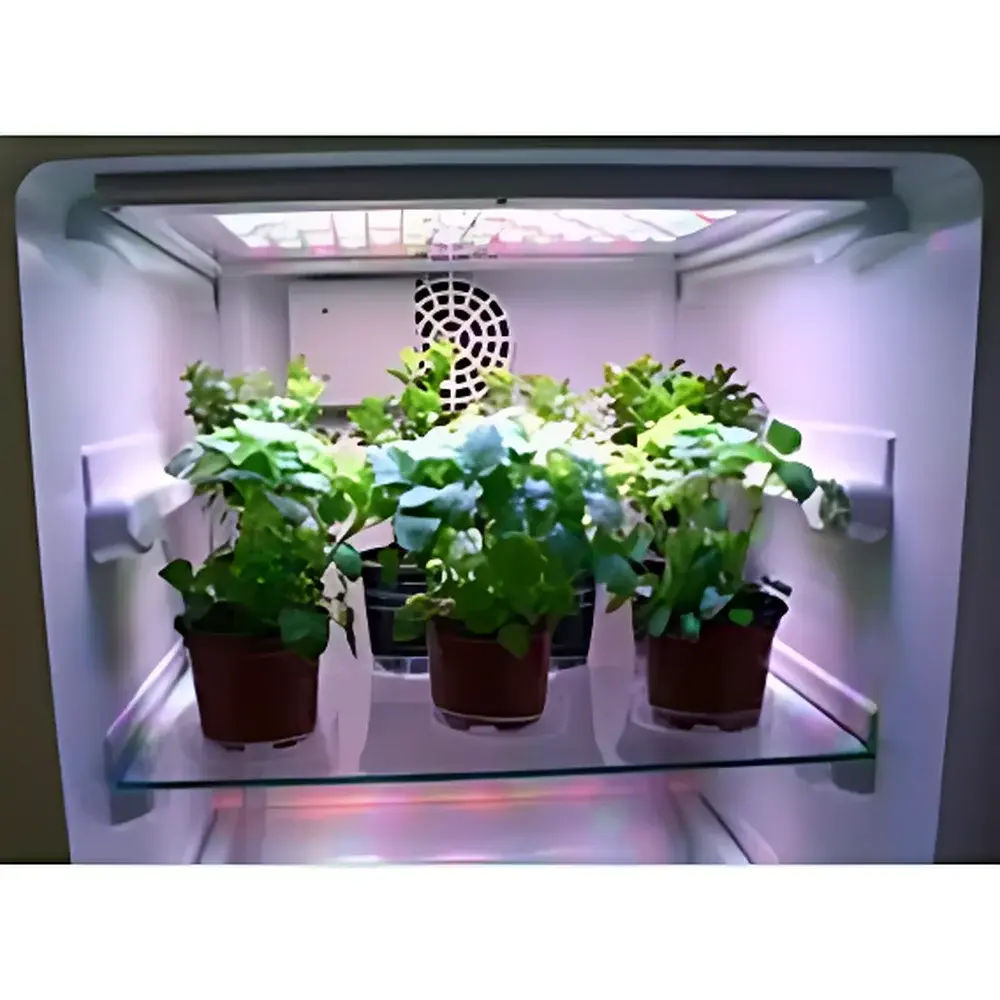
Phytosystems FytoScope Series Controlled-Environment Plant Growth Chambers
| Origin | Czech Republic |
|---|---|
| Manufacturer Type | Authorized Distributor |
| Origin Category | Imported |
| Model | FytoScope FS130 / FS250 / FS360 / FS3400 |
| Light Intensity (FS130) | 1500 µmol·m⁻²·s⁻¹ (up to 2000 µmol·m⁻²·s⁻¹ optional) |
| Light Uniformity | ±5% across active area |
| Temperature Range (Standard) | 15–55 °C (7–55 °C with low-temp option) |
| Temperature Stability | ±0.3 °C |
| Humidity Control (FS3400) | 30–90 % RH |
| CO₂ Control (Optional) | 0–2000 ppm, ±10 ppm accuracy |
| Air Exchange Rate | 250 L/h (FS130) |
| LED Panel Dimensions (FS130) | 25 × 35 cm, 300 individually addressable LEDs |
| Spectral Configurations | WIR (White + IR) or RGBIR (Red/Green/Blue + IR) |
| Fluorescence Monitoring (Optional) | Ft, Fm, QY, NPQ, ΦPSII in real time |
| Data Logging | Internal SD card + Ethernet interface |
| Compliance | CE, RoHS, IEC 61000-6-3, ISO 17025-compatible operation environment |
| Power Supply | 220–240 V AC, 50 Hz, 160 W (compressor only, FS130) |
Overview
The Phytosystems FytoScope Series represents a class of precision-controlled environmental growth chambers engineered for reproducible plant phenotyping, physiological research, and controlled-environment agriculture studies. Unlike conventional growth cabinets relying on fluorescent or incandescent lighting—sources that introduce significant radiant heat—the FytoScope platform integrates high-efficiency, spectrally tunable LED arrays with closed-loop thermal management to decouple photobiological stimulus from thermal load. This architecture enables independent, dynamic regulation of photosynthetically active radiation (PAR), temperature, relative humidity (RH), and CO₂ concentration—parameters critical for modeling climate-responsive plant development, stress physiology, and carbon assimilation kinetics. Each chamber is designed around a modular control architecture compliant with GLP-aligned data integrity requirements, supporting traceable parameter logging, user-accessible audit trails, and secure remote monitoring via Ethernet-connected firmware.
Key Features
- Spectrally Programmable LED Illumination: WIR (White + Infrared) or RGBIR (Red/Green/Blue + Infrared) configurations enable precise replication of natural light spectra or experimental spectral treatments; intensity modulated from 1% to 100% in <1-second temporal resolution to simulate dawn/dusk transitions, photoperiod shifts, or pulsed-light regimes.
- Thermal Decoupling Architecture: Active thermoelectric cooling and compressor-based refrigeration (FS130–FS360) or chilled-water loop integration (FS3400) maintain temperature stability within ±0.3 °C across the entire growth volume, even under maximum PAR load.
- Multi-Parameter Environmental Control: Optional integrated CO₂ sensor (NDIR, 0–2000 ppm range) and capacitive RH sensor (±2% RH accuracy) operate in closed-loop feedback with proportional-integral-derivative (PID) controllers—enabling stable gas-phase environments required for photosynthesis inhibition assays or stomatal conductance modeling.
- In Situ Chlorophyll Fluorescence Monitoring: Optional PAM-compatible fluorescence module permits non-invasive, real-time acquisition of minimal fluorescence (Ft), maximal fluorescence (Fm), quantum yield of PSII (ΦPSII), non-photochemical quenching (NPQ), and photochemical quenching (qP)—all synchronized with environmental setpoints.
- Scalable Physical Configurations: From benchtop (FS130, 130 L) to walk-in (FS3400, 3400 L), all models share identical control firmware, calibration protocols, and data export formats—ensuring experimental scalability without method revalidation.
- Compliance-Ready Operation: Onboard logging stores timestamped parameter histories with operator ID tagging; system supports 21 CFR Part 11-compliant electronic signatures when paired with validated third-party LIMS integration.
Sample Compatibility & Compliance
FytoScope chambers accommodate a broad range of botanical specimens—from Arabidopsis thaliana seedlings and cereal coleoptiles to mature tomato plants and microalgae cultures (with optional orbital shaker integration). The uniform irradiance distribution (±5% spatial variation over designated growth area) meets ISO 21730-1:2022 criteria for standardized photosynthetic response testing. All units comply with EU Directive 2014/30/EU (EMC), 2014/35/EU (LVD), and RoHS 2011/65/EU. For regulated environments, the system supports IQ/OQ documentation packages aligned with ASTM E2500-13 and ISO/IEC 17025:2017 requirements.
Software & Data Management
Phytosystems’ proprietary FytoControl v4.x software provides intuitive graphical programming of multi-step environmental profiles—including ramp-and-hold temperature cycles, sinusoidal light intensity modulation, and CO₂ enrichment pulses—with sub-minute scheduling granularity. Logged data are exported in CSV and HDF5 formats compatible with MATLAB, Python (Pandas/NumPy), and commercial statistical platforms. Remote access is enabled via TLS-encrypted HTTP(S) API, permitting integration into institutional IoT frameworks or centralized lab infrastructure monitoring systems. Audit trail records include parameter change history, user login/logout timestamps, and firmware version metadata—fully retrievable for regulatory review.
Applications
- Quantitative analysis of photoinhibition kinetics under variable spectral quality and intensity
- High-throughput screening of drought, heat, or salinity stress responses using fluorescence-derived physiological indices
- CO₂-response curve generation for Rubisco-limited vs. RuBP-regeneration-limited photosynthesis modeling
- Diurnal rhythm studies requiring synchronized light/dark transitions with millisecond timing precision
- Algal bioreactor optimization under controlled turbulence (via integrated shaker) and spectral tuning
- Pre-clinical evaluation of phytochemical production under defined abiotic stimuli
FAQ
What spectral ranges are supported by the RGBIR LED configuration?
The RGBIR system delivers narrow-band peaks centered at 450 nm (blue), 530 nm (green), 660 nm (red), and 730 nm (far-red), with full-width-at-half-maximum (FWHM) ≤20 nm per channel.
Can multiple FytoScope units be synchronized for cross-chamber experimental designs?
Yes—via Ethernet-based master-slave configuration, enabling coordinated parameter changes across up to 16 units with sub-second temporal alignment.
Is calibration certification included with shipment?
Each unit ships with factory calibration certificates for temperature, RH, CO₂ (if installed), and PAR sensors, traceable to NIST or PTB standards.
How is airflow managed to prevent boundary layer effects on leaf surfaces?
A laminar air distribution system ensures uniform velocity (0.1–0.3 m/s) across the growth zone, minimizing localized transpiration gradients while maintaining thermal homogeneity.
Does the fluorescence module require external excitation sources or optical filters?
No—the integrated PAM detector uses built-in saturating pulses and measuring beams; no external optics or dark-adaptation hardware is needed.



