
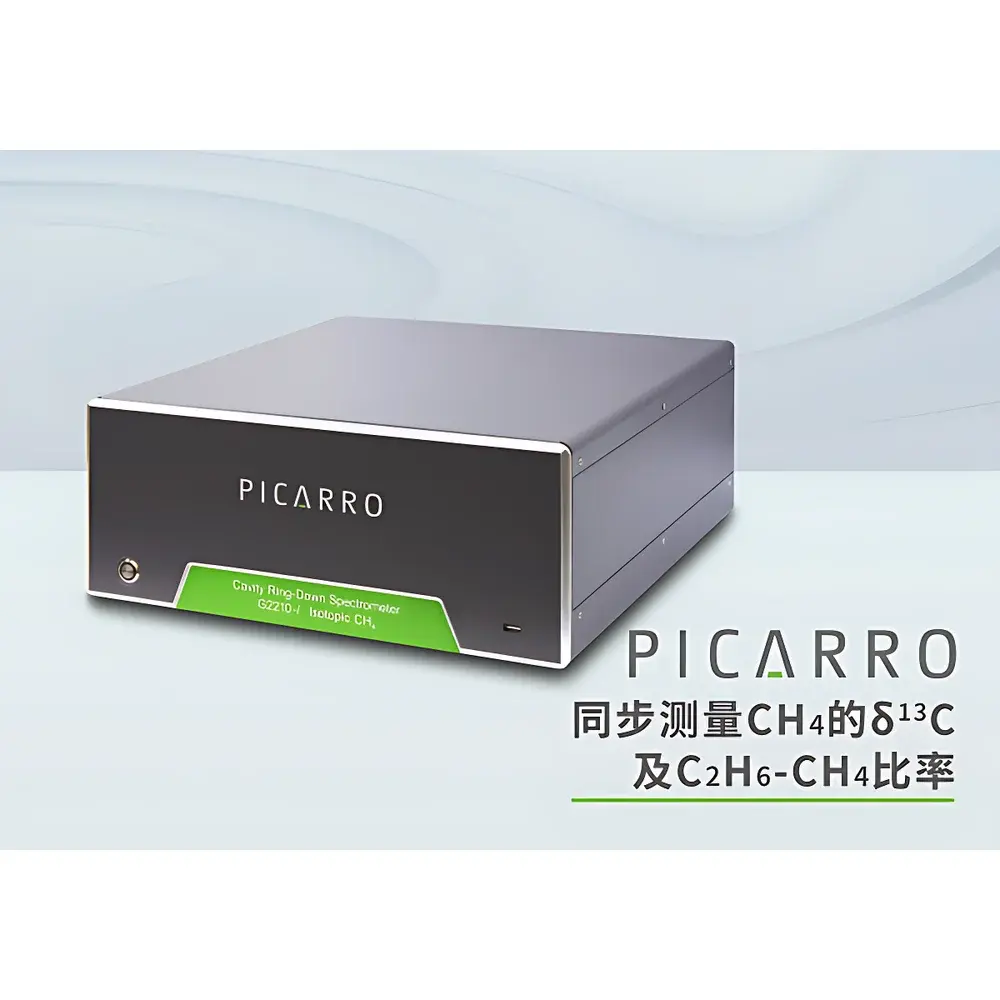
Picarro G2210-i Isotope Ratio Spectrometer for Real-Time Methane Source Attribution
| Brand | Picarro |
|---|---|
| Origin | USA |
| Model | G2210-i |
| Instrument Type | Cavity Ring-Down Spectroscopy (CRDS)-Based Stable Isotope Analyzer |
| Measurement Targets | δ¹³CH₄, CH₄, C₂H₆, CO₂, H₂O |
| Precision (1σ, 5-min avg) | δ¹³CH₄: 0.5–1.0 ‰ |
| CH₄ | <0.1 ppb |
| C₂H₆ | <1 ppb |
| CO₂ | <200 ppb |
| Dynamic Range | CH₄: 2–30 ppm |
| C₂H₆ | 0–100 ppm |
| CO₂ | 300–2000 ppm |
| Measurement Frequency | up to 1.5 Hz |
| Sample Flow | ~40 sccm |
| Cavity Volume | 35 mL |
| Temperature Control Stability | ±0.005 °C |
| Pressure Control Stability | ±0.0002 atm |
| Operating Ambient | 15–35 °C |
| Power | 100–240 VAC, 47–63 Hz, <375 W peak |
Overview
The Picarro G2210-i Isotope Ratio Spectrometer is an ultra-high-precision, field-deployable cavity ring-down spectroscopy (CRDS) instrument engineered for real-time, in situ attribution of methane (CH₄) emission sources. Unlike traditional isotope ratio mass spectrometers (IRMS), the G2210-i employs optical absorption spectroscopy—specifically CRDS—to simultaneously quantify isotopic composition (δ¹³CH₄) and molecular abundances (CH₄, C₂H₆, CO₂, and H₂O) in ambient air without sample pre-concentration or cryogenic trapping. Its core analytical capability centers on resolving the isotopic fingerprint of methane—particularly the carbon-13 isotope ratio—alongside ethane-to-methane (C₂H₆/CH₄) ratios, a critical diagnostic pair for distinguishing biogenic (e.g., landfills, wetlands) from thermogenic (e.g., oil/gas infrastructure, abandoned wells) methane emissions. The system operates with a compact, thermally stabilized 35 mL optical measurement cavity, enabling rapid gas exchange (<10 s response time) and high temporal resolution under variable environmental conditions.
Key Features
- Simultaneous, continuous measurement of δ¹³CH₄, CH₄, C₂H₆, CO₂, and H₂O in ambient air—no offline preparation required
- CRDS-based detection delivering sub-part-per-trillion sensitivity: CH₄ precision <0.1 ppb and C₂H₆ precision <1 ppb (1σ, 5-minute average)
- Isotopic precision of 0.5–1.0 ‰ for δ¹³CH₄, validated against NIST-traceable reference gases and compliant with ISO 13877 and ASTM D7907 guidelines for stable carbon isotope analysis
- Dual operational modes: Mode 1 (isotopic + concentration) at ~0.8–1.0 Hz; Mode 2 (high-speed CH₄/C₂H₆ only) at ~1.5 Hz for transient plume tracking
- Integrated thermal and pressure control: cavity temperature stability ±0.005 °C and pressure stability ±0.0002 atm ensure long-term measurement reproducibility
- Robust architecture designed for unattended field operation—typical calibration interval exceeds 3 months under GLP-compliant monitoring protocols
- Compact footprint (43 × 46 × 18 cm) and low power consumption (120 W analyzer + 150 W external pump) support mobile deployment on vehicles, drones (with compatible payload integration), or fixed-site monitoring stations
Sample Compatibility & Compliance
The G2210-i is optimized for direct analysis of ambient air and air-like matrices containing ~20% O₂. It accepts samples across a broad operational envelope: pressure 300–1000 Torr (40–133 kPa), temperature −10 to +45 °C, and relative humidity 1 ppm); users should conduct interference screening per EPA Method TO-15 Annex A when deploying in complex industrial settings. All measurements are traceable to internationally recognized standards (IAEA CH₄-1, USGS-40, NIST SRM 1646a) and support data integrity requirements under FDA 21 CFR Part 11 when paired with Picarro’s audit-trail-enabled software suite.
Software & Data Management
Picarro’s proprietary Analytical Manager Software (AMS v4.x) provides real-time visualization, automated baseline correction, and multi-gas correlation analysis—including dynamic calculation of C₂H₆/CH₄ slope and δ¹³CH₄ vs. CH₄ mixing ratio trends. Raw spectral data, cavity ring-down times, and calibrated mole fractions are logged at user-selectable intervals (1–60 s) in ASCII and HDF5 formats. The software supports configurable alarm thresholds, remote diagnostics via Ethernet, and seamless integration with third-party platforms (e.g., SCADA, AWS IoT Core) through RESTful API and Modbus TCP protocols. Audit trails record all parameter changes, calibration events, and user logins—enabling full compliance with ISO/IEC 17025 and GLP/GMP documentation standards. Data export modules generate reports conforming to IPCC Tier 3 reporting templates for greenhouse gas inventories.
Applications
- Source apportionment of fugitive CH₄ emissions from oil & gas infrastructure (wellheads, compressor stations, pipelines)
- Quantification and isotopic characterization of landfill gas plumes for regulatory reporting (e.g., U.S. EPA GHGRP Subpart W)
- Long-term monitoring of abandoned oil/gas wells to assess leakage risk and prioritize remediation
- Atmospheric chemistry studies linking δ¹³CH₄ signatures to microbial methanogenesis pathways in wetlands and rice paddies
- Mobile surveys using vehicle-mounted or backpack-configured systems for high-resolution spatial mapping
- Calibration and validation of satellite-based CH₄ observations (e.g., TROPOMI, GHGSat) via ground-truth reference measurements
FAQ
Does the G2210-i require daily calibration?
No. Due to its intrinsic stability from active cavity temperature and pressure control, the G2210-i typically maintains accuracy for >90 days between calibrations when operated within specification. A weekly zero/span check using certified reference gases is recommended for regulatory-grade deployments.
Can it measure δ²H-CH₄ or other isotopologues?
No. The G2210-i is specifically configured for δ¹³CH₄. For hydrogen isotope analysis (δ²H-CH₄), Picarro offers the G5131-i model, which uses a distinct laser wavelength set and cavity design.
Is the instrument compatible with automated air sampling manifolds?
Yes. The G2210-i supports multi-port inlet switching via TTL or RS-232 commands. Standard integration includes 8-channel valve manifolds with programmable cycle timing and leak-check routines.
What maintenance is required beyond routine calibration?
Annual inspection of the external diaphragm pump, optical window cleanliness verification, and cavity purge filter replacement constitute the primary preventive maintenance schedule. No consumables (e.g., filaments, detectors) require periodic replacement.
How does CRDS compare to IRMS for δ¹³CH₄ analysis?
CRDS eliminates the need for vacuum systems, ion sources, and Faraday cup arrays, resulting in lower operational complexity, higher reliability in field environments, and reduced total cost of ownership. While IRMS achieves marginally higher precision (<0.2 ‰) under ideal lab conditions, the G2210-i delivers comparable field performance with superior temporal resolution and minimal infrastructure dependency.




