
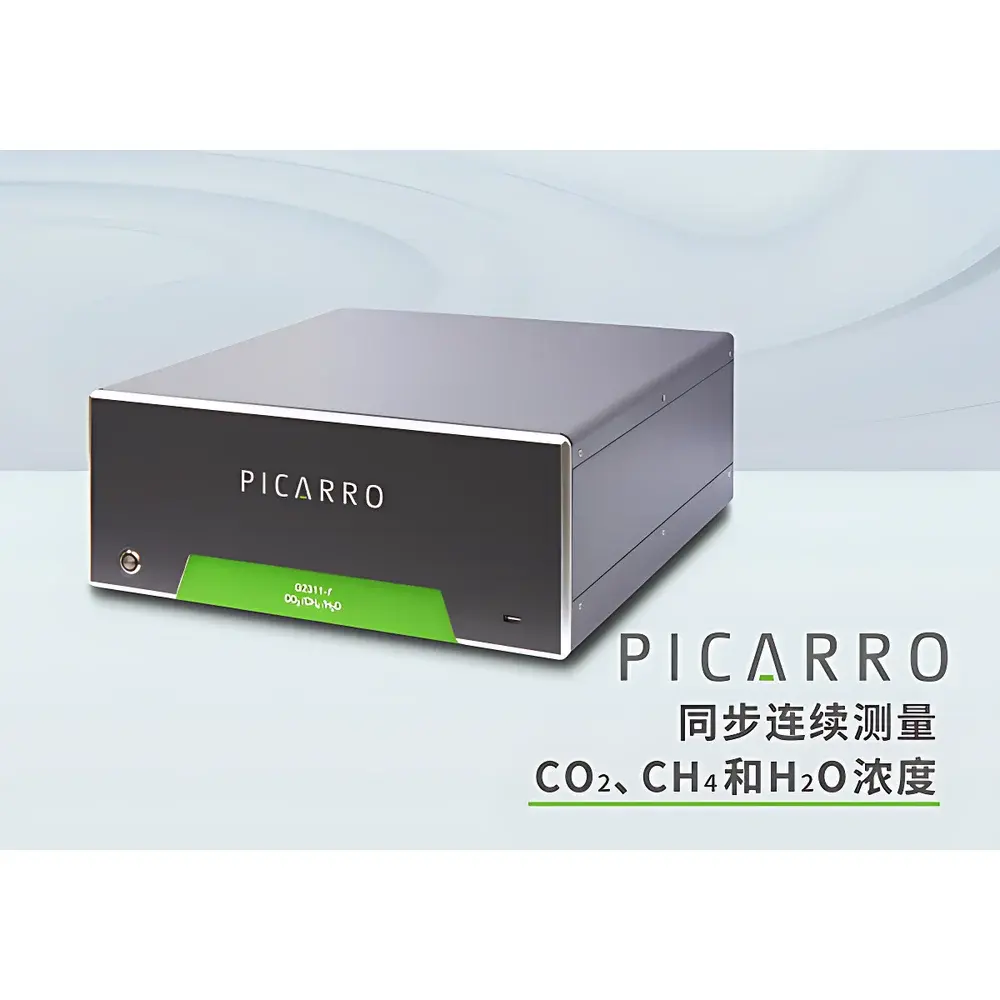
Picarro G2311-f Flux Gas Concentration Analyzer for CO₂, CH₄, and H₂O
| Brand | Picarro |
|---|---|
| Origin | USA |
| Model | G2311-f |
| Instrument Type | Portable |
| Detection Targets | Multi-component (CO₂, CH₄, H₂O) |
| Measurement Principle | Cavity Ring-Down Spectroscopy (CRDS) |
| Sampling Mode | Simultaneous 10 Hz continuous measurement |
| Calibration | Built-in water vapor correction for dry-mole-fraction reporting |
| Compliance | Designed for eddy covariance, gradient, and chamber-based flux quantification per USDA ARS, FLUXNET, and ICOS protocols |
Overview
The Picarro G2311-f Flux Gas Concentration Analyzer is a field-deployable, high-precision optical spectrometer engineered for continuous, simultaneous quantification of carbon dioxide (CO₂), methane (CH₄), and water vapor (H₂O) at 10 Hz. It employs patented Cavity Ring-Down Spectroscopy (CRDS), a laser absorption technique offering sub-part-per-trillion sensitivity and exceptional long-term stability. Unlike conventional NDIR or electrochemical sensors, CRDS delivers absolute concentration measurements traceable to fundamental physical constants—eliminating reliance on reference gas standards during routine operation. The G2311-f is purpose-built for micrometeorological flux measurements, supporting eddy covariance (EC), vertical gradient profiling, and dynamic chamber methods in terrestrial and aquatic ecosystems. Its integrated thermal and pressure control ensures measurement integrity across variable ambient conditions—from arctic tundra to tropical agroecosystems—while the real-time water vapor correction algorithm automatically computes dry-mole-fraction concentrations for CO₂ and CH₄, satisfying data reporting requirements of FLUXNET, ICOS, and USDA ARS flux networks.
Key Features
- Simultaneous 10 Hz measurement of CO₂, CH₄, and H₂O with <200 ppb (CO₂) and <3 ppb (CH₄) 1σ precision in flux mode
- Ultra-low drift performance: ≤250 ppb (CO₂) and ≤2.5 ppb (CH₄) max 24-hour drift at STP; validated per ASTM D6348-18 guidelines for analyzer stability assessment
- Onboard water vapor correction engine compliant with WMO GAW recommendations—outputs dry-mole-fraction concentrations without external drying or calibration gases
- Thermally stabilized optical cavity with ±0.005 °C temperature control and ±0.0002 atm pressure regulation for metrological-grade reproducibility
- Configurable operating modes: high-speed flux mode (≥5 slm sample flow) and high-precision low-flow mode (≥0.4 slm, compatible with 16-channel automated inlet manifolds)
- Ruggedized portable chassis (37.7 kg total with external pump), rated for continuous operation from –10 °C to +45 °C ambient, with RH <99% non-condensing
Sample Compatibility & Compliance
The G2311-f accepts unfiltered, humidified air samples within a 0–7%v H₂O range (up to 39 °C dew point) and operates across 550–1000 Torr (74–134 kPa) sample pressure—enabling direct integration with EC towers, soil chambers, and mobile platforms. It meets functional requirements for ISO 14064-3 verification of greenhouse gas inventories and supports GLP-aligned data acquisition when paired with Picarro’s audit-trail-enabled software. All reported concentrations are traceable to NIST SRM 1610 (CO₂), NIST SRM 1650b (CH₄), and WMO GAW water vapor standards. The instrument’s analog, RS-232, Ethernet, and USB outputs comply with IEC 61000-6-3 EMC emission limits and are compatible with Campbell Scientific CR6/CR1000X dataloggers for synchronized wind vector integration.
Software & Data Management
Picarro’s proprietary Analyzers Control Software (ACS) v4.x provides full instrument configuration, real-time spectral diagnostics, and automated QA/QC flagging per FLUXNET Level 1 processing standards. Data streams are timestamped with microsecond resolution and exported in NetCDF-4 format—fully compatible with AmeriFlux, CarboEurope, and ICOS data ingestion pipelines. The software enforces 21 CFR Part 11-compliant user access controls, electronic signatures, and immutable audit logs for regulatory submissions. Optional firmware updates maintain alignment with evolving IPCC Tier 3 flux calculation methodologies and include built-in uncertainty propagation per GUM (JCGM 100:2018).
Applications
- Eddy covariance flux towers for net ecosystem exchange (NEE) and methane emissions across forests, wetlands, rice paddies, and permafrost regions
- Soil respiration studies using automated chamber systems with sub-second response time validation
- Agricultural GHG monitoring under USDA Climate Hubs protocols and EPA GHGRP Subpart A reporting
- Urban atmospheric boundary layer profiling and landfill gas migration tracking
- Calibration transfer validation for satellite-based XCO₂/XCH₄ retrievals (e.g., OCO-2, TROPOMI)
- Long-term ecological research (LTER) sites requiring >12-month unattended operation with <0.1% annual calibration drift
FAQ
Does the G2311-f require daily zero/span calibration?
No—its CRDS architecture eliminates the need for frequent zero/span adjustments. Factory calibration remains stable for ≥6 months under field conditions; annual NIST-traceable verification is recommended.
Can it operate inside a closed-chamber system?
Yes—configured in low-flow mode, it supports chamber closure cycles as short as 15 seconds with full 10 Hz resolution and automatic pressure-compensated concentration interpolation.
Is dry-mole-fraction output compliant with ICOS data policy?
Yes—the onboard H₂O correction applies the Høgberg et al. (2022) iterative algorithm and reports CO₂ and CH₄ in µmol/mol (dry air), meeting ICOS Level 2 data product specifications.
What data synchronization options exist for co-located sonic anemometers?
The G2311-f accepts TTL pulse triggers and PPS inputs for hardware-synchronized sampling with Campbell CSAT3B, Gill WindMaster Pro, or Metek uSonic-3 Class A anemometers.
Is the 16-channel inlet manifold compatible with flux mode?
No—it is restricted to high-precision low-flow mode only; flux applications require dedicated single-inlet configurations to maintain ≥5 slm laminar flow and <0.1 s residence time.







