
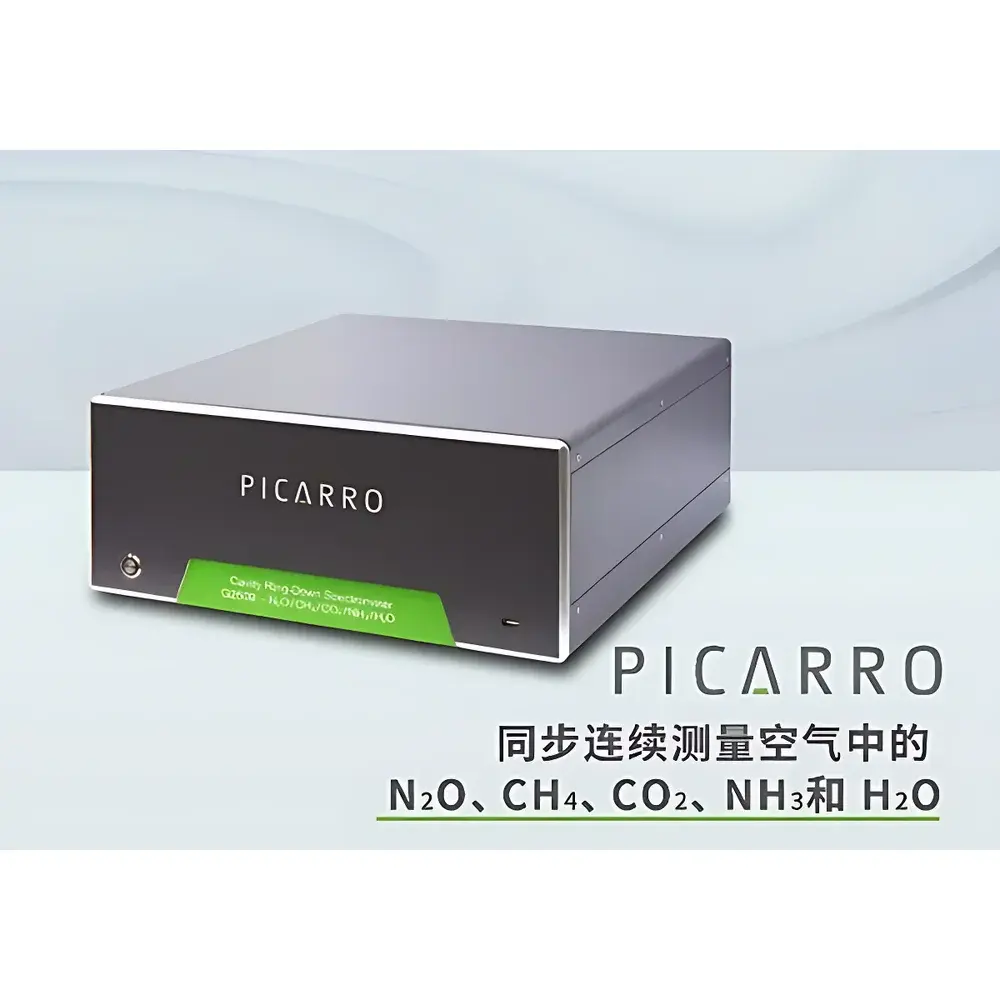
Picarro G2509 Cavity Ring-Down Spectroscopy (CRDS) Multi-Gas Analyzer for N₂O, CH₄, CO₂, NH₃, and H₂O
| Brand | Picarro |
|---|---|
| Origin | USA |
| Model | G2509 |
| Instrument Type | Online Analyzer |
| Detection Targets | N₂O, CH₄, CO₂, NH₃, H₂O |
| Measurement Principle | Cavity Ring-Down Spectroscopy (CRDS) |
| Sensitivity | <5 ppb (N₂O, CH₄, NH₃), <600 ppb (CO₂), <500 ppm (H₂O) |
| Response Time (10–90%) | ≤8 s (N₂O, CH₄, CO₂, H₂O), <2 min (NH₃) |
| Accuracy (1σ, 5-min avg) | ≤0.6 ppb (N₂O), ≤0.1 ppb (CH₄), ≤3 ppb (NH₃), ≤38 ppb (CO₂), ≤0.04 ppb (H₂O), ≤100 ppm (H₂O) |
| Operating Temperature | 10–35 °C |
| Sample Flow Rate | ~1.3 slpm |
| Pressure Range | 300–1000 Torr |
| Humidity Tolerance | RH <99% (non-condensing), dew point up to 25 °C |
| Power | 100–240 VAC, 47–63 Hz, 375 W max (startup), 270 W steady-state (analyzer + pump) |
Overview
The Picarro G2509 is a high-precision, online cavity ring-down spectroscopy (CRDS) analyzer engineered for simultaneous, real-time quantification of five critical atmospheric gases: nitrous oxide (N₂O), methane (CH₄), carbon dioxide (CO₂), ammonia (NH₃), and water vapor (H₂O). Designed specifically for demanding field and laboratory applications in agricultural emissions research—including livestock barns, manure storage facilities, and fertilizer application studies—the G2509 addresses the analytical challenges posed by highly dynamic, high-concentration gas environments where rapid NH₃ and CH₄ fluctuations compromise measurement fidelity. Its CRDS architecture employs ultra-stable optical cavities with sub-part-per-trillion-level detection limits, enabling robust quantification across wide dynamic ranges (e.g., CH₄ up to 800 ppm, NH₃ up to 300 ppb) without manual range switching or dilution. The system reports dry-mole-fraction concentrations for all target species except H₂O, which is measured directly as volumetric mixing ratio. All measurements are traceable to NIST-certified standards and inherently corrected for cross-interferences from major background gases.
Key Features
- Simultaneous, continuous measurement of N₂O, CH₄, CO₂, NH₃, and H₂O at rates ≤8 seconds per gas (except NH₃, ≤2 minutes), delivering high temporal resolution for flux studies and process monitoring.
- Ultra-low detection limits: <0.6 ppb (N₂O, 5-min average), <0.1 ppb (CH₄), <0.07 ppb (NH₃), <38 ppb (CO₂), and 50 production units per ISO/IEC 17025-compliant testing protocols.
- Dedicated NH₃ flow path featuring SilcoNert®-treated stainless steel and PFA tubing, coupled with high sample flow (~1.3 slpm), minimizes surface adsorption and achieves T10–90% <2 minutes for 20 ppb NH₃ spikes.
- Onboard interference compensation algorithms automatically correct for CO₂ (up to 20,000 ppm), NH₃ (up to 2 ppm), and hydrocarbon interferences (e.g., C₂H₆, C₂H₄) characterized per ASTM D6348 Annex A.
- Thermally stabilized optical cavity (±0.005 °C) and pressure-controlled measurement cell (±0.0002 atm) ensure long-term baseline stability (<0.5 ppb drift over 24 h) under variable ambient conditions.
- Fully integrated vacuum pump, keyboard, and mouse included; optional 19-inch rack-mount kit supports deployment in mobile labs or permanent monitoring stations.
Sample Compatibility & Compliance
The G2509 is calibrated and validated for use in ambient air matrices containing typical atmospheric N₂/O₂ ratios. It is not intended for use in non-air backgrounds (e.g., high-H₂, He, or O₂-enriched streams) without prior validation. All performance specifications meet or exceed requirements outlined in EPA Method TO-11A (for NH₃), ISO 14067 (GHG quantification), and USDA ARS protocol #2022-01 for agricultural emission monitoring. Data integrity complies with FDA 21 CFR Part 11 when operated with Picarro’s secure software suite, including full audit trails, electronic signatures, and role-based access control. The analyzer conforms to IEC 61000-6-3 (EMC) and UL 61010-1 safety standards.
Software & Data Management
Picarro’s proprietary Analyze software provides real-time spectral visualization, automated calibration verification, and configurable data export (CSV, NetCDF, HDF5). Raw ring-down time data, cavity pressure/temperature logs, and diagnostic flags are stored locally with timestamped metadata. Remote access via SSH or HTTPS enables secure off-site monitoring and integration with SCADA or cloud-based environmental data platforms (e.g., AWS IoT Core, Azure IoT Hub). All calibration events, user actions, and instrument faults are logged with immutable timestamps—fully compliant with GLP and GMP documentation requirements.
Applications
- Quantification of N₂O and CH₄ emissions from confined animal feeding operations (CAFOs) per IPCC Tier 2 methodologies.
- In-situ monitoring of NH₃ volatilization during manure injection, composting, and urea-based fertilizer application.
- Soil-atmosphere exchange studies requiring co-located, high-frequency N₂O/CH₄/CO₂/NH₃ flux partitioning via eddy covariance or gradient methods.
- Validation of open-path FTIR and DOAS systems using G2509 as a reference-grade point sensor.
- Long-term ambient air quality networks targeting reactive nitrogen and greenhouse gas co-emissions in rural and peri-urban zones.
FAQ
Does the G2509 require external calibration gases during routine operation?
No—its CRDS architecture uses absolute spectroscopic absorption cross-sections and internal reference cells for zero/span stability. Optional periodic verification with certified NIST-traceable standards is recommended every 6–12 months per ISO/IEC 17025 QA/QC guidelines.
Can the G2509 operate unattended for extended periods in outdoor enclosures?
Yes—when housed in temperature-controlled, weatherproof cabinets maintaining 10–35 °C and RH 6-month continuous operation with remote diagnostics and automated self-checks.
How does the system handle high-humidity samples?
H₂O is measured directly and used to mathematically correct dry-mole fractions of other gases. The analyzer has been validated for samples up to 25 °C dew point; condensation must be prevented upstream using Nafion dryers or chilled mirrors.
Is NH₃ measurement affected by high CH₄ concentrations?
No—CRDS spectral isolation and embedded interference correction eliminate CH₄ cross-sensitivity. However, NH₃ concentrations >2 ppm may induce a small, quantifiable bias in N₂O (<±0.003 ppm per ppm NH₃), fully compensated in firmware v3.2+.
What maintenance is required beyond routine filter changes?
Annual inspection of optical windows, pump oil replacement (if applicable), and verification of Swagelok® fittings and PFA tubing integrity constitute the full preventive maintenance schedule. No laser alignment or cavity realignment is needed.
Related Products







