
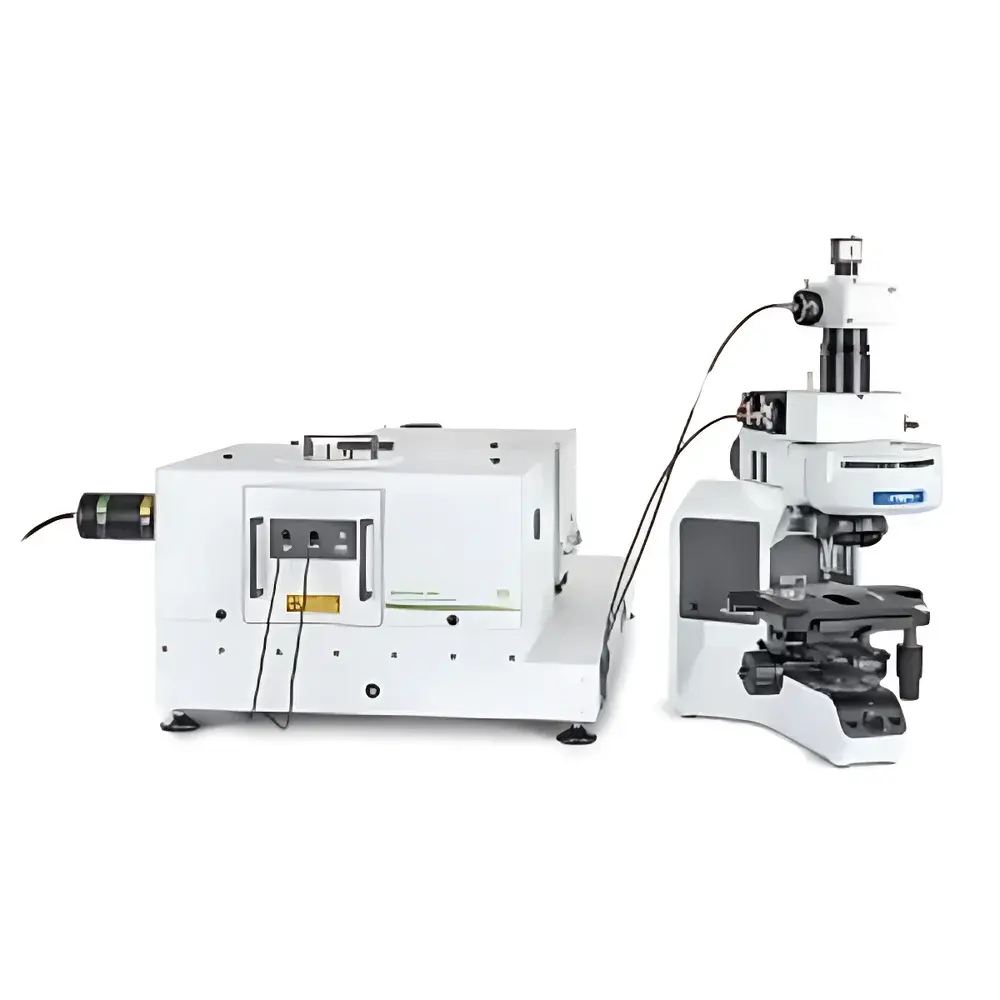
PicoQuant FluoMic Compact Upright Widefield Photoluminescence Microscope
| Brand | PicoQuant |
|---|---|
| Origin | Germany |
| Model | FluoMic |
| Instrument Type | Upright Fluorescence Microscope |
| Excitation Source | Pulsed and CW Lasers (375–1060 nm) |
| Detection Range | 400–1700 nm |
| Spatial Resolution | ≤2 µm |
| Lifetime Measurement Range | ~ps to ms (TCSPC-based) |
| Focus Mechanism | Motorized |
| Control Interface | SymPhoTime 64 & EasyTau 2 Software |
| Compatible Microscope Stands | Olympus BX43, BX53(-P), BX63, BXFM |
| Scan Options | Optional XY/XYZ piezo stages (75 × 75 mm to 80 × 80 × 80 µm range) |
| TCSPC Electronics | PicoHarp 330 / MultiHarp 150 / TimeHarp 260 Pico |
| Detector Options | PMT (PMA-C), Hybrid PMT (PMA Hybrid), InGaAs SPAD (MPD, Excelitas) |
| Spectral Selection | FlexWave wavelength selector (1–80 nm bandwidth, 0.1 nm step, >80% transmission) |
Overview
The PicoQuant FluoMic is a compact, upright widefield photoluminescence (PL) microscope engineered for quantitative, spatially resolved luminescence characterization of solid-state materials. Unlike conventional fluorescence microscopes optimized for biological labeling, the FluoMic implements time-correlated single-photon counting (TCSPC) as its core detection methodology—enabling simultaneous acquisition of steady-state spectra, time-resolved PL decay kinetics, and time-resolved emission spectra (TRES) across UV–NIR spectral domains. Its modular architecture integrates seamlessly with industry-standard Olympus upright platforms (BX43, BX53-P, BX63, BXFM), allowing precise adaptation to diverse sample geometries—from semiconductor wafers and perovskite thin films to LED epitaxial stacks and mineral cross-sections. The system operates on a dual excitation paradigm: pre-aligned fiber-coupled pulsed lasers (LDH, Prima, Unico series; pulse widths <40 ps to 6 ns) and continuous-wave sources deliver tunable excitation from 375 nm to 1060 nm, while spectral selection via the FlexWave unit ensures minimal temporal dispersion during wavelength-scanned measurements.
Key Features
- TCSPC-based lifetime imaging with temporal resolution down to <50 ps (PMA Hybrid-07) and full dynamic range spanning picoseconds to milliseconds
- Wide spectral coverage: excitation 375–1060 nm; detection 400–1700 nm using interchangeable detector modules (PMT, Hybrid PMT, InGaAs SPAD)
- Sub-2 µm spatial resolution achieved through diffraction-limited excitation spot sizing (as low as 12 µm at 100×) and high-NA Olympus objectives (up to NA 0.90)
- Fully motorized Z-focus and optional piezo-driven XY/XYZ scanning stages (75 × 75 mm travel, 100 nm minimum step, ±600 nm positioning accuracy)
- FlexWave wavelength selector enabling high-throughput, dispersion-free spectral scanning (1–80 nm bandwidth, 0.1 nm step, >80% throughput)
- Native integration with SymPhoTime 64 software for synchronized hardware control, real-time decay fitting (multi-exponential, stretched exponential, distributed lifetime models), and TRES image reconstruction
- Compliance-ready architecture supporting audit trails, user access levels, and electronic signature protocols aligned with GLP/GMP and FDA 21 CFR Part 11 requirements
Sample Compatibility & Compliance
The FluoMic accommodates rigid, planar, and semi-transparent samples up to 50 mm in diameter and 30 mm in thickness—ideal for silicon wafers, CIGS or perovskite solar cell substrates, GaN-on-sapphire LED epiwafers, and polished geological thin sections. Sample mounting uses standard microscope slides or custom vacuum chucks compatible with inert atmosphere enclosures (N₂, Ar). All optical paths are sealed against ambient light contamination, and thermal drift is minimized via passive stabilization of critical optomechanical mounts. From a regulatory perspective, the system’s software architecture supports full traceability: SymPhoTime 64 logs all acquisition parameters, detector bias voltages, laser power calibrations, and timestamped metadata per measurement cycle. Raw TCSPC histogram data (.ptu format) is stored unaltered, enabling retrospective re-analysis without loss of fidelity—a requirement for ISO/IEC 17025-accredited laboratories conducting material qualification per ASTM F3010 (perovskite PV stability) or IEC 61215 (PV module testing).
Software & Data Management
SymPhoTime 64 serves as the unified control and analysis environment, providing deterministic synchronization between laser pulsing, stage motion, wavelength selection, and photon arrival timing. The software implements hardware-accelerated deconvolution algorithms for instrument response function (IRF) correction and supports batch processing of multi-position, multi-wavelength, and multi-delay datasets. Built-in analysis modules include global lifetime fitting, phasor plot generation, anisotropy decay modeling, and spectral unmixing based on reference spectra. Data export conforms to HDF5 and ASCII formats for interoperability with MATLAB, Python (via pymeasure or lifetimes), and commercial statistical packages. All user actions—including parameter changes, file saves, and report generation—are recorded in an immutable audit trail with timestamps and operator IDs. Optional validation packages provide IQ/OQ documentation templates compliant with pharmaceutical and semiconductor quality management systems.
Applications
- Semiconductor wafer metrology: mapping non-radiative recombination centers, defect density gradients, and interfacial carrier trapping in Si, GaAs, and 2D TMDCs
- Perovskite photovoltaics: quantifying phase segregation kinetics, ion migration dynamics, and operational stability under illumination and bias stress
- LED and micro-LED development: correlating local quantum efficiency, exciton diffusion length, and Auger recombination coefficients across epitaxial layers
- Mineralogical analysis: distinguishing rare-earth dopant sites in garnets and phosphates via site-selective lifetime signatures
- Polymer and composite characterization: resolving energy transfer pathways in conjugated polymer blends and quantum dot-polymer hybrids
- Nanomaterial photophysics: extracting radiative vs. non-radiative decay branching ratios in colloidal QDs and carbon nanotubes
FAQ
What excitation wavelengths are supported?
The FluoMic accepts fiber-coupled pulsed and CW lasers from 375 nm to 1060 nm, including discrete lines at 405, 450, 488, 515, and 640 nm.
Can it perform hyperspectral lifetime imaging?
Yes—when combined with the FlexWave unit and piezo scanning, the system acquires TRES datasets (λ-emission vs. τ-decay) pixel-by-pixel across defined regions of interest.
Is the system compatible with cryogenic stages?
The optical layout and detector interfaces support integration with standard cryostats (e.g., Linkam CMS196, Janis ST-500); cooling to 4 K requires customized detector mounting and IR-filtered excitation paths.
How is calibration traceability maintained?
Laser power is calibrated using NIST-traceable thermopile sensors; detector quantum efficiency curves are supplied by manufacturers (Hamamatsu, MPD, Excelitas); lifetime standards (e.g., Rhodamine B in ethanol) are included in the validation kit.
Does SymPhoTime 64 support automated reporting for QA/QC workflows?
Yes—customizable report templates can embed pass/fail thresholds, statistical process control charts, and PDF export with embedded digital signatures for release into LIMS environments.






