
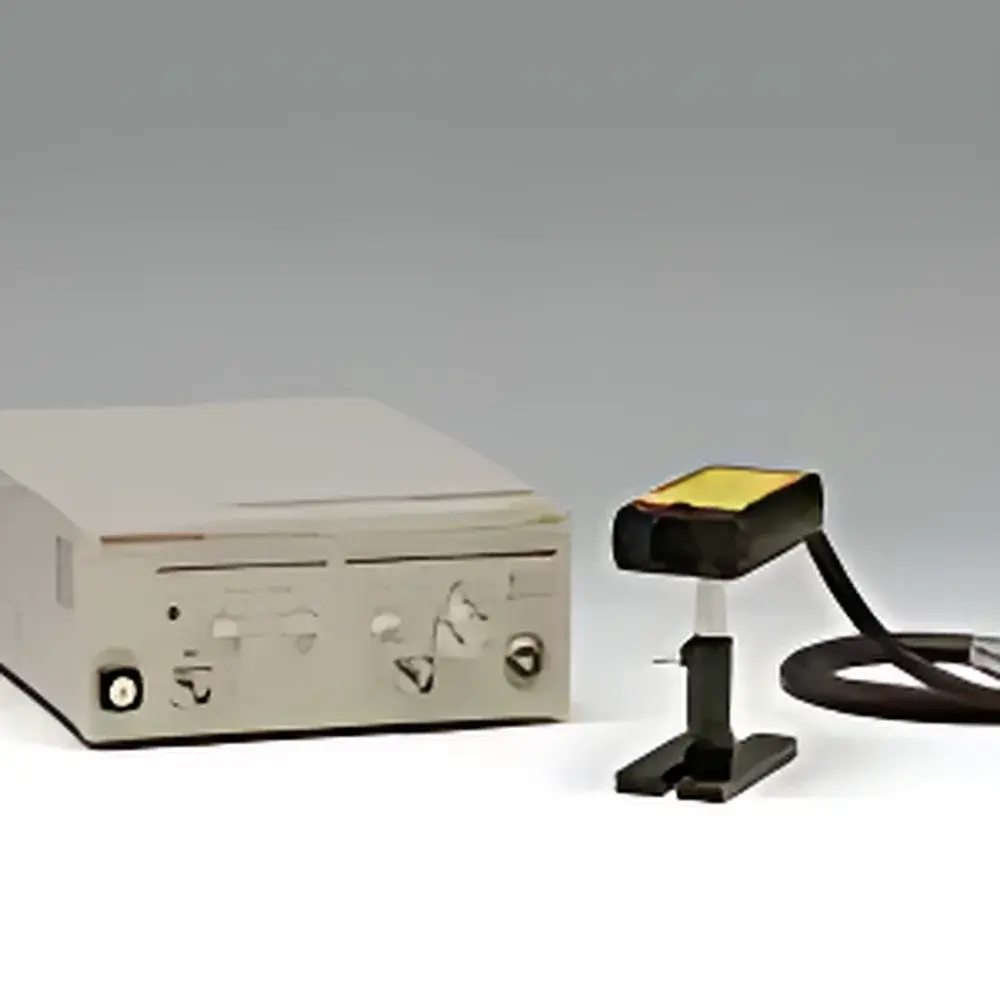
Picosecond Light Pulse Generator PLP-10
| Origin | Japan |
|---|---|
| Manufacturer Type | Distributor |
| Origin Category | Imported |
| Model | PLP-10 |
| Pricing | Upon Request |
Overview
The Picosecond Light Pulse Generator PLP-10 is a precision-engineered optical instrument designed for the generation of ultra-short, time-synchronized light pulses with sub-70 ps full-width-at-half-maximum (FWHM) duration. Based on high-speed laser diode technology, the PLP-10 operates across a broad spectral range from 375 nm to 1550 nm—encompassing key wavelengths used in UV-visible spectroscopy, telecom-band characterization (O-, E-, S-, C-, and L-bands), and near-infrared photonics. Its modular architecture comprises a dedicated controller unit and an interchangeable laser head, enabling flexible integration into optical test benches, automated measurement systems, or laboratory-scale photonic evaluation platforms. The device employs active temperature stabilization and crystal-controlled timing circuits to ensure long-term pulse-to-pulse stability, making it suitable for time-resolved photodetection, transient response calibration, and jitter-sensitive synchronization applications.
Key Features
- Ultra-short optical pulses with FWHM < 70 ps, verified via autocorrelation or streak-camera-based temporal profiling
- Repetition rate programmable up to 100 MHz, supporting both continuous-wave burst modes and externally triggered single-shot operation
- Dual output configurations: free-space collimated beam (window output) and FC/PC or FC/APC fiber-coupled variants for seamless integration with SMF-28, HI1060, or PM fibers
- Internal trigger delay generator with 1 ps resolution and ±5 ns range, enabling precise alignment of optical pulses relative to electrical reference signals
- Onboard quartz oscillator with < 1 ppm frequency stability over 0–40 °C ambient range, ensuring consistent timing accuracy without external clock dependency
- Front-panel interface and USB 2.0 connectivity for remote control via SCPI-compliant commands; compatible with LabVIEW, Python (PyVISA), and MATLAB instrument drivers
Sample Compatibility & Compliance
The PLP-10 supports direct coupling to a wide array of optoelectronic components and photonic devices, including but not limited to silicon photodiodes, InGaAs APDs, superconducting nanowire single-photon detectors (SNSPDs), and electro-absorption modulators. Its wavelength versatility accommodates material-specific absorption edges and detector quantum efficiency profiles—critical for evaluating responsivity roll-off in high-speed receivers. The system complies with IEC 61000-6-3 (EMC emission limits) and IEC 61000-6-2 (immunity requirements), and meets laser safety Class 1 or Class 3B specifications depending on configured output power and wavelength (per IEC 60825-1:2014). For regulated environments, firmware logging and user-accessible timestamped event records support GLP/GMP-aligned traceability when paired with validated data acquisition software.
Software & Data Management
The PLP-10 is supported by the optional PLP-Control Suite—a Windows-based application providing intuitive waveform configuration, real-time status monitoring, and batch parameter scripting. All operational settings—including repetition rate, pulse delay offset, wavelength selection (via interchangeable laser modules), and output attenuation—are stored in non-volatile memory with version-stamped configuration files. Audit trails record user login sessions, parameter changes, and hardware initialization events. When deployed in FDA-regulated laboratories, the system can be configured to comply with 21 CFR Part 11 requirements through optional digital signature modules and role-based access controls, ensuring electronic records integrity during qualification (IQ/OQ/PQ) and routine performance verification.
Applications
- Frequency-domain characterization of plastic optical fiber (POF) and gigabit Ethernet multimode fiber links using time-domain reflectometry (TDR) and impulse response deconvolution
- Transient response analysis of high-bandwidth photodetectors (e.g., >25 GHz bandwidth RF photodiodes) under standardized pulse excitation per IEEE 802.3 and ITU-T G.694.1
- Optical storage media evaluation, including write-read-erase cycle fidelity testing in phase-change and magneto-optical systems
- Calibration source for time-of-flight (ToF) sensors, LiDAR receiver front-ends, and pump-probe spectroscopy setups requiring synchronized dual-wavelength excitation
- Validation of optical time-domain multiplexing (OTDM) components such as ultrafast switches and demultiplexers in research-grade all-optical networks
FAQ
Is the PLP-10 compatible with third-party oscilloscopes and digitizers?
Yes—the PLP-10 provides TTL-compatible sync outputs and accepts external trigger inputs with adjustable polarity and threshold, ensuring interoperability with Keysight, Tektronix, and LeCroy high-speed digitizers.
Can multiple PLP-10 units be synchronized for multi-channel pulse generation?
Yes—using the master-slave triggering mode and low-jitter distribution amplifiers, up to four units can be phase-locked with sub-10 ps inter-channel timing skew.
Does the system support custom wavelength modules outside the standard 375–1550 nm range?
Custom laser heads operating at 266 nm (quadrupled Nd:YAG) or 10.6 µm (CO₂) are available under OEM agreement, subject to regulatory review and thermal management validation.
What maintenance is required for long-term pulse width stability?
No routine optical alignment is needed; periodic verification of pulse duration using a calibrated autocorrelator (recommended annually) ensures metrological continuity per ISO/IEC 17025 guidelines.



