
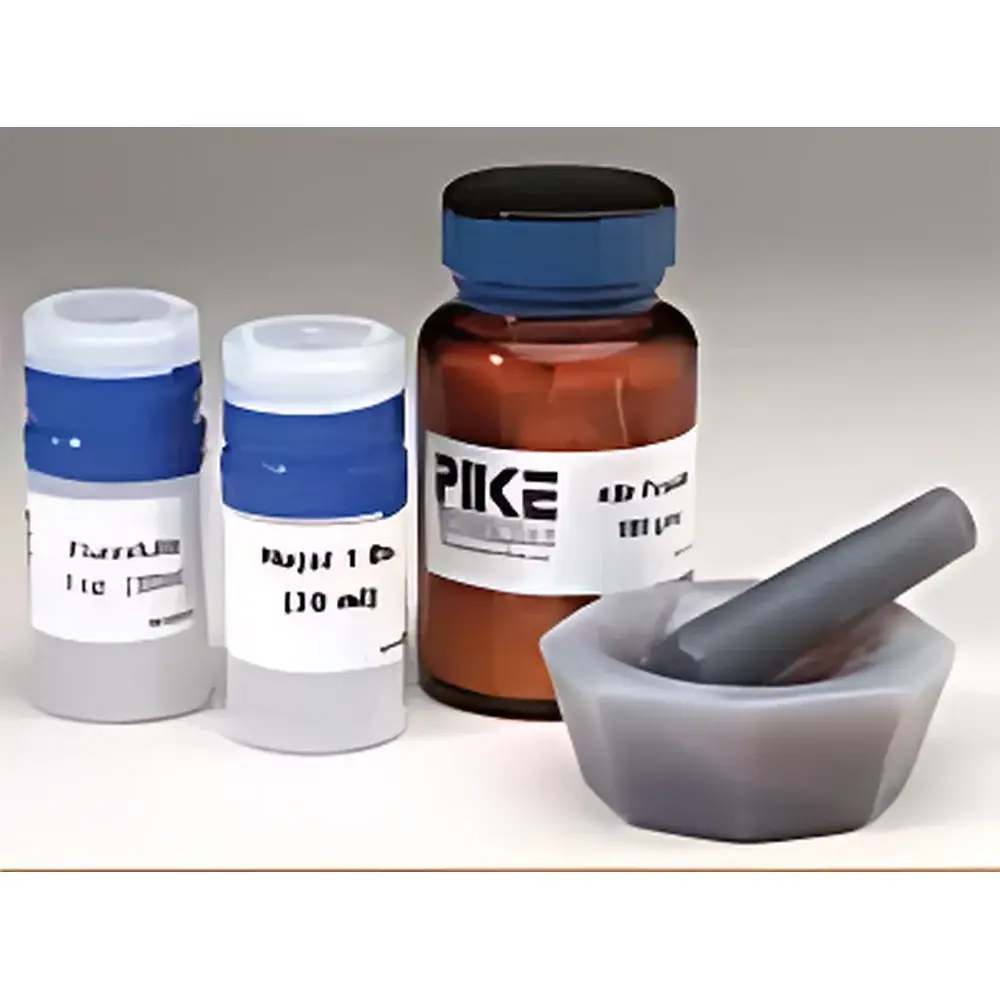
PIKE 160-8010 Spectroscopic Grade Potassium Bromide (KBr) Powder
| Brand | PIKE |
|---|---|
| Origin | USA |
| Model | 160-8010 |
| Purity | Spectroscopic Grade |
| Form | Fine Crystalline Powder |
| Packaging | 100 g Bottle |
| Application | FTIR Sample Preparation (Transmission Pellet & DRIFTS Background) |
| Compliance | Meets ASTM E1421 and ISO 18387 specifications for IR-transparent matrix materials |
| Storage | Desiccated, Room Temperature |
| Hygroscopicity | High — Requires Handling in Dry Atmosphere (<10% RH) |
Overview
PIKE 160-8010 Spectroscopic Grade Potassium Bromide (KBr) Powder is a rigorously purified, low-hygroscopicity matrix material engineered for high-fidelity Fourier Transform Infrared (FTIR) spectroscopy. As a cornerstone reagent in transmission-based sample preparation, KBr serves as an optically transparent, non-absorbing diluent that enables uniform dispersion of analytes at concentrations typically between 0.5–2.0 wt%. When subjected to high-pressure compaction (typically 8–12 tons for 1–2 minutes under vacuum or inert atmosphere), it forms mechanically stable, optically homogeneous pellets with exceptional transmittance across the mid-IR range (4000–400 cm⁻¹). Its intrinsic spectral neutrality—characterized by minimal interference bands (notably absence of OH stretch above 3600 cm⁻¹ and negligible carbonate contamination below 1500 cm⁻¹)—ensures baseline integrity and quantitative reliability in both qualitative identification and semi-quantitative analysis. Unlike technical-grade salts, PIKE’s spectroscopic grade KBr undergoes multi-stage recrystallization, acid-washed filtration, and controlled drying under nitrogen purge to eliminate trace water, metal ions, and organic residues that compromise spectral fidelity.
Key Features
- Spectroscopic purity certified per ASTM E1421 Annex A1: Total impurity content < 10 ppm; residual moisture < 0.01% w/w (Karl Fischer titration verified)
- Consistent particle size distribution (D₅₀ ≈ 2–5 µm) optimized for rapid, homogeneous mixing with analytes in agate mortars
- Batch-to-batch spectral reproducibility validated via reference pellet scanning against NIST-traceable polystyrene film standard
- Supplied in amber glass bottles with PTFE-lined caps under argon atmosphere to prevent ambient moisture uptake
- Compatible with hydraulic pellet presses (e.g., PIKE AutoPress™) and manual die sets (13 mm and 25 mm diameters)
Sample Compatibility & Compliance
PIKE 160-8010 KBr is validated for use with all major FTIR platforms including Thermo Nicolet iS50, PerkinElmer Spectrum Two, Bruker Tensor II, and Shimadzu IRTracer-100. It meets the matrix material requirements specified in ISO 18387:2017 (“Molecular spectroscopy — Requirements for infrared transmission cells and sample preparation materials”) and supports GLP-compliant workflows when documented within instrument-specific SOPs. For regulated environments (e.g., pharmaceutical QC per USP ), KBr pellets are accepted as primary sample presentation format for raw material identity testing, provided full audit trails—including lot number, preparation date, operator ID, and press parameters—are retained. The material exhibits no detectable absorbance features above baseline noise in the 4000–400 cm⁻¹ range when prepared as 1 mm thick pellets at ≥10 ton pressure.
Software & Data Management
While KBr itself is a consumable, its integration into analytical workflows is fully supported by vendor software ecosystems. OMNIC (Thermo), Spectrum OPUS (PerkinElmer), and OPUS (Bruker) include built-in KBr background subtraction protocols and pellet quality diagnostics (e.g., scattering index, baseline curvature metrics). All PIKE KBr lots are assigned unique alphanumeric identifiers traceable to CoA documentation, enabling direct linkage to LIMS entries via barcode scanning. For 21 CFR Part 11 compliance, electronic records generated during pellet preparation (e.g., press log files, environmental RH logs) may be archived alongside spectral data using validated e-signature modules.
Applications
- Transmission FTIR pellet preparation for polymers, APIs, excipients, and inorganic salts
- Diffuse Reflectance Infrared Fourier Transform Spectroscopy (DRIFTS) background acquisition using KBr-packed cups
- Quantitative analysis of carbonyl content in oxidized polyolefins via Beer-Lambert calibration
- Hydration state assessment of clays and zeolites through precise OH band deconvolution
- Reference material for validating spectrometer photometric linearity per ISO 17025 clause 5.9.2
FAQ
How should PIKE 160-8010 KBr be stored to maintain spectral grade integrity?
Store unopened bottles at 20–25°C in a desiccator with indicating silica gel (≤10% RH). Once opened, transfer required quantity to a glove box (<5% RH) for weighing; reseal bottle immediately under argon.
Can this KBr be used for ATR accessories?
No — PIKE 160-8010 is formulated exclusively for transmission pellet and DRIFTS applications. ATR crystals require no matrix dilution.
What is the typical pellet thickness achievable with 100 mg KBr at 10 tons pressure?
Approximately 0.8–1.2 mm, depending on die geometry and press dwell time. Thickness directly impacts absorbance intensity and must be recorded for quantitative work.
Does PIKE provide Certificates of Analysis for each lot?
Yes — Each bottle includes a CoA listing moisture content, chloride assay, sulfate limit test, and representative FTIR background scan (4 cm⁻¹ resolution, 32 scans).
Is this material suitable for far-IR measurements below 400 cm⁻¹?
Not recommended — KBr exhibits increasing lattice absorption below 400 cm⁻¹; for far-IR, CsI or polyethylene matrices are preferred.
Related Products




