
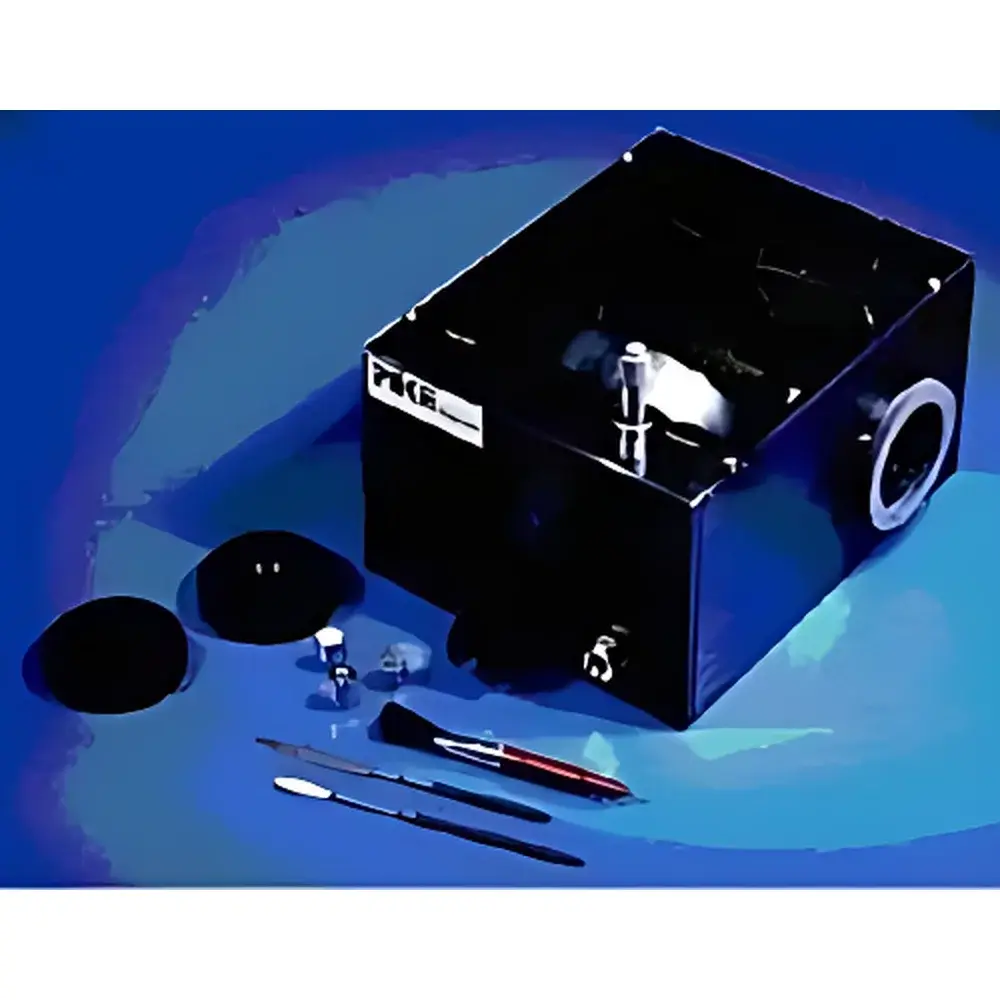
PIKE DiffusIR™ 16XX-11x Research-Grade Diffuse Reflectance Accessory
| Brand | PIKE |
|---|---|
| Origin | USA |
| Model | 16XX-11x |
| Compatibility | FTIR Spectrometers (Varian, Shimadzu, Bruker, Thermo Fisher, PerkinElmer, JASCO) |
| Optical Design | Monolithic Mirror Construction |
| Wavelength Range | Mid-IR and NIR Configurations Available |
| Mounting | Base-Mounted for Benchtop FTIR Systems |
| Application Class | Solid & Powder Sample Analysis |
Overview
The PIKE DiffusIR™ 16XX-11x is a precision-engineered diffuse reflectance accessory designed for quantitative and qualitative analysis of opaque, scattering, and heterogeneous solid samples in Fourier-transform infrared (FTIR) spectroscopy. It operates on the principle of diffuse reflectance spectroscopy—where incident IR radiation penetrates the sample surface, undergoes multiple internal scattering events, and re-emerges as diffusely reflected light captured by the spectrometer’s detector. This physical interaction enables molecular fingerprinting of powders, tablets, polymers, catalysts, soils, and pharmaceutical formulations without requiring complex sample preparation such as KBr pelletization or mulling. The 16XX-11x variant is optimized for high optical throughput and signal stability across both mid-infrared (4000–400 cm⁻¹) and near-infrared (12500–4000 cm⁻¹) spectral regions, depending on configuration and detector selection.
Key Features
- Monolithic mirror construction ensures long-term alignment stability and eliminates micro-vibrational drift between reflective surfaces.
- Base-mounted mechanical design provides rigid integration with major benchtop FTIR platforms—including Varian (now Agilent), Shimadzu IRTracer series, Bruker Tensor and ALPHA systems, Thermo Fisher Nicolet iS series, PerkinElmer Spectrum Two/One, and JASCO FT/IR-6000/7000 series.
- Optimized optical path geometry maximizes radiant flux delivery to the detector, resulting in improved signal-to-noise ratio (SNR) and reproducible spectral baselines across repeated measurements.
- Interchangeable sampling ports accommodate standard 13 mm and 25 mm diameter sample cups, supporting both loose powders and compressed pellets.
- Modular interface allows seamless integration with optional accessories including heated stages (up to 200 °C), motorized multi-position sample changers, and external sample chambers for oversized specimens.
Sample Compatibility & Compliance
The DiffusIR™ 16XX-11x supports direct analysis of non-ideal IR samples—including highly absorbing, granular, or thermally sensitive materials—without spectral distortion from specular reflection artifacts. Its geometry conforms to ASTM E1421–22 “Standard Guide for Describing and Measuring Performance of Diffuse Reflectance Accessories” and supports method validation under ISO 17025-accredited laboratory practices. When used with appropriate background correction protocols and validated calibration standards (e.g., NIST-traceable SRM 1921b), data generated meets regulatory expectations for QC release testing in pharmaceutical manufacturing environments governed by USP , ICH Q5A(R2), and FDA 21 CFR Part 11-compliant workflows when paired with validated FTIR software.
Software & Data Management
No proprietary control software is embedded in the hardware; instead, the accessory functions transparently within native instrument control environments (e.g., Thermo OMNIC, Bruker OPUS, PerkinElmer Spectrum Touch, Shimadzu IRsolution). All spectral acquisition, background subtraction (single-beam or ratioed), Kubelka-Munk transformation, and baseline correction are performed using vendor-supplied processing modules. Audit trail functionality, electronic signatures, and user-access controls must be implemented at the host spectrometer software level. Data export formats include JCAMP-DX (.dx), ASCII, and CSV—ensuring compatibility with LIMS, ELN, and statistical process control (SPC) platforms used in GMP-compliant facilities.
Applications
- Pharmaceutical solid-state characterization: polymorph identification, blend uniformity assessment, excipient compatibility screening.
- Catalyst surface chemistry analysis: adsorbed species detection, oxidation state evaluation, support–metal interaction studies.
- Food and agricultural science: moisture content estimation, starch crystallinity mapping, adulterant detection in powdered commodities.
- Materials science: polymer degradation monitoring, filler dispersion homogeneity, coating thickness estimation via depth-profiling algorithms.
- Environmental analysis: soil organic matter quantification, microplastic identification in sediment matrices, heavy metal speciation in contaminated particulates.
FAQ
Is the DiffusIR™ 16XX-11x compatible with attenuated total reflectance (ATR) accessories?
No—it is a dedicated diffuse reflectance module and does not incorporate ATR crystal elements or pressure mechanisms.
Can this accessory be used for quantitative analysis?
Yes, provided that appropriate calibration models (e.g., PLS regression) are developed using reference standards and validated per ICH Q2(R2) guidelines.
Does the accessory require purging with dry air or nitrogen?
While not mandatory, continuous purge is recommended during mid-IR measurements to minimize atmospheric water vapor and CO₂ interference, particularly below 2000 cm⁻¹.
What maintenance is required for long-term performance?
Periodic inspection of the gold-coated mirror surface for dust accumulation and gentle cleaning with spectroscopic-grade methanol and lint-free wipes; no realignment tools or recalibration procedures are needed due to monolithic construction.
Is technical documentation available in English for installation and operation?
Yes—PIKE provides comprehensive English-language user manuals, mechanical drawings, and application notes covering alignment verification, background acquisition protocols, and troubleshooting flowcharts.




