
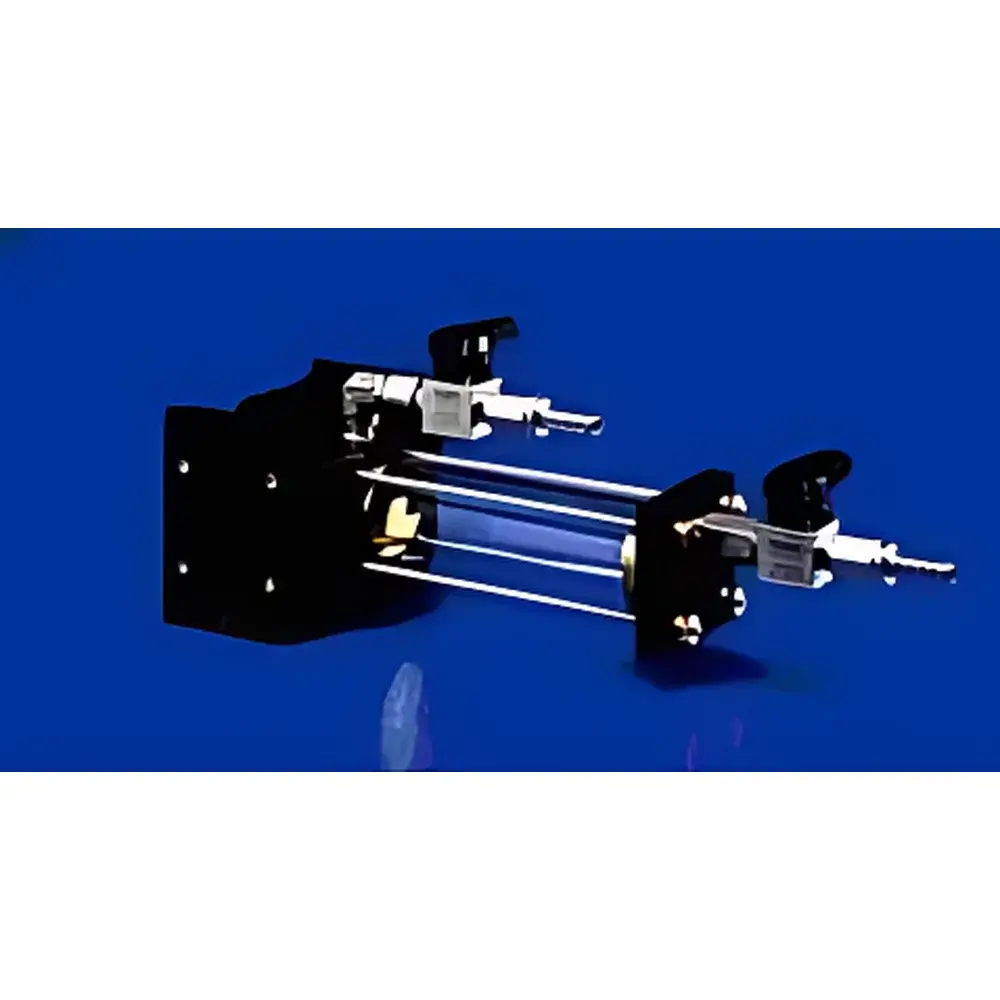
Pike Technologies 16x-xxx Long-Path Gas Cell
| Brand | Pike Technologies |
|---|---|
| Origin | USA |
| Model | 16x-xxx |
| Optical Path Length Options | Fixed (2.4 m, 10 m, 22 m, 33 m) or Variable (1–16 m) |
| Temperature Control Range | –200 °C to +200 °C (±1.0 °C stability) |
| Window Materials | BaF₂, CaF₂, KBr, KRS-5, NaCl, ZnSe |
| Mirror Coating | Gold-coated stainless steel |
| Compatible FTIR Systems | Thermo Nicolet, Bruker Tensor/Vertex, Shimadzu IRTracer, Varian Excalibur |
Overview
The Pike Technologies 16x-xxx Long-Path Gas Cell is an engineered optical absorption cell designed for high-sensitivity quantitative and qualitative analysis of trace gaseous species using Fourier Transform Infrared (FTIR) spectroscopy. Based on the principle of Beer–Lambert law absorption spectroscopy, the cell extends effective optical path length—up to 33 meters in fixed configurations or continuously adjustable from 1 to 16 meters—to amplify absorbance signals of low-concentration analytes. This design enables reliable detection and quantification of volatile compounds at parts-per-trillion (ppt) to parts-per-billion (ppb) concentration levels, making it suitable for environmental monitoring, industrial emissions verification, atmospheric research, and high-purity gas certification.
Key Features
- Modular optical path configuration: Select from five standard fixed-path lengths (2.4 m, 10 m, 22 m, 33 m) or a continuously variable path length system (1–16 m), enabling method optimization across diverse sample matrices and concentration ranges.
- Cryogenic and elevated temperature operation: Integrated Peltier and resistive heating/cooling modules support stable thermal control from –200 °C to +200 °C with ±1.0 °C accuracy, critical for studying temperature-dependent spectral shifts, condensable vapors, or kinetic gas-phase reactions.
- Optically optimized window selection: Six IR-transmissive window materials available—including BaF₂ (UV–MIR), CaF₂ (deep UV–MIR), KBr (broad MIR), KRS-5 (far-IR), NaCl (cost-effective MIR), and ZnSe (high durability, broad MIR–far-IR)—each selected to match spectral range and chemical compatibility requirements.
- High-reflectivity gold-coated stainless steel internal mirrors: Achieve >98% reflectivity across 4000–400 cm⁻¹; mirror surfaces are precision-aligned and sealed within a vacuum-rated stainless steel body to ensure long-term alignment stability and minimal stray light.
- Universal FTIR interface compatibility: Standardized flange dimensions and beam-height alignment allow direct integration with major commercial FTIR spectrometers including Thermo Scientific Nicolet iS series, Bruker Tensor and Vertex platforms, Shimadzu IRTracer systems, and legacy Varian Excalibur instruments.
Sample Compatibility & Compliance
The 16x-xxx Gas Cell accommodates both permanent gases (e.g., CO, CO₂, NOₓ, SO₂, NH₃, CH₄, O₃) and volatile organic compounds (VOCs) such as formaldehyde, acetaldehyde, benzene, and chlorinated hydrocarbons. Its all-metal construction and chemically inert wetted path (stainless steel body, gold mirrors, halide-compatible windows) support use with corrosive, reactive, or moisture-sensitive samples. The cell meets mechanical and dimensional specifications aligned with ISO 17025-compliant calibration workflows and supports traceable calibration using NIST-traceable reference gases. When operated under controlled environmental conditions and paired with validated spectral libraries, it complies with ASTM E1421 and ISO 14971 risk management frameworks for analytical instrumentation used in regulated environments.
Software & Data Management
While the cell itself is hardware-only, its performance integrates seamlessly with standard FTIR acquisition software suites (e.g., Thermo OMNIC, Bruker OPUS, Shimadzu IRsolution). Users may apply advanced multivariate analysis tools—including classical least-squares (CLS), partial least-squares regression (PLSR), and principal component analysis (PCA)—to deconvolve overlapping spectral features and quantify multi-component mixtures. All raw interferograms and processed spectra retain full metadata (path length, temperature, pressure, date/time stamp), supporting audit-ready data handling per FDA 21 CFR Part 11 requirements when deployed in GMP/GLP laboratories using compliant electronic lab notebooks (ELNs) or LIMS.
Applications
- Real-time monitoring of stack emissions and ambient air quality (EPA Method 320, ISO 12039)
- Quantitative analysis of ultra-low-concentration calibration standards for instrument validation
- Study of reaction intermediates and transient species in catalytic gas-phase chemistry
- Verification of high-purity carrier and process gases in semiconductor manufacturing
- Atmospheric simulation experiments in climate research chambers (e.g., smog chambers, cryo-adsorption studies)
- Method development for regulatory compliance testing under EU Directive 2010/75/EU (IED) and US Clean Air Act Title V
FAQ
What is the maximum pressure rating of the 16x-xxx gas cell?
Standard configurations are rated for up to 3 bar absolute pressure; custom high-pressure variants (up to 10 bar) are available upon request.
Can the cell be evacuated and backfilled with inert gas?
Yes—the cell includes dual stainless steel VCR ports with integrated leak-tight valves, enabling high-vacuum evacuation (<10⁻⁵ mbar) and controlled inert gas purging protocols.
Is purge gas required during operation?
Purge gas (typically dry N₂ or Ar) is recommended to minimize atmospheric water vapor and CO₂ interference, especially in long-path configurations; optional integrated purge manifolds are available.
How is path length calibrated and verified?
Path length is factory-verified via He–Ne laser interferometry and documented in the certificate of conformance; users may reconfirm using known spectral line positions (e.g., CO₂ 2349 cm⁻¹ band) or certified reference cells.
Does Pike provide application support for method development?
Yes—Pike Technologies offers technical consultation, spectral interpretation guidance, and method transfer assistance for regulatory and research applications.
Related Products





