
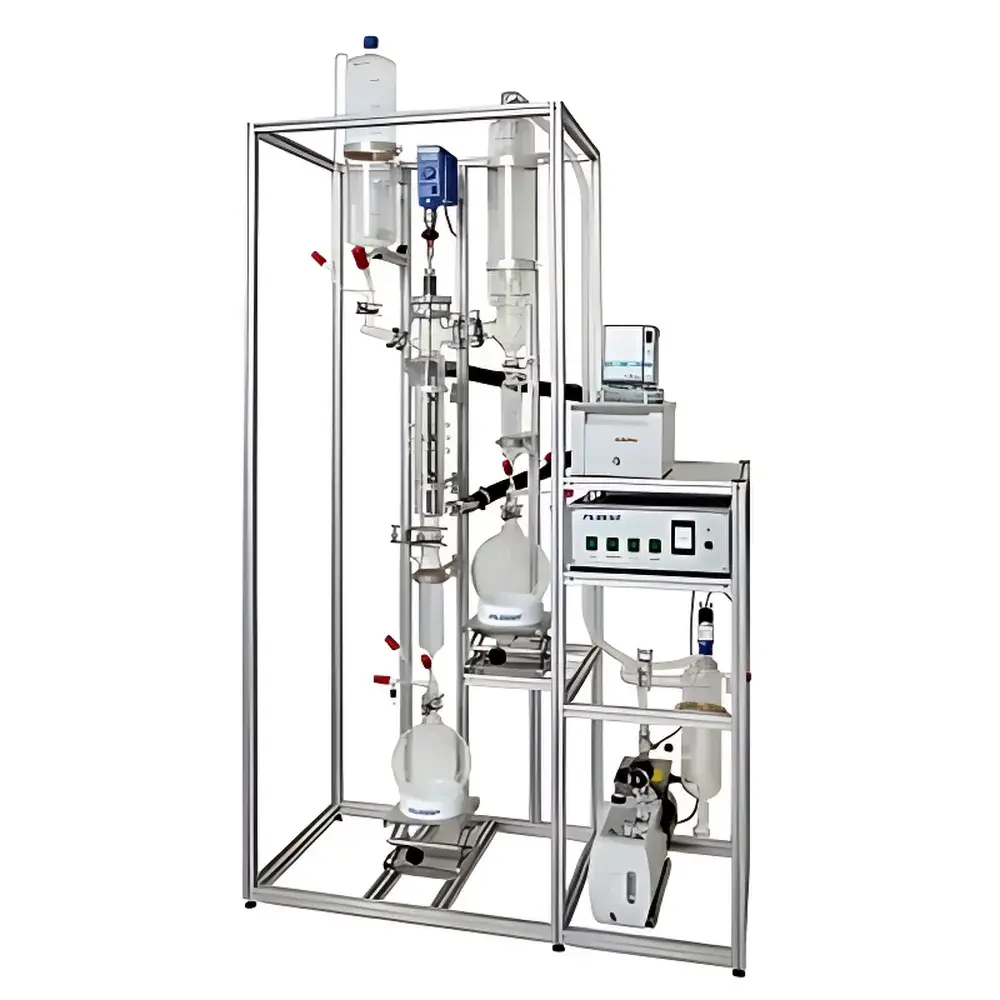
Pilodist TF 650 Thin-Film Evaporator
| Brand | Pilodist |
|---|---|
| Origin | Germany |
| Model | TF 650 |
| Operating Temperature Range | up to 250 °C |
| Operating Pressure Range | 0.1–10 mbar (absolute) |
| Feed Rate | 0.5–10 L/h |
| Evaporation Area | 6.5 dm² |
| Construction Material | High-grade stainless steel (SS 316L standard) |
| Dimensions (W × H × D) | 1.20 × 1.80 × 0.60 m |
| Ultimate Vacuum Capability | ≤0.001 mbar (with compatible vacuum system) |
Overview
The Pilodist TF 650 Thin-Film Evaporator is a precision-engineered, laboratory-scale short-path evaporation system designed for the gentle, high-efficiency separation of volatile components from thermally sensitive, high-boiling, viscous, or polymeric organic feedstocks. Based on the principle of dynamic thin-film formation under controlled reduced pressure, the TF 650 utilizes a vertically oriented, internally heated cylindrical evaporator body with a rotating wiper system that continuously spreads feed material into a uniform, sub-millimeter-thick film. This configuration maximizes surface-to-volume ratio and minimizes thermal residence time—typically ranging from seconds to under one minute—thereby preventing thermal degradation, polymerization, or cracking of labile compounds. The system operates within a precisely regulated pressure range of 0.1–10 mbar (absolute), with ultimate vacuum capability down to ≤0.001 mbar when integrated with a high-performance vacuum pump and cryogenic or sorption-based cold trap. Its maximum operational temperature of 250 °C enables processing of feedstocks with initial boiling points exceeding 300 °C at atmospheric pressure, while maintaining molecular integrity essential for downstream analytical or synthetic applications.
Key Features
- Robust vertical evaporator geometry with 6.5 dm² effective heating surface area, constructed entirely from corrosion-resistant stainless steel (SS 316L), ensuring compatibility with aggressive organic solvents and acidic/basic residues.
- Motor-driven wiper assembly with adjustable rotational speed (typically 50–400 rpm), enabling optimization of film thickness and heat/mass transfer for feeds spanning viscosities from 10 to >10,000 mPa·s.
- Integrated, jacketed condenser mounted directly above the evaporator zone, facilitating immediate condensation of vapors and minimizing back-diffusion or re-evaporation losses.
- Modular vacuum interface with ISO-KF 40/50 flanges, allowing seamless integration with secondary cold traps, vacuum gauges (capacitance manometers), and oil-free vacuum pumps compliant with ISO 8573-1 Class 0 air purity standards.
- Independent PID-controlled heating zones for evaporator wall, condenser, and feed preheater—each with real-time digital readout and ±1 °C thermal stability over full operating range.
- Feed introduction via calibrated peristaltic or diaphragm metering pump, supporting continuous or batch operation with precise volumetric control across the 0.5–10 L/h throughput range.
Sample Compatibility & Compliance
The TF 650 is routinely deployed in laboratories adhering to ASTM D2892 (True Boiling Point Distillation), ASTM D5236 (High Vacuum Distillation of Heavy Hydrocarbons), and ISO 9198 (Petroleum Products — Determination of Distillation Characteristics under Reduced Pressure). It accommodates feed materials including but not limited to: heavy naphthenic base oils, polyolefin oligomers, silicone polymers, pharmaceutical intermediates (e.g., vitamin esters, prostaglandin derivatives), natural product extracts (e.g., tocopherols, sterols), and residue fractions from FCC or hydrocracking units. All wetted surfaces meet USP Class VI and FDA 21 CFR Part 11 requirements for data integrity when paired with validated control software. System design conforms to CE Machinery Directive 2006/42/EC and PED 2014/68/EU for pressure equipment up to 250 °C and 1.5 bar gauge.
Software & Data Management
While the base TF 650 operates via analog/manual controls, optional digital automation packages provide Ethernet-enabled PLC-based operation with touchscreen HMI (Siemens SIMATIC HMI KTP700). Logged parameters—including wall temperature, vacuum level, feed rate, condensate collection mass/time, and wiper RPM—are timestamped and exportable in CSV or Excel format. Audit trails comply with GLP and GMP documentation standards, supporting 21 CFR Part 11 electronic signature functionality when configured with user-role authentication and encrypted database storage. Raw data files are structured for direct import into LIMS platforms or third-party process modeling tools (e.g., Aspen Properties, CHEMCAD).
Applications
- Devolatilization of polymer melts prior to rheological or spectroscopic characterization (ASTM D3835).
- Recovery of heat-labile active pharmaceutical ingredients (APIs) from reaction mixtures without racemization or decomposition.
- Production of narrow-cut distillates from vacuum residue for simulated distillation (SimDis) calibration standards (ASTM D2887).
- Purification of specialty lubricant additives (e.g., ZDDP derivatives, ashless dispersants) where oxidative stability must be preserved.
- Concentration of botanical extracts under oxygen-free, low-oxygen environments using nitrogen sweep gas integration.
- Preparative-scale isolation of fragrance compounds from essential oils with minimal terpene rearrangement.
FAQ
What vacuum level is required to achieve optimal performance with the TF 650?
A two-stage vacuum system comprising a primary dry scroll pump and a secondary high-vacuum turbomolecular pump—optionally backed by a cryogenic trap—is recommended to consistently attain ≤0.001 mbar during operation.
Can the TF 650 be integrated into an existing pilot plant infrastructure?
Yes; the unit features standardized ISO-KF and DN25/DN40 flanged connections, 4–20 mA analog I/O, and Modbus TCP support for centralized SCADA integration.
Is cleaning validation supported for pharmaceutical use?
The fully drainable, slope-toward-outlet design and absence of dead-legs enable reproducible CIP protocols; validation templates aligned with ASTM E3106 are available upon request.
What maintenance intervals are recommended for the wiper mechanism?
Wiper blades (PTFE-impregnated graphite or ceramic composites) require inspection every 200 operational hours and replacement every 1,000 hours under continuous use at >150 °C.
Does Pilodist offer application-specific method development support?
Yes; application engineers provide remote or on-site method optimization—including wiper speed profiling, temperature ramping, and pressure gradient sequencing—based on feedstock rheology and volatility data.




