
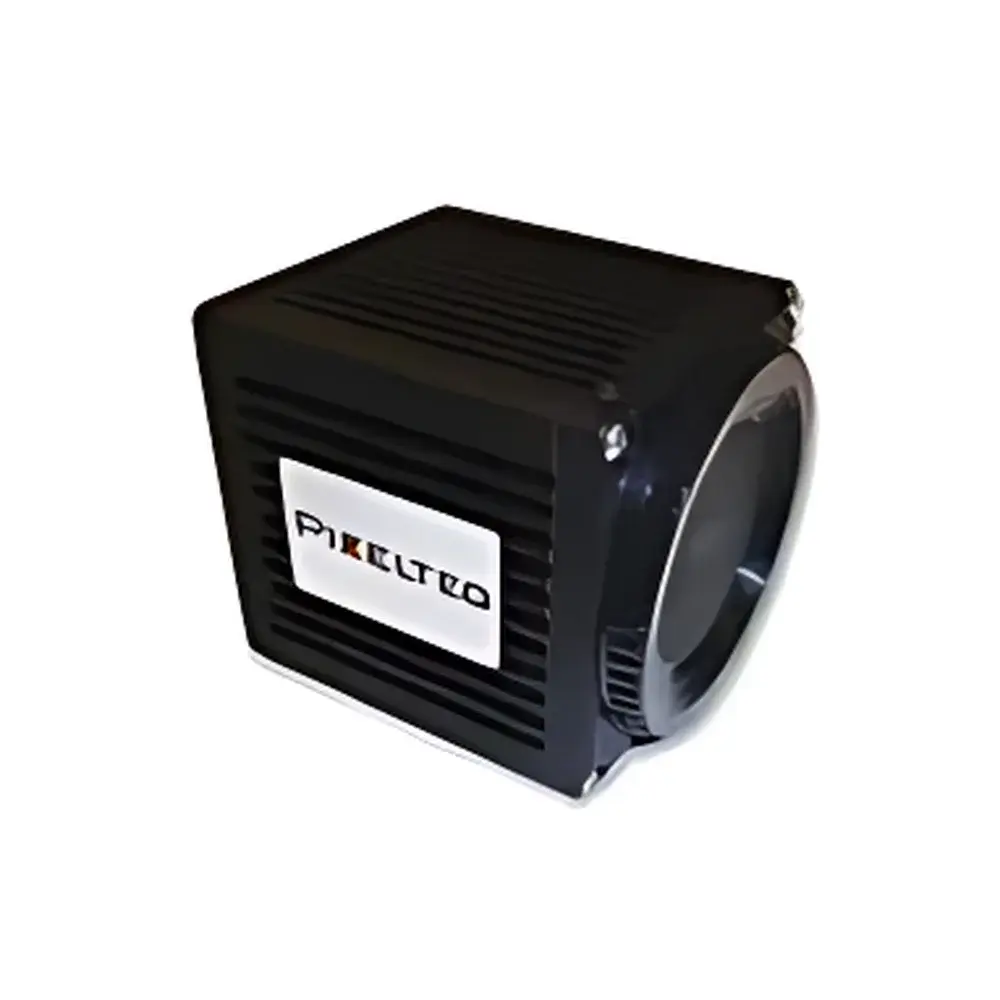
PixelCam™ Multispectral Camera Module
| Origin | USA |
|---|---|
| Manufacturer Type | Distributor |
| Origin Category | Imported |
| Model | PixelCam |
| Pricing | Upon Request |
Overview
The PixelCam™ Multispectral Camera Module is a wafer-level integrated, OEM-optimized imaging solution engineered for high-fidelity spectral data acquisition at video frame rates. Based on pixel-level mosaic filter array technology—where custom dichroic bandpass filters are monolithically patterned directly onto the sensor surface—the PixelCam delivers true simultaneous multispectral capture across 3 to 9 discrete spectral bands within the visible (400–700 nm), near-infrared (NIR, 700–1000 nm), and short-wave infrared (SWIR, up to 1700 nm) ranges. Unlike sequential or tunable-filter systems, PixelCam eliminates temporal misregistration, spatial parallax, and motion-induced spectral artifacts by acquiring all bands in a single exposure. Its architecture leverages standard CMOS/CCD imaging pipelines, enabling native compatibility with existing machine vision interfaces (e.g., USB3 Vision, GigE Vision, MIPI CSI-2) while maintaining physical and electrical footprints comparable to monochrome industrial cameras—same form factor, weight, power consumption (<2.5 W typical), and frame rate (up to 33 fps at full resolution).
Key Features
- Wafer-level dichroic filter mosaic: Custom-designed interference filters deposited at pixel level, ensuring precise spectral band definition and minimal crosstalk (<5% adjacent-band leakage)
- OEM-flexible configuration: Selectable band count (3–9 bands), center wavelengths, and bandwidths (FWHM 10–40 nm), optimized per application requirements
- Real-time synchronous capture: All spectral channels acquired simultaneously—no mechanical scanning, no time-lag between bands, no registration drift
- Industrial-grade robustness: Solid-state construction with no moving parts; qualified for shock (50 g), vibration (5–500 Hz), and extended temperature operation (−10 °C to +60 °C)
- Scalable manufacturing: Designed for high-yield wafer-level fabrication, supporting volume production of identical modules with inter-unit spectral consistency (±1.5 nm center wavelength tolerance)
- Plug-and-play integration: Standardized mechanical mounting (M12 or C-mount options), digital output protocols, and SDK support for Windows/Linux embedded environments
Sample Compatibility & Compliance
PixelCam modules are compatible with standard optical train components—including achromatic lenses, telecentric optics, and collimators—across the 400–1700 nm range. The sensor’s quantum efficiency profile is optimized for peak responsivity in both silicon-sensitive (VIS–NIR) and InGaAs-compatible (SWIR) configurations. All modules comply with RoHS 3 and REACH directives. For regulated applications—including clinical imaging validation and pharmaceutical process monitoring—the firmware supports optional audit-trail logging and user-access control, aligning with GLP/GMP documentation expectations. While not FDA-cleared as a medical device, PixelCam meets ISO 13485-aligned design controls when integrated into Class I or IIa system-level medical instruments.
Software & Data Management
The PixelCam SDK provides low-level register access, real-time band synchronization control, and hardware-triggered acquisition modes. Included software tools enable spectral cube generation (BIL/BIP format), pseudo-color mapping (LUT-based per-band weighting), and basic spectral index calculation (e.g., NDVI, NDWI). Raw data streams retain full bit-depth fidelity (12-bit or 14-bit per channel), supporting downstream analysis in MATLAB, Python (via OpenCV and scikit-image), or ENVI. Optional middleware supports OPC UA integration for Industry 4.0 factory-floor deployment and time-synchronized metadata tagging (GPS, IMU, ambient light, temperature). All firmware updates follow secure signed-package protocols compliant with NIST SP 800-193 guidelines.
Applications
- Agricultural phenotyping: Real-time crop health assessment via chlorophyll, water stress, and nitrogen indices from UAV-mounted units
- Medical diagnostics support: Non-invasive tissue oxygenation mapping and lesion boundary delineation in dermatology and wound care research
- Industrial sorting & defect detection: Discrimination of material composition (plastics, textiles, food contaminants) based on spectral reflectance fingerprints
- Remote sensing & environmental monitoring: Surface water quality analysis (chlorophyll-a, turbidity, CDOM) using drone-deployed lightweight modules
- Defense & security: Covert surveillance under low-light conditions leveraging NIR/SWIR contrast without active illumination
- Automated optical inspection (AOI): In-line PCB solder joint verification and coating uniformity assessment across multiple spectral bands
FAQ
Can PixelCam be calibrated traceably to NIST standards?
Yes—each production batch undergoes spectral radiometric calibration using NIST-traceable integrating sphere sources. Certificate of Calibration (CoC) with uncertainty budgets is available upon request.
Is SWIR-capable PixelCam compatible with standard silicon lenses?
No—SWIR configurations (1000–1700 nm) require lenses made of CaF₂, ZnSe, or Ge. VIS–NIR modules (400–1000 nm) operate optimally with broadband fused silica or coated glass lenses.
What is the minimum integration time for full-frame capture at 33 fps?
Minimum exposure is 10 µs per frame; dynamic range remains linear down to 1000:1 SNR at this setting.
Does PixelCam support external triggering with sub-microsecond jitter?
Yes—hardware trigger input supports TTL/LVDS with ≤200 ns jitter and programmable delay (0–10 ms) for synchronized multi-sensor deployments.
Can I modify the pixel mosaic pattern post-fabrication?
No—the dichroic filter array is permanently defined during wafer processing. Custom patterns must be specified prior to mask fabrication.




