
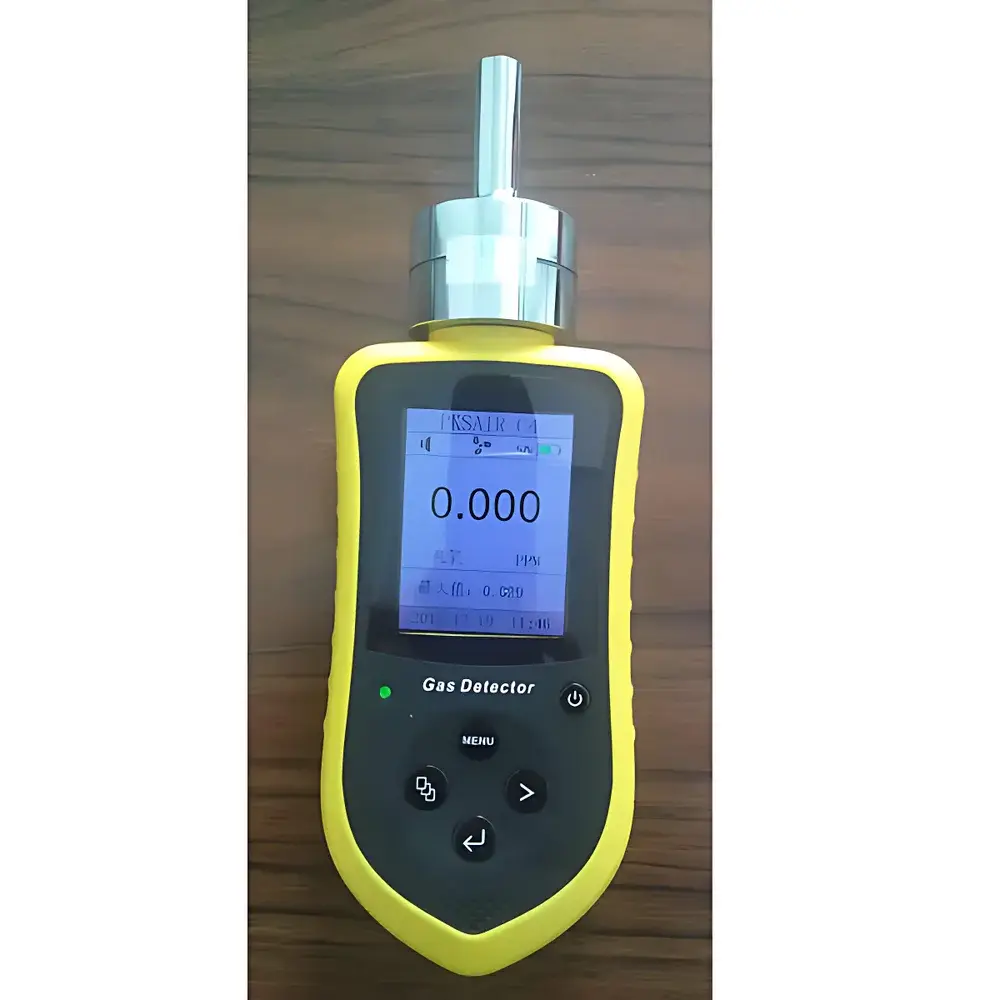
PKSAIR-C4 Portable Pump-Aspirated Ozone Analyzer
| Origin | Beijing, China |
|---|---|
| Manufacturer Type | Authorized Distributor |
| Origin Category | Domestic (China) |
| Model | PKSAIR-C4 |
| Price Range | USD 1,400–2,800 |
| Instrument Type | Portable |
| Measurement Range | 0.001–2.000 ppm (or mg/m³) |
| LOD | 0.001 ppm |
| Response Time | ≤30 s (T90) |
| Zero Drift | ≤±1% F.S./year |
| Resolution | ≤±2% of reading |
| Detection Principle | Electrochemical |
| Sampling Method | Integrated pump aspiration (300–500 mL/min) |
| Accuracy | ≤±3% of reading |
| Repeatability | ≤±2% |
| Linearity Error | ≤±2% |
| Display | 2.4″ color TFT LCD (320×240 px) |
| Operating Temp. | −20 °C to +50 °C |
| Humidity | ≤95% RH (non-condensing) |
| Dimensions | 211.5 × 73 × 34.5 mm |
| Weight | 240 g |
| Power | Rechargeable 2800 mAh Li-polymer battery (≈20 h continuous operation) |
| Ingress Protection | IP65 |
| Explosion Protection | Ex ib IIC T4 Gb |
| Data Storage | Optional internal memory for up to 100,000 records |
| Compliance | GB 50493–2009, GB 12358–2006, GBZ 2.1–2007, GB 3836.1–2010, GB 3836.4–2010 |
Overview
The PKSAIR-C4 Portable Pump-Aspirated Ozone Analyzer is an intrinsically safe, field-deployable electrochemical gas detection instrument engineered for high-fidelity real-time monitoring of ozone (O₃) in ambient air and occupational environments. Unlike passive diffusion-based analyzers, the PKSAIR-C4 integrates a certified Thomas® miniature vacuum pump—ensuring consistent, controlled sample draw at 300–500 mL/min. This active aspiration eliminates boundary-layer diffusion delays and enhances measurement reproducibility—particularly critical in low-flow or turbulent settings (e.g., confined spaces, ducts, or VOC-rich industrial zones). The sensor operates on a three-electrode electrochemical principle, delivering stable, linear output across its full 0.001–2.000 ppm range with built-in temperature and humidity compensation algorithms compliant with ISO 8573-1 and ASTM D6196–19 reference methodologies. Designed for compliance-driven applications, the device meets national Chinese standards for toxic gas detection (GB 12358–2006), hazardous area instrumentation (GB 3836.4–2010), and occupational exposure limit enforcement (GBZ 2.1–2007).
Key Features
- Intrinsically safe circuit architecture (Ex ib IIC T4 Gb), certified for use in Zone 1/21 explosive atmospheres
- Integrated Thomas® micro-vacuum pump—low-noise, >10,000-hour service life, flow-stabilized aspiration
- 24-bit high-resolution ADC coupled with a 32-bit nanoscale microcontroller for sub-millisecond signal processing
- 2.4″ color TFT LCD (320×240 px) with auto-brightness adjustment and dual-language UI (English/Chinese)
- Full-range environmental compensation: real-time correction for temperature (−20 °C to +50 °C) and relative humidity (≤95% RH, non-condensing)
- User-configurable dual-stage alarms (high/low), audible (≥85 dB), visual (dual-color LED), and on-screen text alerts
- Robust housing: ABS+PC polymer blend with UL94 V-0 flame retardancy, IP65 dust/water ingress protection
- Field-serviceable modular design—sensor cartridge, battery, and pump assembly replaceable without tools
- Low-power architecture enabling ≥20 hours of continuous operation on a single 2800 mAh Li-polymer charge
- Micro-USB port compatible with universal 5 V DC chargers—including standard Android adapters
Sample Compatibility & Compliance
The PKSAIR-C4 is validated for direct sampling of ambient air, indoor workplace air, and process vent streams containing ozone at trace to low-ppm concentrations. Its electrochemical sensor exhibits minimal cross-sensitivity to common interferents including NO₂, Cl₂, SO₂, and VOCs—verified per GB/T 18204.2–2014 interference testing protocols. The analyzer complies with multiple regulatory frameworks governing occupational health and safety instrumentation: GB 50493–2009 (petrochemical site gas detection design), GB 12358–2006 (general performance requirements), and GBZ 2.1–2007 (workplace O₃ exposure limits: 0.1 ppm TWA, 0.3 ppm STEL). It also satisfies intrinsic safety requirements per GB 3836.1–2010 and GB 3836.4–2010, making it suitable for deployment in refineries, biopharma cleanrooms, wastewater treatment facilities, and sterilization chambers where explosive or oxidizing atmospheres may occur.
Software & Data Management
Data integrity and audit readiness are supported through optional onboard memory storing up to 100,000 timestamped records—including concentration values, alarm events, power cycles, calibration logs, and fault diagnostics. All entries include UTC timestamps, sensor ID, and environmental metadata (T/RH). Export is performed via USB connection using vendor-neutral CSV format compatible with Excel, MATLAB, or LIMS platforms. No proprietary software is required; raw files open directly in spreadsheet applications. The device supports GLP-aligned features including password-protected configuration access, tamper-evident calibration history, and dual recovery modes (one-touch reset + factory restore). Firmware updates are delivered via signed binary packages with SHA-256 checksum validation.
Applications
- Occupational hygiene monitoring in ozone-generating workplaces (e.g., water disinfection plants, UV sterilization labs, corona discharge systems)
- Indoor air quality (IAQ) assessment in offices, schools, and healthcare facilities following WHO O₃ guidelines (100 µg/m³ ≈ 0.05 ppm 8-hr average)
- Environmental compliance verification at municipal air quality monitoring stations and EPA-regulated emission sources
- Safety patrol in chemical manufacturing, semiconductor fabrication, and pharmaceutical production where ozone is used as an oxidant
- Research-grade field measurements in atmospheric chemistry studies, including tropospheric ozone gradient mapping
- Hazardous materials response—rapid screening during chlorine/ozone leak incidents or decontamination operations
- Validation of ozone destruct units and catalytic scrubbers in HVAC and exhaust abatement systems
FAQ
What detection principle does the PKSAIR-C4 use for ozone measurement?
It employs a calibrated, temperature-compensated electrochemical cell with a three-electrode configuration optimized for selective O₃ oxidation at the working electrode.
Is the instrument suitable for use in explosive atmospheres?
Yes—certified to Ex ib IIC T4 Gb per GB 3836.4–2010, permitting safe operation in Zone 1 gas hazard areas.
Can measurement units be switched between ppm and mg/m³?
Yes—the device automatically converts readings using NTP (25 °C, 1 atm) reference conditions and displays both units simultaneously.
Does the analyzer support external data logging or remote telemetry?
No native Bluetooth/WiFi module is included; however, the USB interface enables batch download of stored records for offline analysis and reporting.
What maintenance is required to ensure long-term accuracy?
Biannual zero calibration with certified zero air and annual span calibration using NIST-traceable ozone standard gas (0.5 ppm) are recommended per GB 12358–2006.







