
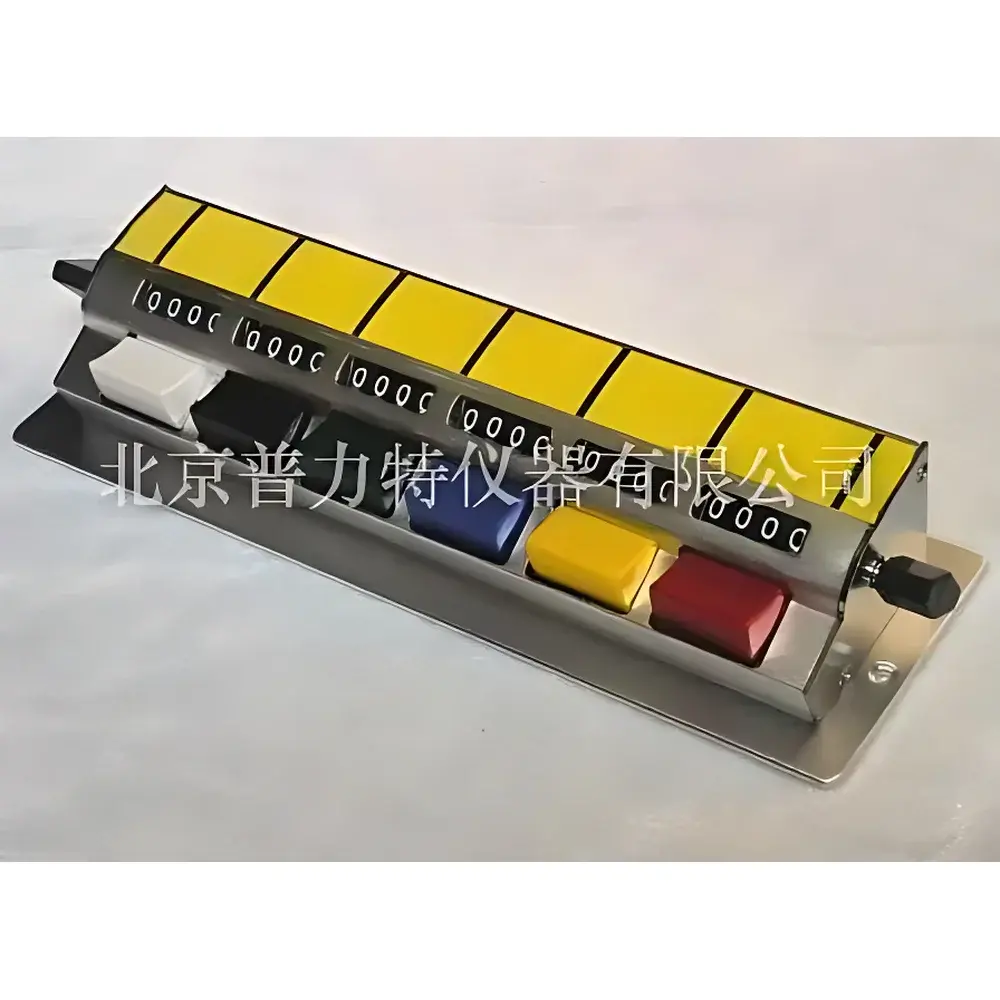
Plankton Classification and Counting Device PT-C
| Origin | Beijing, China |
|---|---|
| Manufacturer Type | Distributor |
| Product Origin | Domestic (China) |
| Model | PT-C |
| Pricing | Upon Request |
| Instrument Category | Algal Counter |
Overview
The PT-C Plankton Classification and Counting Device is a dedicated mechanical-digital tally instrument engineered for routine microscopic analysis of freshwater and marine plankton communities. Designed to operate in tandem with optical microscopes—typically inverted or compound systems equipped with 10×–40× objectives—the PT-C supports manual, observer-driven identification and enumeration of phytoplankton and zooplankton taxa directly from microscope slides, sedimentation chambers (e.g., Utermöhl chambers), or membrane filters. Its operation relies on the fundamental principle of visual taxonomic discrimination followed by discrete integer-based accumulation, eliminating reliance on image recognition algorithms or software-based segmentation. This architecture ensures deterministic repeatability, zero computational latency, and full traceability of each counting step—a critical requirement in regulatory water quality monitoring workflows governed by ISO 14442:2022 (Water quality — Guidance on enumeration of phytoplankton) and EPA Method 180.1 (Algal Identification and Enumeration).
Key Features
- Mechanical counter architecture with nine independent classification channels plus one global total register—enabling simultaneous tracking of up to nine morphologically distinct plankton groups (e.g., diatoms, dinoflagellates, cyanobacteria, rotifers, copepod nauplii)
- Dedicated tactile push-button interface: nine labeled momentary switches, each incrementing its assigned channel by +1 per actuation; no debounce delay or electronic lag
- Single-axis mechanical reset knob located on the device’s lateral panel: full zeroing of all ten registers (nine categories + total) with one continuous rotation
- Compact, benchtop form factor (260 × 120 × 75 mm) optimized for integration within microscopy workstations without obstructing eyepiece access or stage movement
- Non-powered design: no batteries, no firmware, no calibration drift—operational integrity remains invariant across temperature fluctuations (10–35°C) and extended usage cycles
- High-contrast LED-illuminated digit display (optional accessory): improves readability under low ambient light conditions common during prolonged Utermöhl chamber analysis
Sample Compatibility & Compliance
The PT-C is compatible with standard plankton enumeration substrates including Sedgwick-Rafter chambers, Palmer-Maloney cells, and ISO-compliant Utermöhl settling chambers (ISO 8692:2012). It supports both qualitative classification (e.g., genus-level ID per APHA Standard Methods 10200 H) and quantitative reporting (cells/mL, individuals/L) when used with calibrated chamber volumes and defined field areas. The device conforms to GLP documentation requirements: each count session generates an auditable physical record—no digital logs required—facilitating direct inclusion in laboratory notebooks compliant with 21 CFR Part 11 Annex 11 principles for manual data entry traceability. While not an analytical instrument per se, its use is explicitly referenced in national water quality protocols such as China’s HJ 1081–2019 (Determination of Phytoplankton Density in Water Bodies) and EU WFD monitoring guidelines.
Software & Data Management
The PT-C operates independently of software. All counting data remain external to digital systems until manually transcribed into laboratory information management systems (LIMS), Excel spreadsheets, or statistical packages (e.g., R, PRIMER). This design eliminates cybersecurity risks associated with connected instrumentation and avoids validation burdens linked to electronic records under FDA 21 CFR Part 11 or EU Annex 11. For laboratories requiring digital capture, optional USB-digital interface modules (sold separately) enable serial output of register values to host PCs running custom Python or LabVIEW scripts—though such configurations fall outside the base device’s scope and require separate IQ/OQ validation.
Applications
- Routine surveillance of eutrophication indicators in reservoirs, lakes, and drinking water intakes
- Ecological assessment of coastal and estuarine plankton community structure under IUCN and OSPAR frameworks
- Quality control of algal cultures in aquaculture hatcheries and biotechnology facilities
- Academic research involving long-term plankton time-series where inter-observer consistency must be preserved across decades
- Training laboratories teaching taxonomic identification skills—provides immediate feedback without algorithmic bias or black-box processing
FAQ
Does the PT-C require calibration or periodic verification?
No. As a purely mechanical tally device, it requires no calibration. Verification consists solely of manual cross-checking against a known reference count (e.g., pre-counted slide) to confirm switch actuation fidelity.
Can the PT-C store counts between sessions?
No. All registers reset to zero upon knob rotation or power loss (if LED backlight is installed). Persistent storage requires manual recording.
Is the PT-C suitable for automated image-based analysis?
No. It is designed exclusively for human-observed, microscope-coupled counting. It does not interface with cameras or image analysis platforms.
What maintenance is required?
None beyond occasional cleaning of button surfaces with isopropyl alcohol. No lubrication or internal servicing is specified or recommended.
Does the device meet CE or RoHS requirements?
As a non-electrical mechanical instrument (excluding optional LED module), it falls outside CE marking scope. RoHS compliance applies only to the LED variant’s PCB components.







