
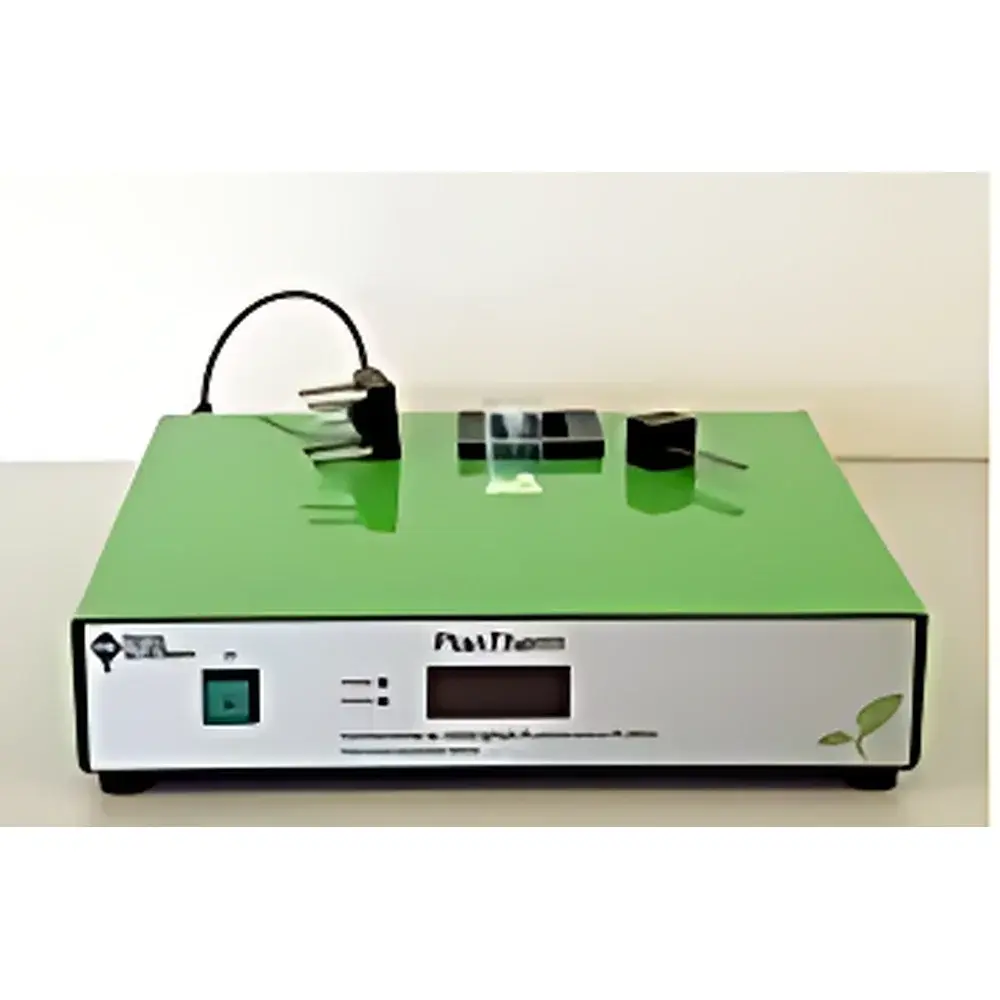
PlanTherm PT 100 Plant and Algal Thermotolerance Analyzer
| Origin | Czech Republic |
|---|---|
| Manufacturer Type | Distributor |
| Origin Category | Imported |
| Model | PT 100 |
| Price | Upon Request |
Overview
The PlanTherm PT 100 Plant and Algal Thermotolerance Analyzer is a dual-parameter, high-resolution thermal stress assessment platform engineered for quantitative evaluation of membrane integrity and photosynthetic apparatus stability under controlled linear heating. It operates on two complementary biophysical principles: (1) electrolyte leakage measurement via real-time electrical conductivity monitoring—reflecting plasma membrane thermostability—and (2) chlorophyll a fluorescence kinetics profiling—reporting on the thermal resilience of Photosystem II (PSII) reaction centers and electron transport chain components. By simultaneously acquiring conductance–temperature (G–T) and fluorescence–temperature (F–T) curves during a programmable ramp from 20 °C to 85 °C, the system delivers two independent, physiologically grounded thermotolerance indices: the electrolyte leakage inflection temperature (TEL) and the PSII critical temperature (Tc). These parameters are directly traceable to established plant stress physiology protocols and enable discrimination between constitutive (structural) and acquired (inducible) thermotolerance mechanisms.
Key Features
- Dual-sensor synchronized acquisition: Simultaneous high-frequency (2 Hz) recording of conductivity and chlorophyll fluorescence during linear thermal ramping
- Programmable thermal control: Linear heating rate adjustable from 1–3 °C/min across a 20–85 °C range with ±0.01 °C temperature resolution
- Optimized optical excitation: 460 nm LED source delivering both measuring light (low-intensity, non-saturating) and saturating pulse light; intensity fully user-configurable
- Integrated electromagnetic stirring: Adjustable 0–2000 rpm agitation ensures homogeneous sample temperature distribution and minimizes boundary layer effects in algal suspensions
- Standardized sample geometry: 7 mL cuvette format compatible with detached leaves (max. 0.5 cm × 2.0 cm) and microalgal cultures (OD730 ≤ 0.8)
- Embedded computing: Intel NUC-based workstation (i3-3217U, 2 GB DDR3 RAM, ≥90 GB SSD) running dedicated ProfileCon GUI software with real-time visualization of raw curves and derived metrics
Sample Compatibility & Compliance
The PT 100 supports a broad spectrum of photosynthetic organisms without modification: dicot and monocot leaves (using integrated leaf clamps), moss gametophytes, lichen thalli, and unicellular or colonial microalgae (e.g., Chlamydomonas reinhardtii, Dunaliella salina, Phaeodactylum tricornutum). All measurements adhere to standardized physiological assay frameworks referenced in ISO 11269-2 (chlorophyll fluorescence), ASTM D7575 (electrolyte leakage in plant tissue), and FAO/IAEA guidelines for abiotic stress phenotyping. Data logging includes full audit trail metadata (timestamp, operator ID, protocol version, instrument calibration status), supporting GLP-compliant experimental documentation and regulatory submissions under OECD Test Guidelines 208 and 227.
Software & Data Management
ProfileCon software provides a validated, menu-driven interface compliant with FDA 21 CFR Part 11 requirements for electronic records and signatures. Users define heating protocols, set fluorescence excitation parameters, and configure data export formats (CSV, Excel-compatible .xlsx, HDF5). The software automatically identifies four fluorescence inflection points (F0, Fm, Tc, Td) and calculates TEL using second-derivative peak detection on the G–T curve. All raw time-series datasets—including temperature, conductivity, and fluorescence—are stored with embedded sensor calibration coefficients and environmental context tags. Exported files retain SI-unit annotations and metadata headers required for FAIR (Findable, Accessible, Interoperable, Reusable) data practices.
Applications
- Rapid screening of thermotolerance variation across crop germplasm collections (e.g., rice, wheat, tomato, soybean)
- Quantitative validation of transgenic or CRISPR-edited lines for enhanced heat resilience
- Mechanistic studies of membrane lipid remodeling and PSII repair cycle dynamics under thermal stress
- Comparative ecophysiology of native vs. invasive plant species under projected climate scenarios
- Algal strain selection for industrial biotechnology applications requiring thermal robustness in open pond or photobioreactor systems
- Integration with multi-omics workflows: correlation of TEL/Tc values with transcriptomic (e.g., HSP expression), proteomic (e.g., Rubisco activase stability), and metabolomic (e.g., proline, trehalose accumulation) profiles
FAQ
What biological endpoints does the PT 100 quantify?
It quantifies two primary thermotolerance biomarkers: the electrolyte leakage inflection temperature (TEL), indicating plasma membrane thermostability, and the PSII critical temperature (Tc), reflecting functional stability of the photosynthetic apparatus.
Can the PT 100 be used for intact plants or only detached tissues?
It is designed for excised leaves and algal suspensions. Intact whole-plant assays require complementary instrumentation (e.g., infrared thermography or gas exchange systems).
Is calibration traceable to international standards?
Yes—conductivity sensors are calibrated against certified KCl standards (ISO 7888); temperature probes are NIST-traceable Pt100 sensors with factory calibration certificates.
How is data integrity ensured during long-duration experiments?
The embedded SSD logs all sensor outputs at 2 Hz with cyclic redundancy checksums; power-fail recovery preserves partial datasets up to the last stable write cycle.
Does the system support remote monitoring or network integration?
ProfileCon includes TCP/IP server mode enabling secure SSH access and integration with institutional LIMS or ELN platforms via RESTful API endpoints.





