
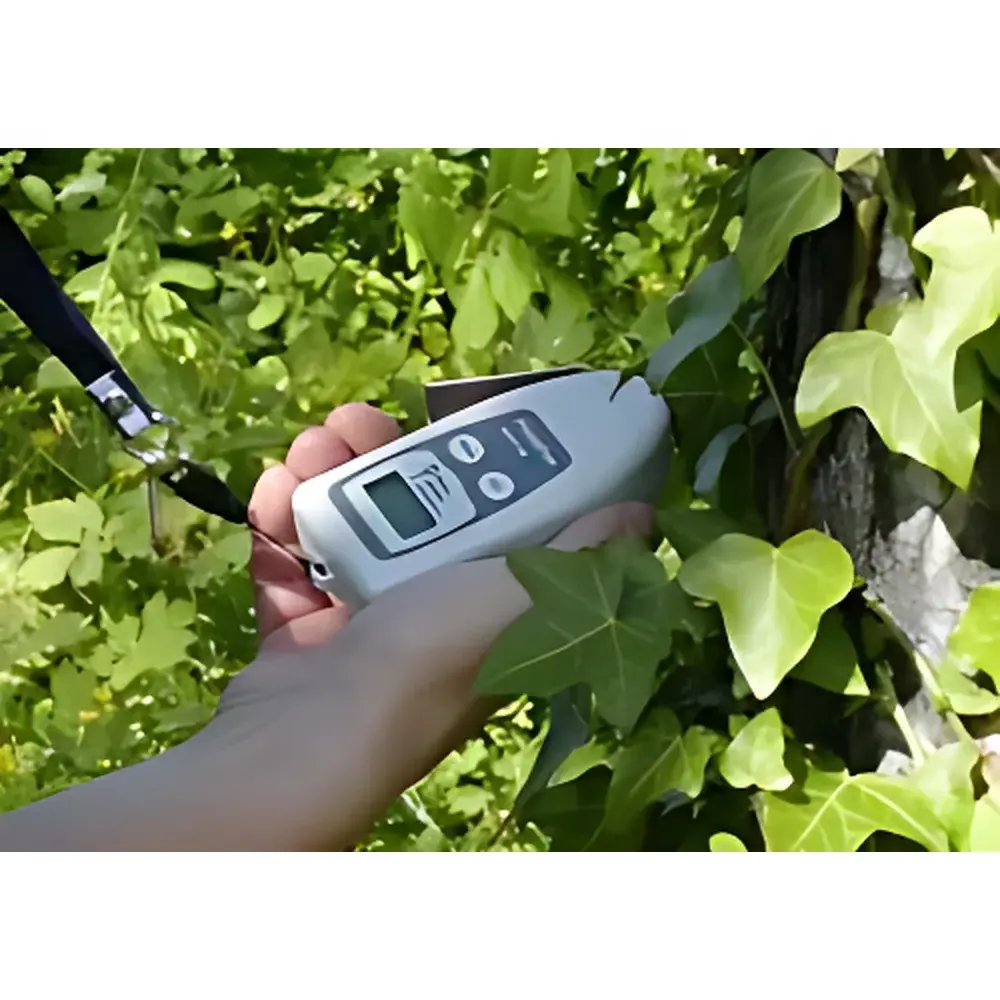
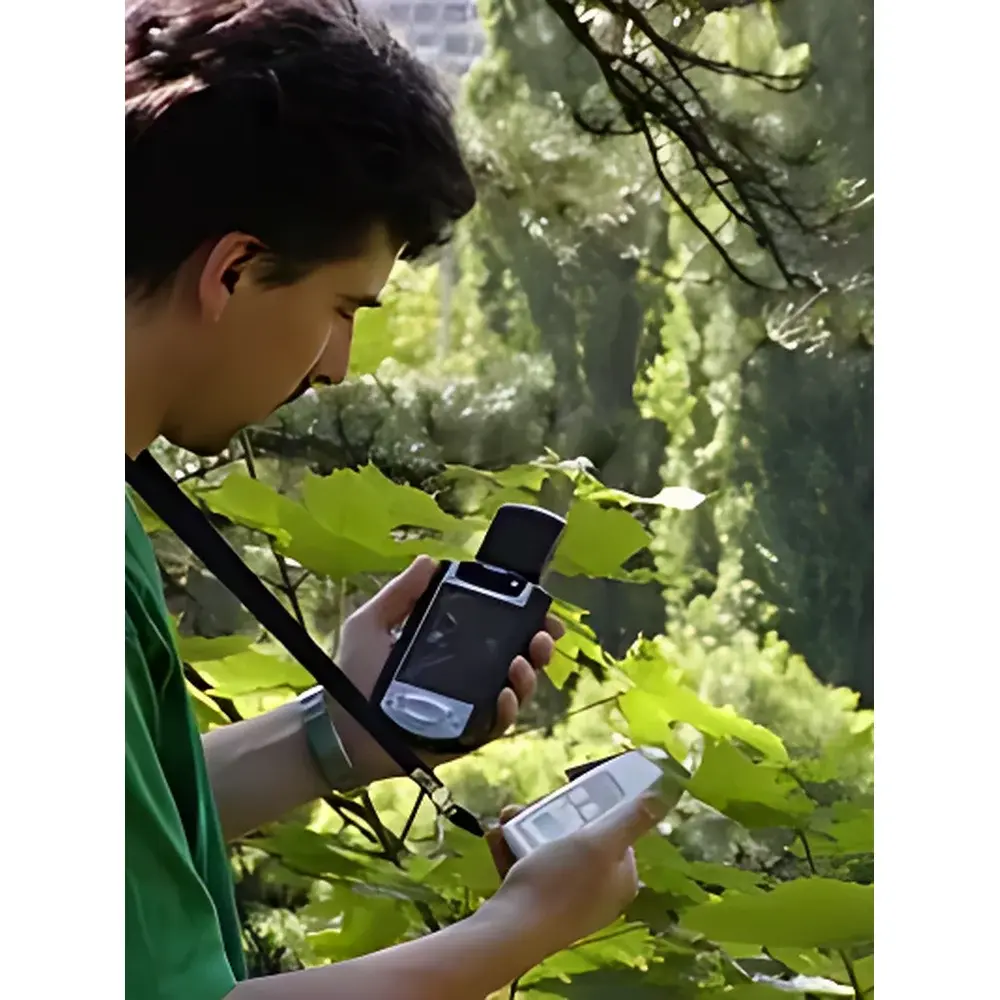
PlantPen PRI Meter (Czech-made Portable Photochemical Reflectance Index Sensor)
| Origin | Czech Republic |
|---|---|
| Manufacturer Type | Authorized Distributor |
| Origin Category | Imported Instrument |
| Model | PlantPen PRI Meter |
| Price | Upon Request |
| Measurement Principle | Dual-wavelength reflectance ratio at 531 nm and 570 nm |
| PRI Formula | (R₅₃₁ − R₅₇₀) / (R₅₃₁ + R₅₇₀) |
| Spectral Detection Range | 500–600 nm |
| Operating Temperature | 0–55 °C |
| Relative Humidity | 0–95 % RH (non-condensing) |
| Storage Conditions | −10 to 60 °C, 0–95 % RH (non-condensing) |
| Communication | Bluetooth 1.1, USB 2.0 |
| Internal Memory | 4 MB (up to 100,000 measurements) |
| Display | 2×8-character monochrome LCD |
| Keypad | Sealed, waterproof two-button interface |
| Power Supply | 4 × AA rechargeable or alkaline batteries (70 h continuous operation) |
| Auto-power-off | After 5 min idle |
| Dimensions | 120 × 57 × 30 mm (4.7″ × 2.2″ × 1.2″) |
| Weight | 180 g |
Overview
The PlantPen PRI Meter is a handheld, field-deployable optical sensor engineered for rapid, non-destructive assessment of the Photochemical Reflectance Index (PRI) in living plant foliage. Based on the well-established radiometric principle of differential reflectance at two narrowband wavelengths—531 nm and 570 nm—the instrument computes PRI = (R531 − R570) / (R531 + R570). This index serves as a sensitive proxy for the xanthophyll cycle activity and, by extension, the efficiency of photosynthetic light use under varying environmental conditions. Unlike broad-spectrum chlorophyll meters, the PlantPen PRI Meter targets a specific physiological process: the dynamic regulation of excess excitation energy via non-photochemical quenching (NPQ). Its compact design, robust enclosure, and battery-operated architecture make it suitable for repeated in situ measurements across agricultural plots, forest canopies, alpine transects, and controlled-environment growth chambers.
Key Features
- Direct, real-time PRI calculation with no post-processing required—results displayed instantly on the integrated monochrome LCD
- Dual-LED optical system with factory-calibrated 531 nm and 570 nm emitters ensuring spectral fidelity and inter-unit reproducibility
- Field-hardened mechanical design: IP65-rated sealed keypad, shock-absorbing housing, and cold-condensation-resistant optics
- Extended operational autonomy: 70 hours of continuous measurement on four standard AA cells—no external power source needed
- Onboard storage capacity of 100,000 timestamped measurements (with optional GPS tagging), eliminating reliance on external logging devices
- Flexible data retrieval via USB 2.0 cable or Bluetooth 1.1 wireless link—compatible with Windows and macOS platforms
- Configurable firmware architecture supporting user-defined indices beyond PRI, including NDVI and custom reflectance ratios
Sample Compatibility & Compliance
The PlantPen PRI Meter is optimized for intact, fully expanded leaves from herbaceous and woody species—including but not limited to Zea mays, Arabidopsis thaliana, Quercus robur, and Picea abies. It accommodates leaf thicknesses between 0.1 mm and 3.5 mm without mechanical compression artifacts. Measurements comply with established protocols for spectral vegetation index acquisition (e.g., ASTM E2615-20, ISO 17123-7:2021). While not a GLP-certified analytical instrument per se, its traceable calibration methodology and deterministic signal processing support data integrity requirements for peer-reviewed ecological and agronomic studies. The device meets CE marking directives for electromagnetic compatibility (2014/30/EU) and low-voltage safety (2014/35/EU).
Software & Data Management
Comprehensive desktop software (Windows/macOS) enables full configuration, remote triggering, live data streaming, and batch export to CSV or Excel (.xlsx) formats. Each exported record includes PRI value, acquisition timestamp, internal temperature, battery status, and—when enabled—georeferenced coordinates (WGS84). Audit trails are preserved through immutable file metadata; no data alteration occurs during export. The software supports time-series visualization, statistical summary generation (mean, SD, CV%), and alignment with external environmental logs (e.g., PAR, VPD, soil moisture). All firmware updates are digitally signed and delivered via secure HTTPS channels—ensuring version control and cybersecurity compliance for institutional deployments.
Applications
- Early detection of water deficit stress in irrigation scheduling and drought-resilience breeding programs
- Quantification of diurnal and seasonal shifts in photosynthetic efficiency across ecosystem gradients
- Validation of remote-sensing PRI products derived from UAV-mounted or satellite-based hyperspectral sensors
- Phenotyping experiments assessing genotype-by-environment interactions under controlled abiotic stress regimes
- Undergraduate and graduate teaching modules on plant ecophysiology, photobiology, and spectral remote sensing fundamentals
- Long-term monitoring of forest health in response to climate variability and air pollution exposure
FAQ
How does the PlantPen PRI Meter differ from conventional NDVI meters?
It measures a physiologically specific index tied to the xanthophyll cycle—not canopy structure or chlorophyll density. PRI responds within minutes to changes in light-use efficiency, whereas NDVI reflects longer-term pigment and biomass accumulation.
Can the device be calibrated in-house?
Yes—using certified neutral-density reflectance standards (e.g., Spectralon® 99 % white reference) and the included calibration routine. Full calibration logs are stored internally and exportable.
Is GPS integration mandatory for geotagging?
No—GPS is optional and requires an external Bluetooth-enabled receiver. When disabled, timestamps remain synchronized to the device’s internal RTC with ±2 s accuracy over 30 days.
What is the minimum leaf area required for reliable measurement?
A circular region of interest ≥12 mm diameter is recommended; smaller areas risk edge effects due to optical fringing and incomplete illumination coverage.
Does the instrument require dark adaptation before measurement?
No—measurements are valid under ambient daylight, shaded conditions, or controlled lighting. No pre-acclimation period is necessary.





