
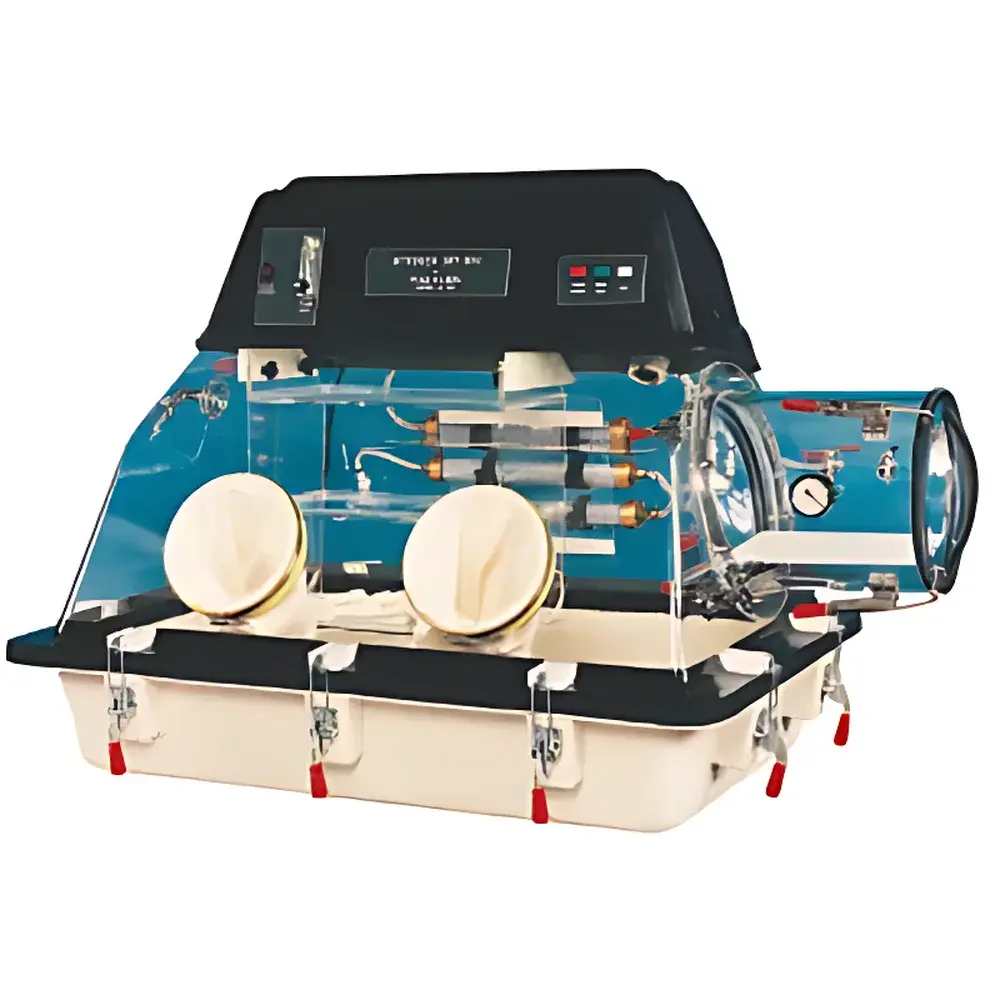
Plas-Labs 850-NB Nitrogen-Purged Dry Glove Box
| Brand | Plas-Labs |
|---|---|
| Origin | USA |
| Model | 850-NB |
| Application Type | Production-Grade Glove Box |
| Chamber Material | Acrylic (PMMA) |
| Dimensions (L×W×H) | 1400 × 890 × 970 mm |
| Chamber Volume | 489 L |
| Antechamber Volume | 18.8 L |
| Glove Quantity | 1 pair |
| Relative Humidity Control | ≤9.4% RH (typical operating condition) |
| Operating Temperature | Ambient |
| Air Exchange & Purge | Dual-membrane vacuum pump system with regenerative desiccant drying |
| Desiccant System | Three replaceable PC-mounted molecular sieve cartridges with self-sealing quick-disconnect fittings |
| Lighting | Integrated “Bright Light” LED illumination (40,000 hr rated life) |
| Exhaust Valves | Four bottom-mounted purification valves |
| Antechamber Internal Dimensions | 305 mm W × Ø280 mm |
| Main Chamber Internal Dimensions | 1040 mm W × 710 mm D × 660 mm H |
| Compliance | Designed for ISO Class 5–7 cleanroom-adjacent operation |
Overview
The Plas-Labs 850-NB is a production-grade nitrogen-purged dry glove box engineered for reproducible inert-atmosphere manipulation of moisture- and oxygen-sensitive materials. Unlike purge-only systems relying solely on continuous gas flow, the 850-NB employs an active recirculation architecture: ambient air drawn from the chamber passes through three parallel molecular sieve desiccant cartridges, removing residual moisture to sustain ≤9.4% RH under steady-state operation. This closed-loop drying mechanism—combined with dual independent vacuum隔膜 pumps servicing both the antechamber and desiccant regeneration cycle—ensures stable, low-humidity conditions without excessive nitrogen consumption. The unit is purpose-built for lithium-ion battery electrode handling, cathode/anode slurry formulation, solid-state electrolyte synthesis, and moisture-critical pharmaceutical intermediate processing where ambient humidity control below 10% RH is essential for process fidelity and material stability.
Key Features
- Monolithic acrylic (PMMA) main chamber: seamless one-piece construction eliminates seams, crevices, and microbial harborage points; optical clarity supports visual inspection and alignment-critical operations.
- Integrated “Bright Light” LED lighting system: uniform, shadow-free illumination across full chamber depth; 40,000-hour rated lifespan minimizes maintenance downtime and spectral drift over time.
- Three PC-mounted molecular sieve desiccant cartridges: field-replaceable via self-sealing quick-disconnect fittings—no pressure loss or atmosphere breach during cartridge exchange.
- Dual independent vacuum隔膜 pumps: one dedicated to antechamber evacuation (cycle time < 90 s), the other to desiccant regeneration airflow management; each pump features oil-free operation and chemical-resistant diaphragm materials.
- White Hypalon® gloves (1 pair standard): certified for resistance to UV, ozone, acids, bases, and repeated flexing; tensile strength retention >90% after 10,000 cycles per ASTM D573.
- Four bottom-mounted purification exhaust valves: enable controlled, laminar outflow during chamber purging or emergency venting; configured for connection to facility exhaust or local scrubber systems.
Sample Compatibility & Compliance
The 850-NB accommodates samples ranging from coin-cell assembly fixtures and glove-compatible weighing boats to multi-liter solvent reactors and roll-to-roll electrode calendering jigs. Its 489 L working volume and 1040 × 710 × 660 mm internal dimensions support ergonomic two-handed manipulation without spatial constraint. While the base configuration operates at ambient temperature and does not include active cooling/heating, it meets mechanical and material compatibility requirements for ISO 14644-1 Class 5–7 environments when installed in controlled rooms. The system’s passive leak integrity—verified via standardized helium leak detection protocols per ASTM E493—supports routine validation in regulated settings. Optional integration with data loggers enables compliance with FDA 21 CFR Part 11 when paired with electronic signature-capable software platforms.
Software & Data Management
The 850-NB operates as a stand-alone hardware platform with no embedded microcontroller or proprietary firmware. All operational parameters—including antechamber cycle status, desiccant saturation indicators (via optional humidity sensors), and pump duty cycles—are monitored via analog gauges and mechanical controls. For traceability-driven labs, third-party environmental monitoring systems (e.g., Vaisala, Omega, or DeltaTRAK) can be interfaced using standard 4–20 mA or RS-485 outputs (available via optional I/O module). Audit trail generation, electronic signatures, and alarm escalation require external SCADA or LIMS integration—consistent with industry-standard practices for GxP-aligned glove box deployments.
Applications
- Lithium-ion battery R&D and pilot-scale manufacturing: electrode slurry mixing, separator coating, cell assembly, and post-formation cycling under inert, low-RH conditions.
- Pharmaceutical development: handling of hygroscopic APIs, lyophilized powder reconstitution, and sterile filtration of moisture-labile excipients.
- Materials science: synthesis and characterization of metal–organic frameworks (MOFs), perovskite precursors, and air-sensitive catalysts.
- Electronics packaging: die attach, wire bonding, and encapsulation of MEMS devices requiring sub-10% RH during critical curing steps.
- Forensic and analytical chemistry: preparation of reference standards and calibration solutions sensitive to hydrolysis or oxidation.
FAQ
Does the 850-NB include oxygen monitoring capability?
No—the base model provides nitrogen purging and moisture removal only. Oxygen analyzers (e.g., electrochemical or zirconia-based sensors) are available as factory-installed options or retrofittable accessories.
Can the system be upgraded to accommodate four gloves?
Yes—the 850-NBB variant offers dual workstation configuration with four Hypalon gloves and independent antechamber access; structural reinforcement and airflow redistribution are included in that design.
What maintenance intervals are recommended for the desiccant cartridges?
Under continuous operation at 25°C and 50% ambient RH, molecular sieve cartridges typically require replacement every 6–12 months; actual service life depends on cumulative moisture load and regeneration frequency.
Is the acrylic chamber resistant to common battery electrolyte solvents?
Standard PMMA exhibits limited resistance to carbonate-based solvents (e.g., EC/DMC); extended exposure may cause stress cracking. For aggressive solvent handling, Plas-Labs recommends optional chamber lining with fluoropolymer-coated stainless steel or consultation for chemically resistant alternatives.
How is leak integrity validated during installation?
Factory-certified helium leak testing (≤1 × 10⁻⁶ mbar·L/s sensitivity) is performed pre-shipment. Field verification follows ASTM E493 using calibrated helium mass spectrometry; documentation templates are provided for QA record retention.
Related Products



