
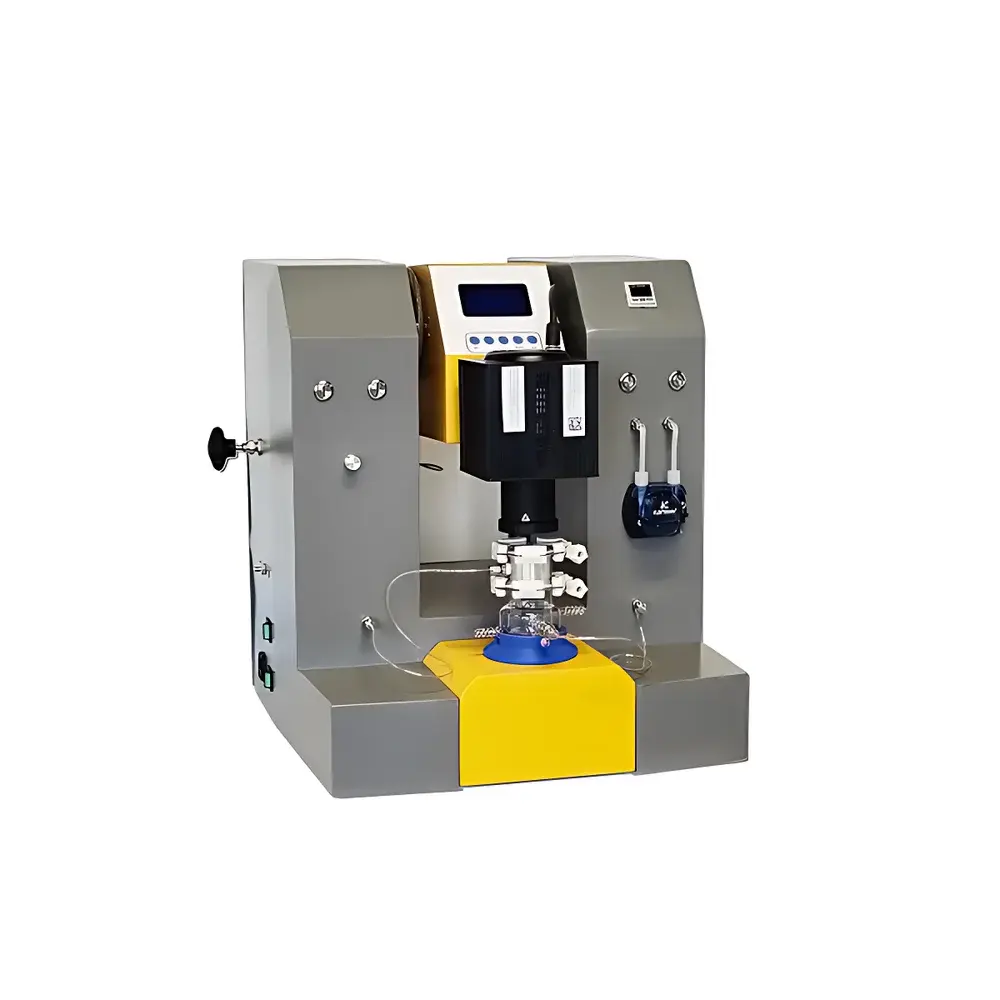
PLC-GDHC I Gas Diffusion Multiphase Continuous-Flow Photocatalytic Reaction Platform
| Brand | PerfectLight |
|---|---|
| Origin | Beijing, China |
| Model | PLC-GDHC I |
| Flow Control Range | 3–100 mL/min (1 gas inlet standard) |
| Temperature Range | 5–80 °C (thermostatic bath controlled) |
| Pressure Rating | 0.2 MPa (gauge) |
| Pressure Measurement Range | −1 to 1 MPa (gauge), ±0.25% F.S. |
| Pressure Control Range | −0.08 to 0.3 MPa |
| Pressure Stability | ±0.01 MPa |
| Light Source | Integrated white LED (400–800 nm), motorized vertical adjustment |
| Optical Window Transmission | 0.19–5 μm, Ø35 mm |
| Reactor Gas Volume | 120 mL |
| Max Liquid Fill Volume | 10 mL |
| Catalyst Loading | Powder catalysts evenly spread on hydrophobic porous gas diffusion layer (GDL), GDL diameter: Φ35 mm (effective), Φ37–Φ40 mm (overall) |
| Main Body Material | High-temp powder-coated metal chassis |
| Gas Diffusion Chamber | Anodized aluminum |
| Inlet Chamber | Borosilicate glass |
Overview
The PLC-GDHC I Gas Diffusion Multiphase Continuous-Flow Photocatalytic Reaction Platform is an engineered system designed for rigorous investigation of heterogeneous photocatalytic processes involving gaseous reactants and solid catalysts under controlled illumination. It operates on the principle of continuous-flow gas-phase photocatalysis, where reactive gases—such as CO₂, N₂, CH₄, or volatile organic compounds—are introduced into a sealed reaction chamber, diffused uniformly across a catalyst bed via a precision-engineered hydrophobic gas diffusion layer (GDL), and exposed to tunable visible-light irradiation. Unlike batch reactors, this platform enables steady-state kinetic analysis, improved mass transfer efficiency, and reproducible gas–solid interfacial contact—critical for quantifying quantum yield, turnover frequency (TOF), and long-term catalyst stability. Its architecture integrates thermal regulation (5–80 °C), precise pressure management (−0.08 to 0.3 MPa gauge), and optical compatibility across deep-UV to near-IR (0.19–5 μm), making it suitable for fundamental mechanistic studies and protocol development aligned with ASTM E2938 (standard guide for photocatalytic activity testing) and ISO 22197-1 (photocatalytic air-purification performance).
Key Features
- Gas diffusion layer (GDL) optimized for uniform gas distribution and minimized concentration polarization at the catalyst surface—enabling consistent gas–solid interaction during prolonged operation.
- High-efficiency gas recirculation loop achieving full system homogenization in less than 10 minutes, supporting dynamic equilibrium studies and transient response characterization.
- Modular light source integration with motorized vertical positioning and interchangeable spectral modules (e.g., narrowband LEDs, UV lamps, or laser diodes), facilitating wavelength-dependent action spectrum analysis.
- Robust mechanical construction: borosilicate glass inlet chamber for optical access and chemical inertness; anodized aluminum gas diffusion chamber for thermal stability and corrosion resistance; 316L stainless steel fluidic components compliant with high-purity gas handling standards.
- Integrated pressure and temperature monitoring with digital feedback control, meeting requirements for GLP-compliant experimental logging when paired with validated data acquisition software.
Sample Compatibility & Compliance
The PLC-GDHC I accommodates powdered heterogeneous photocatalysts—including TiO₂, g-C₃N₄, MOFs, perovskites, and doped oxides—loaded directly onto the hydrophobic GDL. Liquid co-reactants (e.g., H₂O vapor, methanol, or aqueous sacrificial agents) may be introduced via controlled humidification or micro-dosing without compromising gas-phase kinetics. The system supports operation under mild positive or negative gauge pressures, enabling studies under sub-atmospheric conditions relevant to vacuum-assisted desorption or elevated-pressure CO₂ reduction. All wetted materials meet USP Class VI biocompatibility criteria; pressure transducers are calibrated to ISO/IEC 17025-accredited standards. The platform is compatible with ISO 17025-aligned validation protocols and supports audit-ready metadata generation for regulatory submissions under FDA 21 CFR Part 11 when integrated with compliant software.
Software & Data Management
While the base configuration operates via front-panel controls and analog signal outputs, optional digital interfaces (RS-485, USB, or Ethernet) enable connection to third-party SCADA or LabVIEW-based acquisition systems. Real-time logging of temperature, pressure, flow rate, and lamp intensity is supported at 1 Hz resolution. Data export formats include CSV and HDF5, ensuring interoperability with Python-based kinetic modeling frameworks (e.g., Cantera, Pyomo) and statistical analysis tools (e.g., OriginPro, MATLAB). Optional firmware upgrades provide automated sequence programming—such as multi-step pressure ramps, timed light-on/off cycles, or synchronized gas switching—for unattended overnight experiments adhering to OECD Test Guideline 121 (adsorption/desorption screening).
Applications
- Photocatalytic CO₂ reduction to CO, CH₄, or C₂H₄ under simulated solar illumination and controlled water vapor partial pressure.
- Light-driven nitrogen fixation to NH₃ using earth-abundant catalysts, with real-time NH₃ quantification via online FTIR or electrochemical sensors.
- Gas-phase photocatalytic degradation of NOₓ, formaldehyde, or benzene—evaluated per ISO 22197-2 for indoor air purification efficacy.
- Kinetic isotope effect (KIE) studies using ¹³CO₂ or D₂O to probe rate-determining steps in multi-electron transfer reactions.
- Accelerated aging tests of photocatalyst durability under cyclic thermal–photo–pressure stress conditions.
FAQ
Can the PLC-GDHC I accommodate corrosive gases such as HCl or Cl₂?
Yes—provided appropriate material substitutions are implemented (e.g., Hastelloy valves, fluoropolymer-sealed GDL), and gas purification trains are used upstream to prevent condensate formation.
Is the optical window compatible with excimer lasers operating at 193 nm?
Yes—the fused silica optical window transmits down to 0.19 μm (190 nm) with >85% transmission at 193 nm, enabling deep-UV photoactivation studies.
How is catalyst deactivation monitored during extended runs?
By coupling the platform with inline GC-TCD/FID or real-time MS detection, users can track product selectivity shifts and quantify carbon balance loss over time.
Does the system support simultaneous liquid and gas feed introduction?
It supports vapor-phase liquid introduction (e.g., ethanol/water vapor) via saturator modules; direct liquid injection into the gas stream requires optional misting accessories to avoid GDL flooding.
What calibration certificates are supplied with the instrument?
Each unit ships with factory calibration reports for pressure transducers (traceable to NIST standards) and temperature sensors (IEC 60751 Class A), plus a material compliance dossier detailing RoHS, REACH, and CE conformity.



