
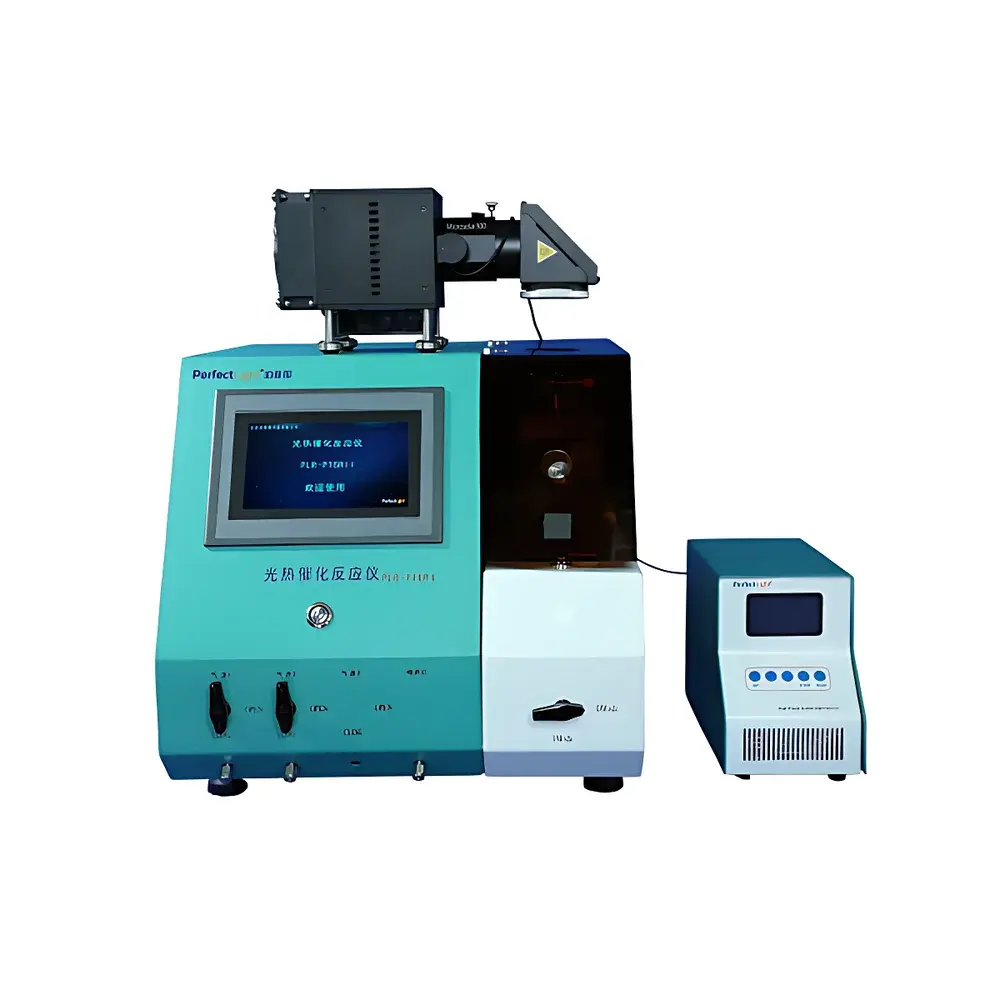
PLR-PTSRⅡ Photothermal Catalytic Reaction System
| Brand | PerfectLight |
|---|---|
| Origin | Beijing, China |
| Model | PLR-PTSRⅡ |
| Reactor Type | Flow-through / Batch-integrated Photothermal Reactor |
| Volume | 18 mL (gas phase, sealed mode) |
| Max Operating Pressure | 1.6 MPa (gauge) |
| Max Temperature | 550°C (N₂ atmosphere) |
| Material | 304 Stainless Steel |
| Optical Window | Ø35 mm, Transmission Range: 0.19–5 μm |
| Gas Flow Control Range | 3–60 mL/min, ±1% F.S. |
| Pressure Control Range | 0.3–1.6 MPa |
| Temperature Control Resolution | ±0.1°C |
| Catalyst Format | Powder-on-membrane or porous disc (Ø51 mm, ≤5.5 mm thick) |
| Humidification Capability | Yes, liquid water injection supported |
| Heating Modes | Electrical, Photoirradiation (Xe lamp compatible), or Coupled Photothermal |
Overview
The PLR-PTSRⅡ Photothermal Catalytic Reaction System is a precision-engineered benchtop reactor platform designed for fundamental and applied research in heterogeneous photocatalysis, thermocatalysis, and synergistic photothermal catalysis under controlled gas-phase conditions. It operates on the principle of simultaneous or sequential irradiation (via external high-intensity xenon light sources) and resistive heating to enable precise decoupling or coupling of photon and thermal energy inputs—critical for mechanistic studies of surface reaction pathways in CO₂ reduction, NH₃ synthesis, VOC oxidation, and sulfur/nitrogen fixation. The system supports both differential-flow (steady-state kinetic analysis) and integral-batch (time-resolved product accumulation) operational modes within a single, modular stainless-steel architecture. Its core design emphasizes optical accessibility, thermal uniformity, and gas-phase mass transport fidelity—achieving high photon flux delivery to catalyst surfaces via a large-diameter (Ø35 mm), broadband quartz window (transmission: 190 nm–5 µm), while maintaining mechanical integrity up to 1.6 MPa and thermal stability to 550°C under inert carrier gas (N₂).
Key Features
- Triple-mode heating capability: independent or synchronized electrical resistance heating, photoirradiation (compatible with standard 300–1000 W xenon arc lamps), and photothermal coupling with programmable thermal profiles (up to 8 segments).
- High-optical-access reactor chamber fabricated from ASTM A240 304 stainless steel, rated for 1.6 MPa working pressure and resistant to corrosion by common catalytic feed gases (CO₂, H₂, NH₃, O₂, NOₓ, H₂O vapor).
- Integrated optical window with certified transmission across UV-Vis-NIR (190 nm–5 µm), enabling full-spectrum photocatalytic excitation and in situ spectroscopic compatibility (e.g., DRIFTS, Raman).
- Dual-mode gas handling: differential flow operation (3–60 mL/min, ±1% F.S.) with optional multi-channel mass flow controllers (1–3 lines), and sealed batch mode with total gas volume configurable between 18–35 mL depending on valve configuration.
- In-situ humidification port permitting controlled liquid water injection for steam-assisted or hydrolytic reaction studies without compromising pressure integrity.
- K-type thermocouple-based temperature sensing (0–900°C range) with ±0.1°C resolution and active PID control; surface temperature monitoring option available for direct catalyst bed measurement.
Sample Compatibility & Compliance
The PLR-PTSRⅡ accommodates heterogeneous catalysts in two primary formats: (1) powder catalysts immobilized on custom-supported membranes (diameter Ø37–50 mm, minimum effective area ≥ Ø35 mm), and (2) freestanding porous discs (Ø51 mm, thickness ≤5.5 mm). Thermal expansion constraints are explicitly defined for low-CTE materials to ensure dimensional stability at elevated temperatures. All wetted components comply with ISO 8502-3 surface cleanliness standards for metallic reactors. While not certified to ASME BPVC Section VIII Div. 1, the system adheres to EN 13445-1 design principles for unfired pressure equipment and incorporates dual redundant pressure relief mechanisms. It supports GLP-compliant experimental execution when paired with validated data acquisition systems meeting FDA 21 CFR Part 11 requirements for electronic records and signatures.
Software & Data Management
The system interfaces with industry-standard SCADA platforms via RS485/Modbus RTU or optional Ethernet/IP protocols. Real-time logging of temperature, pressure, flow rate, and lamp power is performed at ≥1 Hz sampling frequency. Data export conforms to ASTM E1461-compliant CSV and HDF5 formats, enabling seamless integration with kinetic modeling tools (e.g., MATLAB Reaction Engineering Toolbox, Cantera). Optional software modules include automated sequence programming for multi-step photothermal ramps, pressure hold-and-ramp protocols, and time-synchronized gas chromatography trigger signals. Audit trails record all parameter changes, user logins, and calibration events—fully traceable for GMP-aligned reporting.
Applications
- Photothermal CO₂ hydrogenation to CH₄, CO, or C₂₊ hydrocarbons under tunable light/heat ratios.
- Plasmon-enhanced ammonia synthesis via N₂ dissociation on Ru/TiO₂ or Fe-based catalysts under sub-ambient pressures.
- Gas-phase photocatalytic oxidation of formaldehyde, benzene, or chlorinated VOCs in air streams at ppm-level concentrations.
- Thermally assisted photocatalytic desulfurization of model diesel fractions using ZnIn₂S₄ or MoS₂ heterostructures.
- Kinetic isotope effect (KIE) studies in H/D exchange reactions under simultaneous UV irradiation and controlled thermal activation.
FAQ
Is the PLR-PTSRⅡ compatible with vacuum operation?
No—this system is engineered for positive-pressure operation only; it does not support vacuum or negative-gauge conditions.
Can liquid-phase reactants be introduced directly into the reactor chamber?
Yes, up to 1.5 mL of liquid (e.g., water, alcohols) may be injected via the humidification port for co-feed or steam-generation studies, subject to temperature- and pressure-dependent vapor pressure limits.
What light sources are recommended for optimal spectral match?
Standard 300–1000 W xenon arc lamps with AM1.5G filters or adjustable monochromators are validated; UV-enhanced lamps (e.g., Ushio XBO series) are supported for deep-UV-driven reactions.
Does the system include catalyst mounting fixtures?
Yes—standard fixtures for Ø51 mm disc catalysts and membrane-mounting clamps for Ø37–50 mm supported films are supplied with each unit.
Is third-party calibration documentation provided?
Factory calibration certificates for pressure transducers (±0.25% F.S.), flow meters (±1% F.S.), and thermocouples (NIST-traceable) are included; on-site verification services are available upon request.



