
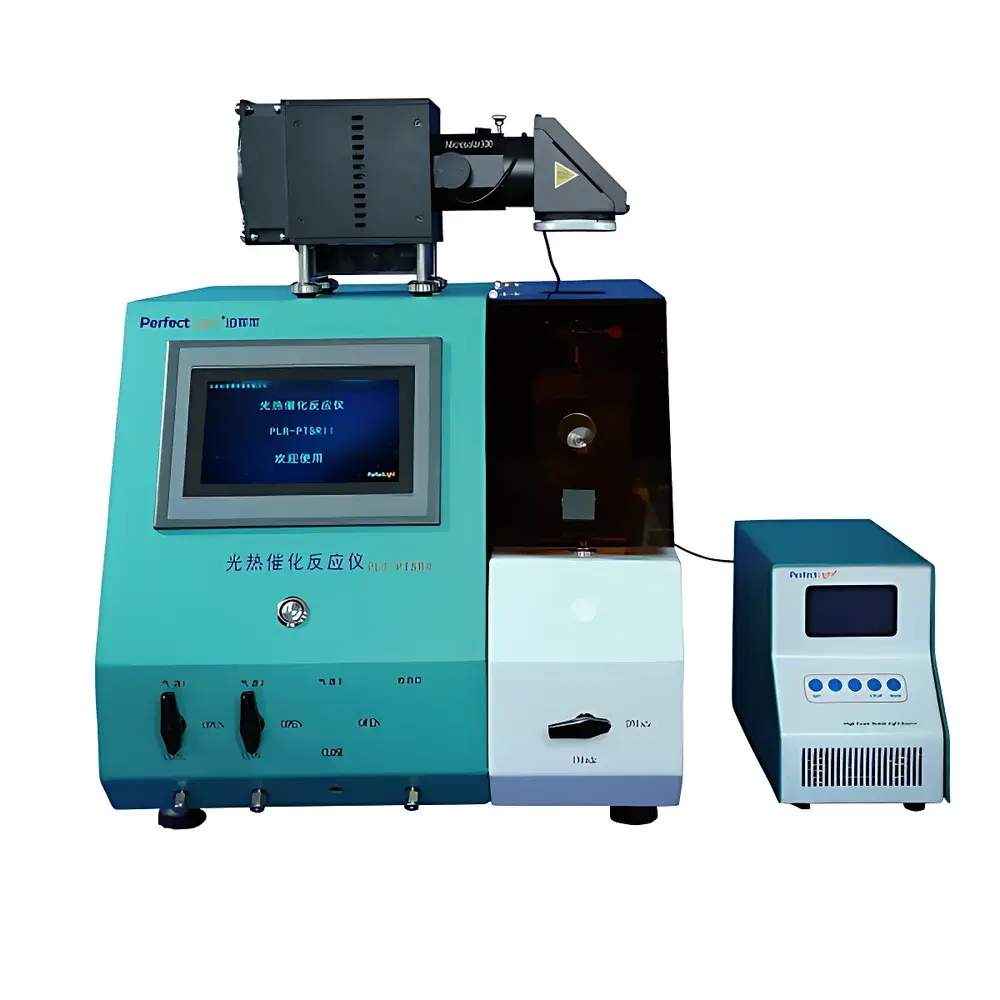
PLR-PTSR II Photothermal Catalytic Reaction System
| Brand | PerfectLight (PerfekLight) |
|---|---|
| Origin | Beijing, China |
| Model | PLR-PTSR II |
| Reaction Pressure | 1.6 MPa (gauge) |
| Maximum Reaction Temperature | 550 °C |
| Catalyst Bed Volume | 12 mL |
| Reactor Material | 304 Stainless Steel |
| Optical Window Transmission Range | 0.19–5 μm |
| Optical Window Diameter | Ø35 mm |
| Gas Volume (Differential Mode) | ~35 mL |
| Gas Volume (Integral Mode) | ~27 mL |
| Liquid Loading Capacity | ≤1.5 mL |
| Catalyst Forms | Powder-on-membrane or porous disc (Ø51 mm, ≤5.5 mm thick) |
| Membrane Support Size | Ø37–Ø50 mm, effective area ≥Ø35 mm |
| Mass Flow Control Range | 3–60 mL/min, ±1% FS |
| Pressure Control Range | 0.3–1.6 MPa (gauge), ±0.25% FS |
| Temperature Control Range | Ambient to 550 °C (N₂), resolution ±0.1 °C |
| Heating Modes | Electric, Photoirradiation, or Coupled Photothermal |
| Temperature Program | Up to 8 segments (isothermal, constant-power, or ramped profiles) |
Overview
The PLR-PTSR II Photothermal Catalytic Reaction System is a precision-engineered benchtop platform designed for quantitative investigation of heterogeneous gas–solid phase catalytic processes under simultaneous light and thermal excitation. It operates on the principle of controlled photothermal reaction kinetics—where photon absorption by catalysts (e.g., plasmonic nanoparticles, doped oxides, or MOFs) synergistically enhances surface reactivity alongside thermally driven elementary steps. Engineered for reproducible operation up to 550 °C and 1.6 MPa (gauge), the system supports both differential-flow (steady-state) and integral-batch (transient) reaction modes—enabling rigorous kinetic modeling, catalyst deactivation studies, and structure–activity correlation under industrially relevant conditions. Its modular architecture integrates calibrated mass flow control, high-fidelity pressure regulation, and multi-mode temperature management—all synchronized with broadband optical irradiation (compatible with Xe-arc lamps covering 0.19–5 μm). The system meets foundational requirements for ISO/IEC 17025-compliant catalysis laboratories and supports method development aligned with ASTM E2932 (photocatalytic CO₂ reduction) and USP analytical instrument qualification principles.
Key Features
- High-illumination-efficiency reactor geometry: Optimized internal reflectivity and axial light path alignment ensure >85% incident photon utilization across the catalyst bed, minimizing shadowing and enabling uniform photoexcitation.
- Dual-mode gas handling: Differential-flow configuration (3–60 mL/min, ±1% FS) enables steady-state rate measurements; integral mode (27 mL volume) facilitates transient response analysis and adsorption/desorption profiling.
- Robust pressure–temperature co-control: Integrated 304 stainless steel reactor withstands 1.6 MPa (gauge) with active pressure regulation (0.3–1.6 MPa, ±0.25% FS) and K-type thermocouple feedback (0–900 °C, ±0.1 °C resolution).
- Flexible sample integration: Accommodates powder catalysts immobilized on custom membranes (Ø37–Ø50 mm) or freestanding porous discs (Ø51 mm, ≤5.5 mm thick); optional humidification module enables controlled H₂O co-feed for hydrolysis-inclusive mechanisms.
- Multi-parameter synchronization: Independent control of irradiance intensity, heating power, and gas composition allows decoupled or coupled photothermal protocols—including 8-segment programmable temperature ramps, isothermal holds, or constant-photon-flux modes.
Sample Compatibility & Compliance
The PLR-PTSR II accepts solid-phase catalysts in supported powder or monolithic disc formats, with strict dimensional tolerances (e.g., membrane diameter ≥Ø35 mm, thickness ≤5.5 mm) to maintain thermal and optical homogeneity. Liquid precursors (≤1.5 mL) may be introduced at ambient conditions prior to pressurization and heating. The system complies with ASME B31.3 process piping design guidelines for low-pressure reactors and incorporates fail-safes including burst-disc protection and redundant pressure transducers. All wetted parts are electropolished 304 stainless steel, certified per ASTM A240 for corrosion resistance in oxidizing and mildly acidic gas environments (e.g., CO₂/H₂O/O₂ mixtures). Data acquisition adheres to ALCOA+ principles—ensuring attributable, legible, contemporaneous, original, accurate, complete, consistent, enduring, and available records—supporting GLP/GMP audit readiness and FDA 21 CFR Part 11 compliance when paired with validated software.
Software & Data Management
The system interfaces via RS485/Modbus RTU with optional PC-based control software (Windows 10/11 compatible), providing real-time visualization of temperature, pressure, flow rates, and lamp power. Raw sensor data are timestamped and stored in CSV or HDF5 format with metadata embedding (user ID, method name, calibration certificates). Software modules support automated sequence execution (e.g., light-on → ramp-to-T → introduce reactant → collect effluent), baseline correction, and export-ready kinetic plots (conversion vs. time, Arrhenius analysis, quantum yield estimation). Audit trails record all parameter changes, user logins, and calibration events—meeting ISO/IEC 17025 clause 7.7.1 requirements for measurement traceability.
Applications
- Photothermal CO₂ hydrogenation to CH₄, CO, or C₂₊ hydrocarbons under syngas-relevant pressures (1–1.6 MPa)
- Light-assisted NH₃ synthesis via Li-mediated N₂ splitting at sub-400 °C
- Oxidative degradation of VOCs (e.g., formaldehyde, toluene) in humid air streams
- Sulfur capture and photocatalytic SO₂ oxidation over TiO₂–CeO₂ composites
- Transient isotopic labeling (¹³CO₂, D₂O) for mechanistic probing of surface intermediates
FAQ
What light sources are compatible with the PLR-PTSR II?
The system is optimized for 300–1500 W xenon arc lamps with quartz or fused silica optics; collimated beam delivery through the Ø35 mm UV–NIR-transmissive window ensures uniform irradiance across the catalyst bed.
Can liquid-phase co-reactants be introduced during operation?
Yes—pre-loaded liquids (≤1.5 mL) may be vaporized in situ under controlled heating; continuous liquid injection requires optional syringe pump integration and vaporizer pre-heating.
Is the system suitable for long-term stability testing?
With continuous monitoring of pressure decay, temperature drift (<±0.5 °C over 24 h), and flow consistency, the PLR-PTSR II supports 100+ hour catalyst durability assessments under photothermal stress.
How is catalyst loading standardized across experiments?
The 12 mL catalyst bed volume is defined geometrically between fixed quartz frits; gravimetric loading (±0.1 mg) and BET surface area verification are recommended prior to kinetic runs.
Does the system support reactive gas mixtures beyond CO₂ and N₂?
Yes—up to three independently controlled gas lines (optional) accommodate H₂, O₂, NH₃, or corrosive gases (e.g., H₂S) when configured with chemically resistant seals and flow sensors.



