
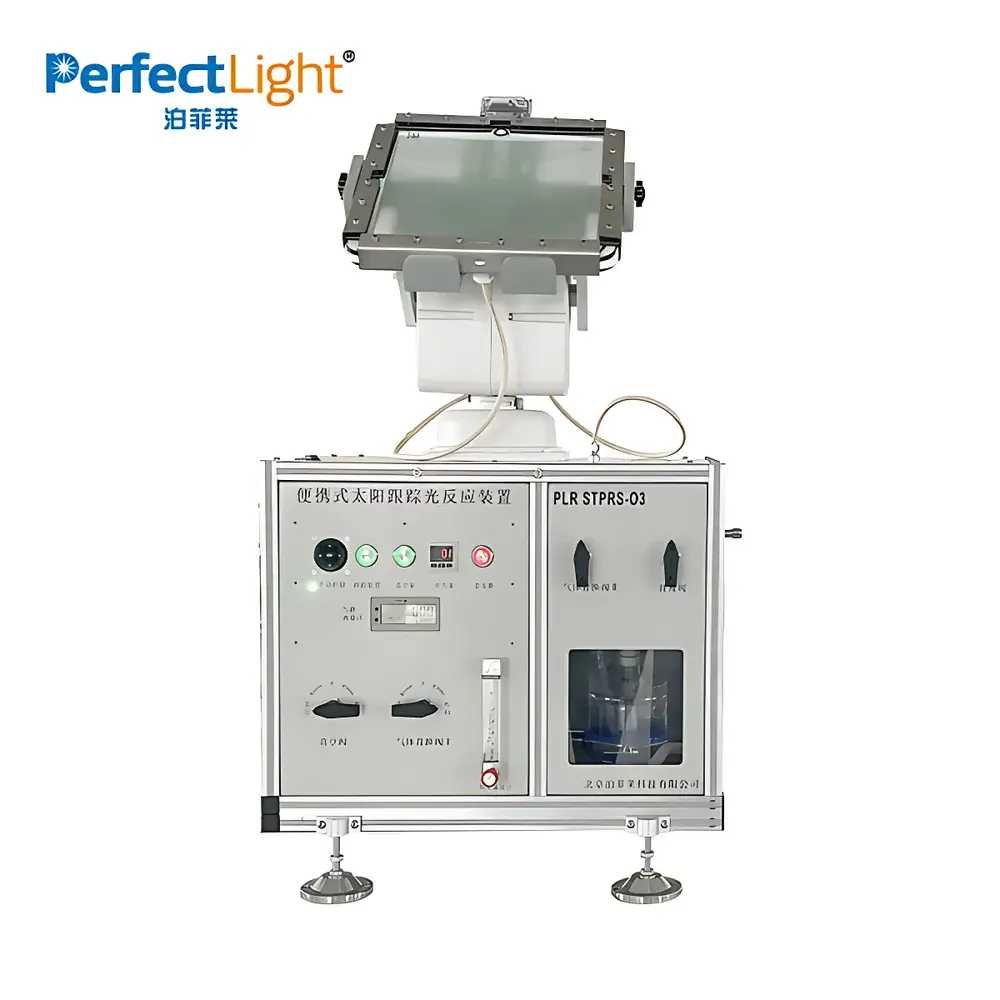
PLR STPRS-O3 Portable Solar-Tracking Photoreactor System
| Brand | PerfectLight (PoFeiLai) |
|---|---|
| Origin | Beijing, China |
| Model | PLR STPRS-O3 |
| Tracking Actuation | Photoelectric Auto-Tracking & Manual Override |
| Pan Range | 0–210° (adjustable reference) |
| Tilt Range | 0–90° |
| Reactor Active Area | 250 × 250 mm |
| Optical Window | Ultra-White Glass |
| Diffuser Plate | Frosted Glass |
| Adjustable Liquid Layer Thickness | 3 mm |
| Tubing Dimensions | 4 × 6 mm (ID × OD) |
| Operating Pressure Range | −60 to +20 kPa (with automatic pressure relief >20 kPa) |
| Reaction Vessel Materials | Borosilicate Glass, Fluoropolymer (FEP/PFA), Silicone Elastomer, 316 Stainless Steel |
| Liquid Reservoir Volume | ~300 mL |
| Gas Flow Measurement | Standard Mass Flow Controller (H₂, 0–20 sccm) |
| Liquid Flow Control | Rotameter (0–1 L/min), recommended ≥100 mL/min |
| Gas Inlet Pressure Limit | <0.1 MPa |
| Ambient Operation Temperature | 15–35 °C |
Overview
The PLR STPRS-O3 Portable Solar-Tracking Photoreactor System is an engineered field-deployable platform designed for quantitative solar-driven photocatalytic reaction studies under real-world insolation conditions. It operates on the principle of incident photon flux utilization—capturing direct and diffuse solar irradiance via a precisely aligned, motorized two-axis tracking mount and delivering it through a high-transmittance optical window onto a planar, liquid-phase photocatalytic reactor. Unlike fixed-angle or simulated-light benchtop systems, the STPRS-O3 enables time-resolved kinetic analysis of gas-evolving reactions (e.g., H₂ evolution, CO₂ reduction, O₂ generation) under natural spectral distribution and diurnal intensity variation. Its structural architecture prioritizes mechanical stability in outdoor environments while maintaining optical fidelity, chemical inertness, and operational safety across variable atmospheric conditions.
Key Features
- Two-axis photoelectric solar tracker with programmable azimuth (0–210°) and elevation (0–90°) control—enabling continuous alignment within ±0.5° of true solar position throughout daylight hours.
- Modular, foldable mechanical frame constructed from anodized aluminum alloy—designed for rapid assembly/disassembly and transport in standard field equipment cases (total system mass ≤10 kg).
- Flat-plate photoreactor with 250 × 250 mm active illumination area, sealed by ultra-white glass (transmittance >91.5% at 300–1100 nm) and backed by a frosted glass diffuser plate to homogenize incident irradiance distribution.
- Adjustable liquid-layer thickness (fixed at 3 mm nominal) ensures consistent optical path length and reproducible photon absorption profiles across repeated experiments.
- Integrated gas separation and volumetric quantification subsystem—including gas-liquid membrane separator, calibrated wet-test meter, and optional digital mass flow controller (H₂, 0–20 sccm)—supporting stoichiometric yield calculation with ±2% volumetric repeatability.
- Pressure-regulated reaction chamber capable of operation under vacuum (−60 kPa gauge) or mild overpressure (up to +20 kPa), with passive pressure-relief valve activation above threshold to prevent seal failure or glass fracture.
Sample Compatibility & Compliance
The PLR STPRS-O3 accommodates heterogeneous photocatalysts immobilized on conductive substrates (e.g., FTO/ITO glass, Ti mesh) or suspended as colloidal dispersions (e.g., TiO₂ P25, g-C₃N₄, MOF-based composites) in aqueous or organic solvent systems. All wetted components—including reaction chamber walls, tubing (FEP/PFA), seals (fluoroelastomer), and reservoir bottles (borosilicate glass)—are chemically resistant to common photocatalytic media (pH 2–12, oxidizing/reducing agents). The system complies with ISO 17025-relevant traceability requirements for gas volume measurement when used with NIST-traceable rotameters or certified MFCs. Vacuum integrity meets ASTM E471 specifications for low-pressure leak testing; pressure relief functionality aligns with EN 851-2 guidelines for laboratory-scale pressurized reaction vessels.
Software & Data Management
While the base configuration operates via analog controls and manual data logging, optional USB-connected environmental sensors (pyranometer, ambient temperature/humidity, module surface temperature) interface with open-source Python-based acquisition scripts (provided). Timestamped irradiance and gas evolution data can be exported to CSV or HDF5 formats for post-processing in MATLAB, Origin, or Jupyter environments. Audit trails for operator inputs, pressure events, and tracking status are recorded locally on microSD card—supporting GLP-aligned documentation workflows. No proprietary cloud service or vendor-locked firmware is employed; all firmware binaries are publicly verifiable via SHA-256 checksums.
Applications
- Outdoor validation of solar hydrogen production efficiency using Pt/TiO₂, NiS/CdS, or perovskite-based photocatalysts.
- Field assessment of CO₂ photoreduction selectivity toward CH₄, CO, or C₂H₄ under unfiltered AM1.5G irradiance.
- Long-term stability testing of photocorrosion-resistant catalysts (e.g., BiVO₄/WO₃ heterojunctions) under cyclic UV–vis exposure.
- Comparative quantum yield determination across geographic latitudes and seasonal solar angles—enabling correction of lab-to-field performance gaps.
- Educational deployment in university environmental engineering field courses for hands-on renewable energy experimentation.
FAQ
Can the system operate autonomously for multi-day unattended experiments?
Yes—when paired with a 12 V DC power bank (≥20 Ah) and optional environmental sensor suite, the tracker and flow controls maintain stable operation for up to 72 h without intervention. Battery voltage and pressure status are monitored via LED indicators.
Is calibration of the gas measurement subsystem required before each use?
Rotameter-based flow measurement requires zero-point verification prior to each campaign using dry air at ambient temperature; MFC-equipped units retain factory calibration valid for 12 months per ISO 6145-7.
What maintenance intervals are recommended for outdoor deployment?
Optical window cleaning every 48 h in dusty environments; annual replacement of silicone O-rings and inspection of gearmotor lubrication points per manufacturer’s technical bulletin TB-STPRS-03.
Does the system support integration with third-party data loggers or SCADA platforms?
All analog outputs (0–5 V tracking angle signals, 4–20 mA pressure transducer output) conform to IEC 61000-4-5 surge immunity standards and are compatible with Campbell Scientific CR1000X or Siemens Desigo CC gateways.
Are replacement parts—such as the ultra-white glass window or FEP tubing—available as standalone SKUs?
Yes—PerfectLight provides full mechanical drawings and RoHS-compliant part numbers for all consumables and wear components under extended warranty support (36 months from date of shipment).



