
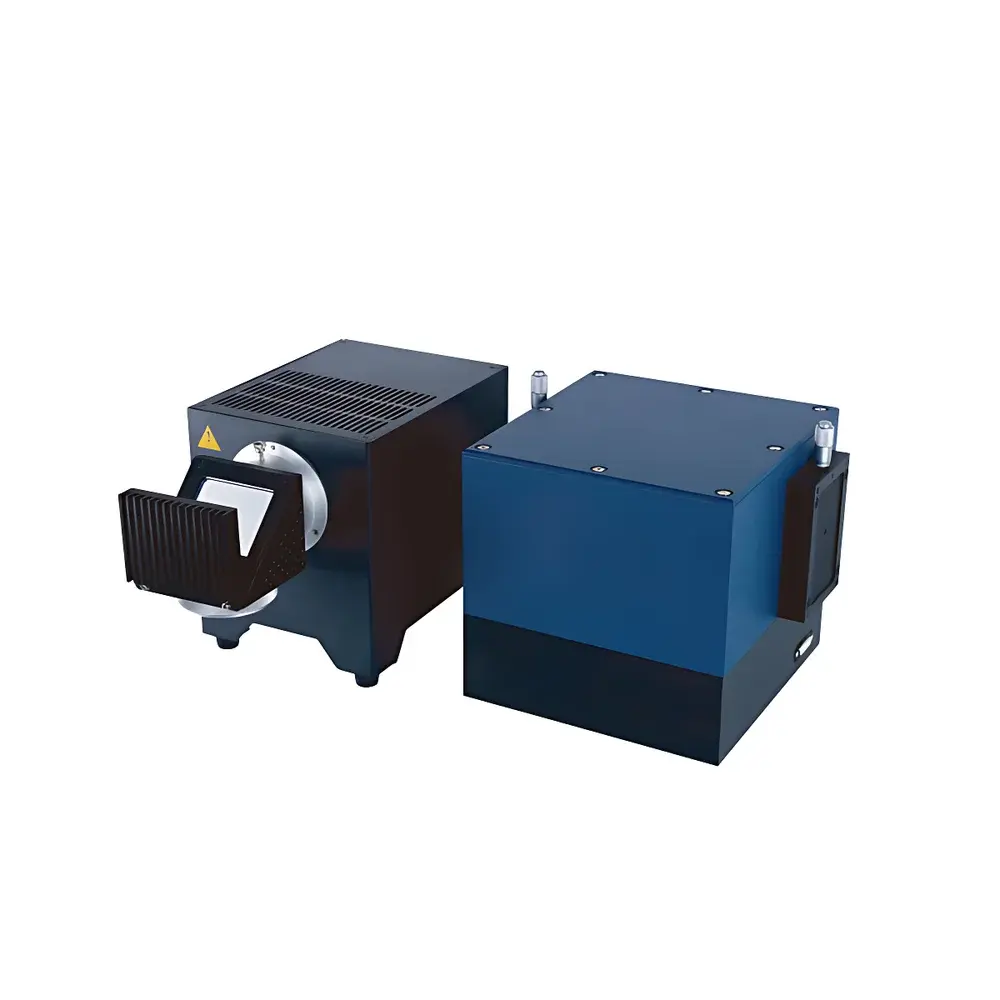
PLS-AL150300 PerfectLight Tunable Monochromatic Light Source with Xenon Lamp
| Brand | PerfectLight |
|---|---|
| Origin | Beijing, China |
| Model | PLS-AL150300 |
| Light Source Type | Xenon Lamp |
| Illumination Mode | External Irradiation |
| Focal Length | 150 mm |
| f-number | f/2.5 |
| Stray Light Level | 5×10⁻⁴ |
| Wavelength Step Resolution | 1 nm |
| Grating Type | Imported Dual Grating |
| Grating Active Area | 45×45 mm² |
| Groove Density | 2400 lines/mm (multiple options available) |
| Blaze Wavelengths | #1: 300 nm, #2: 780 nm |
| Output Wavelength Range | 350–750 nm |
| Slit Width Adjustment | 0.01–3 nm (continuous manual) |
| Optional Motorized Filter Wheel | 4-position, anti-second-order-diffraction filters |
Overview
The PLS-AL150300 is a high-performance, motorized monochromator-based tunable light source engineered for precision photonic characterization in research-grade optical laboratories. Built around a stabilized 150 W short-arc xenon lamp and a dual-grating monochromator system, it delivers spectrally pure, continuously adjustable output across the visible and near-UV spectral range (350–750 nm). Its optical architecture follows Czerny-Turner configuration with optimized collimation and focusing optics (f/2.5, 150 mm focal length), enabling high throughput while maintaining excellent wavelength fidelity and minimal spectral contamination. The system operates on the principle of angular dispersion via ruled diffraction gratings—selectively isolating narrowband radiation through precise grating rotation and slit-controlled bandwidth definition. This makes it especially suitable for applications demanding quantitative photon flux control, such as action spectrum determination, quantum yield measurement, and spectral responsivity calibration.
Key Features
- High spectral purity achieved through dual-grating design and stray light suppression (<5×10⁻⁴), minimizing higher-order contributions and background noise.
- Continuous wavelength tuning from 350 nm to 750 nm with 1 nm step resolution, ensuring compatibility with broad-band photoelectrochemical (PEC) and optoelectronic device evaluation protocols.
- Manually adjustable entrance and exit slits (0.01–3 nm continuous range), allowing dynamic control over spectral bandwidth and irradiance trade-offs without hardware replacement.
- Imported 2400 grooves/mm blazed gratings (300 nm and 780 nm blaze options) mounted on precision rotation stages, providing optimal efficiency across UV–VIS regions.
- Modular integration capability: supports optional 4-position motorized filter wheel with anti-second-order-diffraction coatings, enabling automated order-sorting and spectral cleanup during sequential scans.
- External illumination geometry facilitates flexible coupling into custom reaction cells, flow chambers, or optical benches—ideal for in situ and operando spectroelectrochemical setups.
Sample Compatibility & Compliance
The PLS-AL150300 is designed for use with solid-state photoelectrodes, liquid-phase photocatalytic suspensions, thin-film solar absorbers, and microfluidic photoreactors. Its external irradiation configuration allows direct beam delivery onto samples housed in quartz cuvettes, electrochemical cells (e.g., three-electrode PEC cells), or gas-tight photoreactors. All optical components comply with ISO 9022-3 (optical instrument environmental testing) and are compatible with standard laboratory safety practices for Class 3B optical radiation sources. While not certified for medical or industrial process control, its stable output and reproducible wavelength selection support GLP-aligned experimental workflows. When paired with calibrated reference detectors (e.g., NIST-traceable Si photodiodes), the system enables traceable spectral irradiance measurements per ISO/IEC 17025 requirements.
Software & Data Management
The PLS-AL150300 operates via RS-232 or USB interface using vendor-provided control software compatible with Windows 10/11. The GUI supports automated wavelength scanning, dwell-time programming, slit-width presets, and synchronized filter-wheel positioning. Export formats include CSV and ASCII for post-processing in MATLAB, Python (NumPy/Pandas), or OriginLab. Audit trail functionality records timestamped parameter changes, facilitating documentation for internal quality reviews. Although native support for FDA 21 CFR Part 11 electronic signatures is not embedded, the system can be integrated into validated laboratory information management systems (LIMS) via OPC UA or TCP/IP protocols when deployed in regulated R&D environments.
Applications
- Quantum efficiency mapping of photocatalysts and photoelectrodes under monochromatic illumination (ASTM E261–22).
- Spectral response analysis of dye-sensitized, perovskite, and organic photovoltaic devices.
- Action spectrum acquisition for photocatalytic H₂ evolution, CO₂ reduction, and pollutant degradation kinetics.
- In situ absorption/transmission spectroscopy in microfluidic photoreactors with time-resolved detection.
- Bandgap estimation and Tauc plot derivation from wavelength-dependent photocurrent onset data.
- Calibration of spectroradiometers and reference solar simulators against traceable irradiance standards.
FAQ
What is the typical spectral bandwidth achievable at 500 nm with 0.1 mm slit width?
Bandwidth depends on grating dispersion and slit geometry; with the default 2400 g/mm grating and 150 mm focal length, a 0.1 mm slit yields ~0.8 nm FWHM at 500 nm.
Can this system be used for UV-C (<280 nm) measurements?
No—the specified output range is 350–750 nm; UV-C operation requires vacuum UV optics, ozone-free purge, and specialized gratings not included in this configuration.
Is the xenon lamp intensity stabilized during wavelength scanning?
Yes—lamp power supply incorporates closed-loop current regulation, and optical feedback compensation is available as an optional upgrade for long-duration spectral scans.
Does the system meet CE or RoHS directives?
The unit complies with RoHS 2011/65/EU and carries CE marking for electromagnetic compatibility (EMC Directive 2014/30/EU) and low-voltage safety (LVD Directive 2014/35/EU).
How often does the xenon lamp require replacement?
Rated lifetime is ≥1,000 hours at nominal power; actual service life depends on warm-up/cool-down cycles and operating current—recommended replacement interval is every 12–18 months in daily-use lab environments.





