
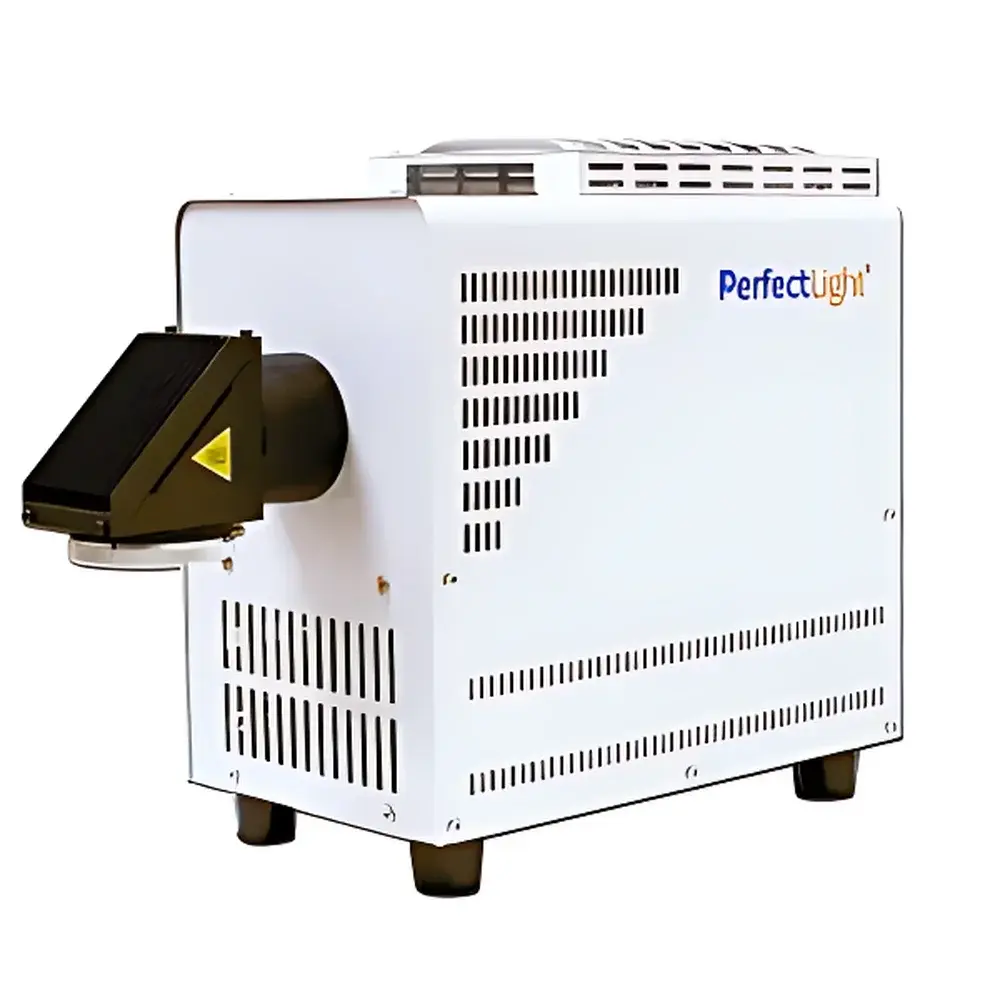
PLS-ILS Integrated Spherical Xenon Light Source
| Brand | PerfectLight (PufeiLai) |
|---|---|
| Origin | Beijing, China |
| Model | PLS-ILS |
| Light Source Type | Xenon Arc Lamp |
| Illumination Mode | External Irradiation |
| Lamp Power Options | 250 W / 350 W |
| Current Display | Digital |
| Operating Mode | Programmable Control |
| Current Adjustment Range | 9–16 A |
| Lamp Lifetime | >1000 h (under standard photocatalytic operating conditions) |
| Total Optical Power Output | 50 W |
| Irradiance | ≥2000 mW/cm² |
| Spectral Range | 320–780 nm (extendable to 2500 nm) |
| Beam Divergence Angle | <10° |
| Minimum Spot Diameter | ≥50 mm (distance-dependent) |
| Long-Term Intensity Stability | ≤±3% |
| Protection Features | Fan-failure interlock, auto-start on power-up, post-shutdown cooling delay, over-current and overload cut-off |
| Thermal Management | Proprietary passive + active heat dissipation architecture |
| Optional Accessories | Fiber-optic coupling kits, beam homogenizers, liquid filters, light guide tubes, motorized height-adjustable stages, mechanical shutters, five-point irradiance mapping kit |
| Optional Filter Modules | Bandpass filters, long-pass/short-pass edge filters, AM1.5G spectral correction filters, neutral density attenuators |
| Optional Safety Solutions | UV/visible protective eyewear, light-tight enclosure |
| Optional Measurement Tools | Calibrated optical power meter, fiber-coupled spectrometer |
Overview
The PLS-ILS Integrated Spherical Xenon Light Source is an engineered solution for laboratory-scale photochemical and photocatalytic research requiring high-intensity, spectrally broad, and spatially uniform illumination. Designed around a stabilized DC-powered short-arc xenon lamp housed in a precisely aligned ellipsoidal reflector cavity, the system delivers collimated, low-divergence output with minimal angular spread (<10°). Its integrated lamp-and-power-supply architecture eliminates external cabling complexity and reduces footprint—critical for benchtop photoreactor integration. The spherical reflector geometry ensures isotropic photon collection efficiency and enhances irradiance homogeneity across the target plane, making it suitable for quantitative irradiation experiments where spatial uniformity directly impacts reaction kinetics reproducibility. Unlike conventional point-source lamps, the PLS-ILS maintains stable radiometric output over extended durations (≤±3% drift over 8 h), enabled by microprocessor-based digital current regulation and adaptive thermal management.
Key Features
- Monolithic design integrating lamp housing, power supply, and control electronics into a single compact chassis
- Interchangeable 250 W and 350 W xenon arc lamps compliant with IEC 61167 lamp base standards (GX12Q)
- Digital current readout with programmable ramping and stepwise intensity control (9–16 A range)
- Real-time thermal monitoring with dual-stage fan control and automatic shutdown upon thermal or electrical fault detection
- Optimized reflector geometry yielding ≥2000 mW/cm² irradiance at 10 cm working distance, with ≥50 mm uniform irradiated area
- Full-spectrum output spanning 320–780 nm (UV-Vis-NIR), compatible with optional spectral filtering modules up to 2500 nm
Sample Compatibility & Compliance
The PLS-ILS supports irradiation of gaseous, liquid-phase, and solid-supported photocatalysts in batch or flow-through configurations. Its external irradiation geometry allows direct coupling with commercial quartz photoreactors, gas-phase reaction cells, and electrochemical PEC cells equipped with optically transparent windows. All optical interfaces conform to ISO 10110 surface quality specifications for fused silica components. The system meets CE electromagnetic compatibility (EMC) Directive 2014/30/EU and Low Voltage Directive 2014/35/EU requirements. For GLP-compliant laboratories, the programmable operation mode enables audit-trail-capable experiment logging when interfaced with external data acquisition systems supporting IEEE 1451.2 transducer electronic data sheets (TEDS).
Software & Data Management
While the PLS-ILS operates as a standalone instrument via front-panel controls, its RS-232 and analog 0–5 V output ports enable integration into automated experimental workflows. Third-party software platforms—including LabVIEW, MATLAB, and Python-based control libraries—can manage lamp ignition sequences, current setpoints, and runtime logging. Optional accessories such as the five-point irradiance mapping kit provide traceable calibration against NIST-traceable reference detectors (e.g., Thorlabs S120VC), supporting ISO/IEC 17025-compliant uncertainty budgets for irradiance measurements. Firmware updates are delivered via USB interface and retain user-defined parameter presets across reboots.
Applications
- Photocatalytic water splitting (H₂/O₂ evolution) and overall water decomposition under simulated solar irradiation
- CO₂ photoreduction to CH₄, CO, or C₂ hydrocarbons using plasmonic or heterojunction catalysts
- Gas-phase degradation of volatile organic compounds (VOCs), NOₓ, SOₓ, and formaldehyde in environmental simulation chambers
- Aqueous-phase degradation of organic dyes (e.g., methylene blue, rhodamine B), phenolic compounds, and halogenated aromatics
- Photoelectrochemical (PEC) characterization of semiconductor photoanodes/cathodes under controlled illumination spectra
- Fundamental studies of photoinduced electron transfer, exciton dynamics, and transient absorption spectroscopy sample excitation
FAQ
What lamp types are compatible with the PLS-ILS?
The system accepts standardized DC-operated short-arc xenon lamps with GX12Q base, rated at 250 W or 350 W nominal power. Mercury-xenon hybrid lamps are not supported due to divergent thermal and electrical characteristics.
Can the PLS-ILS be used for ASTM G154 or ISO 4892-3 accelerated weathering tests?
No—the PLS-ILS lacks the spectral irradiance control, humidity regulation, and cyclic exposure programming required by those standards. It is intended for research-grade photocatalysis, not industrial durability testing.
Is the spectral output calibrated to AM1.5G?
The native output does not match AM1.5G; however, optional solar-spectrum correction filters (certified per ASTM E927-20) can be installed to approximate terrestrial solar irradiance between 350–1100 nm.
How is irradiance uniformity verified across the illuminated area?
Uniformity is characterized using a five-point mapping procedure per ISO 9241-307, measuring irradiance at center and four radial positions (25 mm from center). Homogeneity is specified as ±5% across ≥50 mm diameter at 10 cm standoff distance.
Does the system support remote triggering for time-resolved experiments?
Yes—mechanical shutter control and lamp modulation are available via TTL-compatible external trigger input (5 V logic level), enabling synchronization with pump-probe laser systems or fast-gated detectors.






