
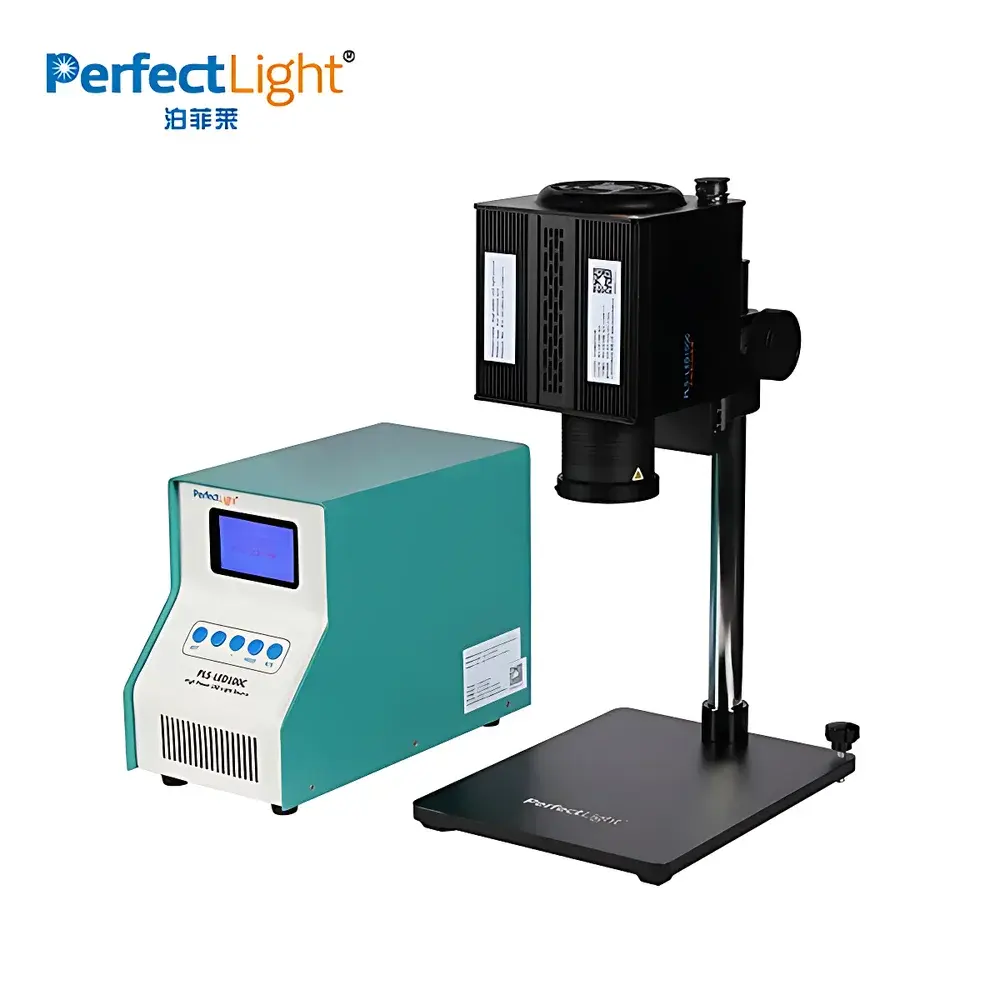
PLS-LED 100C High-Power LED Light Source
| Brand | PerfectLight (PoFeiLai) |
|---|---|
| Origin | Beijing, China |
| Model | PLS-LED 100C |
| Light Source Type | High-Intensity Monochromatic/Polychromatic LED Array |
| Illumination Mode | External Irradiation |
| Spectral Output | Narrowband (FWHM 15–20 nm), Center Wavelength Tolerance ±10 nm |
| Output Aperture | Φ38 mm (expandable via collimating or diffusing extension tubes) |
| Beam Options | Collimated (Φ50–60 mm, adjustable divergence) or Diffused (divergence angle adjustable by working distance) |
| Wavelength Selection | 365–940 nm (discrete monochromatic), Warm/Natural/Neutral/Cool White (3000–>7000 K), Custom Multi-Channel Arrays (e.g., 6–7 channel, plant-specific R:B ratios 1:9 to 9:1, pink broadband 380–840 nm) |
| LED Lifetime | >10,000 h |
| Intensity Stability | ≤±1% short-term fluctuation |
| Control Architecture | Embedded micro-CPU with digital constant-current regulation |
| Safety Features | Fan-failure auto-shutdown, over-current/over-load protection, 360° rotatable lamp housing, height-adjustable precision support stand |
| Optional Accessory | PLS-LED ZM articulating beam director |
Overview
The PLS-LED 100C is a modular, high-stability LED light source engineered for quantitative photochemical and photophysical research in controlled laboratory environments. Unlike broadband arc lamps (e.g., Xe or Hg), it delivers spectrally defined irradiance via high-brightness surface-mount LED arrays, enabling precise wavelength selection without optical filtering losses. Its core architecture employs constant-current digital regulation with embedded micro-CPU feedback, ensuring intensity stability ≤±1% over time—critical for quantum yield determination, photocurrent quantification in photoelectrochemical (PEC) cells, and kinetic studies requiring reproducible photon flux. The system operates on the principle of electroluminescence from semiconductor junctions, offering narrow spectral bandwidth (FWHM 15–20 nm) and minimal thermal drift—eliminating the need for water cooling or warm-up stabilization typical of plasma-based sources. Designed for external illumination geometry, it integrates seamlessly into custom-built reactors, electrochemical cells, gas-phase flow systems, and solid-state sample stages.
Key Features
- Modular lamp-head design: Interchangeable LED modules (monochromatic, white, or multi-spectral) mount onto a universal power chassis—enabling rapid reconfiguration without recalibration.
- Three irradiation modes: Continuous (CW), pulsed (adjustable frequency and duty cycle), and stepped-intensity output—supporting transient absorption, time-resolved photocurrent measurement, and dose-controlled degradation experiments.
- Precision beam management: Standard Φ38 mm output port accepts optional collimating tubes (yielding near-parallel beams, Φ50–60 mm at target plane) or diffusing extensions (adjustable divergence via working distance).
- Digital intensity control: Real-time monitoring and adjustment via front-panel interface or RS-232/USB; all parameters stored with timestamped logging capability.
- Thermal and electrical safety architecture: Integrated fan-speed monitoring with automatic shutdown on failure; current-limiting circuitry compliant with IEC 61000-4-5 surge immunity standards; IP20-rated enclosure for lab use.
- Mechanical flexibility: 360° rotational lamp housing with lockable detents; vertically adjustable support column (micrometer-scale positioning) for repeatable sample-to-source alignment.
Sample Compatibility & Compliance
The PLS-LED 100C supports diverse sample formats including quartz/glass electrochemical cells, gas-phase photoreactors (e.g., annular or cylindrical flow-through configurations), thin-film catalyst substrates, suspended nanoparticle dispersions, and immobilized photocatalytic membranes. Its external irradiation geometry avoids internal heating artifacts common in immersion-type sources. All LED modules comply with IEC 62471 Photobiological Safety classification (Risk Group 1 for most wavelengths ≥400 nm; RG2 for deep UV <385 nm—requiring appropriate eye protection per ANSI Z87.1). The system’s digital control firmware supports audit-trail generation (user ID, timestamp, setpoint, actual output), aligning with GLP documentation requirements for catalytic efficiency reporting. While not certified to ISO/IEC 17025 as a standalone metrological instrument, its stability and traceable wavelength calibration (NIST-traceable spectroradiometric verification available upon request) meet ASTM E2938 and ISO 11477 criteria for irradiance reference sources in photochemical testing.
Software & Data Management
The PLS-LED 100C operates autonomously via onboard firmware but interfaces with host PCs using ASCII-command protocol over USB virtual COM port. A vendor-provided Windows application enables scriptable sequence programming (e.g., ramp-and-hold intensity profiles, multi-wavelength switching schedules), real-time intensity plotting, and CSV export of time-stamped irradiance logs. All settings—including mode, intensity %, pulse width, and dwell time—are stored non-volatilely. Firmware updates are delivered via signed HEX files with checksum validation. For integration into automated platforms (e.g., robotic reaction screening), the device supports TTL-triggered start/stop and analog voltage input (0–5 V) for external intensity modulation. Data export complies with FAIR principles: machine-readable metadata (wavelength, FWHM, aperture, distance) is embedded in each log file header.
Applications
- Quantitative photochemistry: Action spectrum analysis, apparent quantum yield (AQY) mapping across 365–940 nm, and wavelength-dependent rate constant determination.
- Photoelectrochemical characterization: Incident photon-to-current efficiency (IPCE) measurements, Mott-Schottky analysis, and bias-assisted photocurrent transients under monochromatic excitation.
- Environmental photocatalysis: Gas-phase VOC (formaldehyde, NOx, SOx) and aqueous-phase pollutant (azo dyes, phenol, BTEX) degradation kinetics under controlled photon flux.
- Advanced materials testing: Stability assessment of perovskite films, MOF photocatalysts, and covalent organic frameworks (COFs) under accelerated narrowband stress.
- Biological & agricultural photonics: Plant photomorphogenesis studies using tunable red/blue ratio arrays; photodynamic therapy (PDT) sensitizer screening with pink broadband (380–840 nm) emission.
FAQ
What spectral calibration documentation is provided with the PLS-LED 100C?
Each unit ships with a factory-measured relative spectral power distribution (SPD) report, listing peak wavelength, FWHM, and radiant flux (mW) at rated drive current. NIST-traceable absolute calibration is available as an optional service.
Can multiple PLS-LED 100C units be synchronized for multi-wavelength excitation?
Yes—via external TTL triggering or master-slave RS-485 daisy-chaining; timing jitter between units is <10 µs.
Is the collimated output truly collinear, and what is its divergence angle?
Collimation achieves <5 mrad full-angle divergence (typical), yielding Φ50–60 mm spot size at 1 m working distance; divergence is adjustable ±2 mrad via fine-focus ring on the collimator tube.
How is thermal management handled during extended operation at maximum output?
Active forced-air cooling with dual-ball-bearing fans; temperature sensors monitor heatsink baseplate (max operating temp: 65°C); output power derates linearly above 50°C ambient to maintain LED junction temperature <85°C.
Does the system support compliance with FDA 21 CFR Part 11 for regulated laboratories?
While the base firmware does not include electronic signature or role-based access control, the audit-log structure (user, timestamp, parameter, value) satisfies foundational ALCOA+ data integrity requirements; Part 11 readiness can be achieved via validated third-party LIMS integration.






