
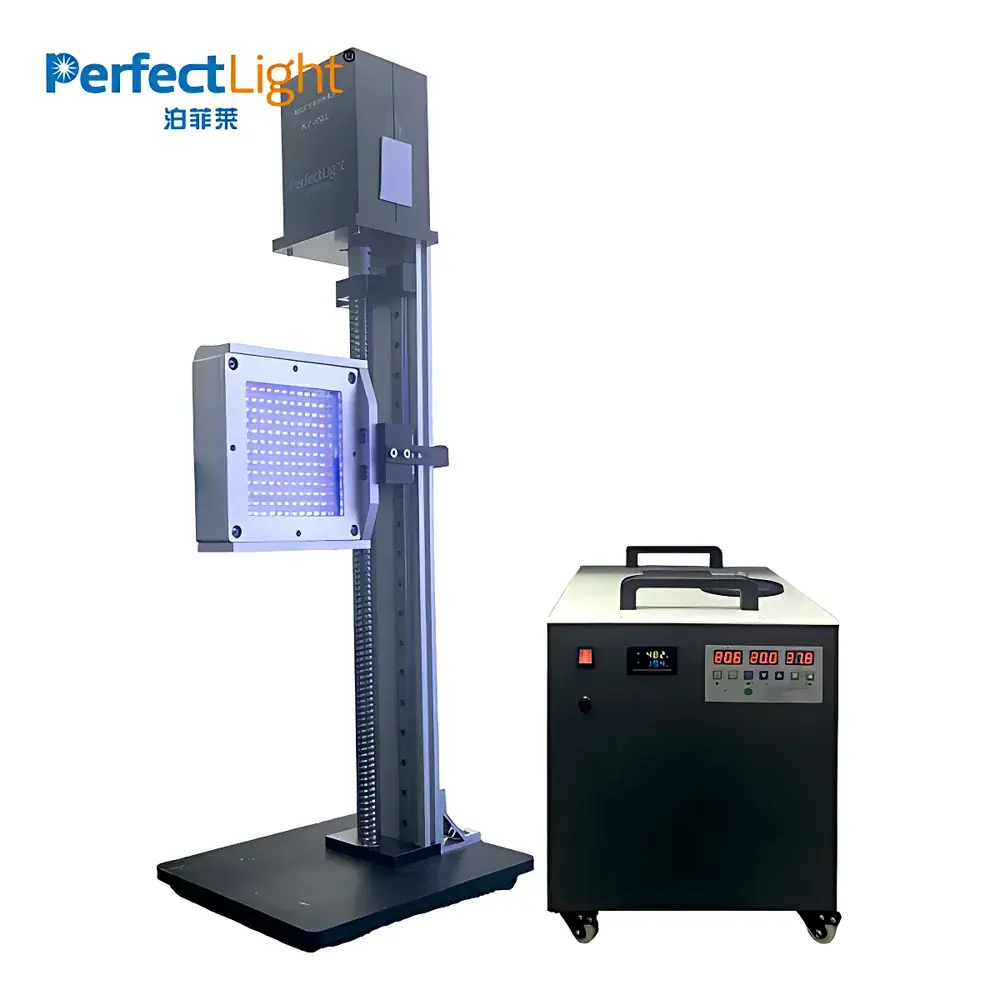
PLS-LED-LC1000 Water-Cooled High-Intensity LED Light Source
| Brand | PerfectLight (PofeiLai) |
|---|---|
| Model | PLS-LED-LC1000 |
| Light Source Type | High-Power Monochromatic LED Array |
| Cooling Method | Active Liquid Cooling |
| Irradiance | Up to 2.0 W/cm² at Sample Plane |
| Spectral Range | Standard Options: 365 nm, 385 nm, 395 nm, 405 nm |
| Power Supply | 220 V AC, 50 Hz |
| Total System Power | 610 W (Host) / 1000 W (LED Module) |
| Operating Temperature | 0–40 °C (non-condensing) |
| Storage Temperature | −10–60 °C, 30–85% RH (non-condensing) |
| Illumination Mode | External (Top/Oblique/Normal Incidence) |
| Uniformity | ≥90% over 100 mm × 100 mm active area |
| Safety | Ozone-Free Operation |
| Compliance | CE-marked design principles |
Overview
The PLS-LED-LC1000 is a precision-engineered, water-cooled high-intensity LED light source designed for demanding optical laboratory applications requiring stable, spectrally defined, and spatially uniform irradiation. Unlike arc-lamp-based systems (e.g., xenon or mercury), this instrument utilizes high-efficiency monochromatic LED chips mounted on copper-based thermally decoupled substrates, enabling sustained output without spectral drift or UV-induced ozone generation. Its core operational principle relies on solid-state electroluminescence combined with active liquid thermal management—ensuring long-term radiometric stability (<±1.5% intensity drift over 8 h at rated power) and minimal thermal load on sensitive samples. The system is optimized for external illumination configurations, supporting collimated, focused, or diffuse beam delivery via optional optical accessories (e.g., integrating spheres, homogenizers, or fiber-coupled adapters). It serves as a primary irradiance reference in photovoltaic quantum efficiency calibration, accelerated material aging protocols, and photobiological exposure studies where reproducible photon flux density is critical.
Key Features
- High-intensity output: Delivers up to 2.0 W/cm² irradiance at the sample plane under standard operating conditions—achievable across multiple discrete UV–VIS–NIR wavelengths.
- Thermal architecture: Copper-core PCBs with thermal-electrical isolation and closed-loop deionized water cooling maintain junction temperatures below 65 °C, ensuring LED lifetime >15,000 h (L70 rating).
- Spectral flexibility: Factory-configured options include 365 nm, 385 nm, 395 nm, and 405 nm; custom wavelengths between 250 nm and 1050 nm are available upon specification—each calibrated per CIE S 026/E:2019 spectral irradiance traceability protocols.
- Optical uniformity: Distributed LED array geometry combined with perimeter light-guiding optics achieves ≥90% irradiance uniformity over a 100 mm × 100 mm field—validated using NIST-traceable silicon photodiode mapping.
- Ozone-free operation: Solid-state emission eliminates mercury/xenon plasma discharge, eliminating ozone generation and associated ventilation requirements—compliant with ISO 14644-1 Class 8 cleanroom ambient compatibility.
- Integrated power regulation: Digital PWM-driven current control enables precise light power adjustment from 10% to 100% of maximum output in 0.1% increments, with real-time feedback via onboard photodiode monitoring.
Sample Compatibility & Compliance
The PLS-LED-LC1000 supports non-contact external irradiation of planar, curved, or irregular samples—including silicon wafers, polymer films, biological tissue cultures, and optical coatings. Its low-thermal-load design minimizes convective heating effects, making it suitable for temperature-sensitive photopolymerization and photosynthetic response assays. The system conforms to key regulatory and metrological frameworks: irradiance output is referenced to SI-traceable standards (NIST SRM 2270a); electrical safety follows IEC 61010-1; and electromagnetic compatibility aligns with EN 61326-1. While not inherently FDA 21 CFR Part 11 compliant, its digital control interface supports integration into GLP/GMP-compliant data acquisition systems when paired with audit-trail-enabled software (e.g., LabVIEW or MATLAB-based DAQ platforms).
Software & Data Management
The unit operates via front-panel tactile controls or RS-485/Modbus RTU communication protocol for remote integration. Optional USB-to-serial adapter enables direct connection to Windows/Linux hosts running third-party control environments. Real-time irradiance logging (sample rate: 1 Hz), power setpoint history, coolant temperature telemetry, and fault-event timestamps are exportable as CSV files. For laboratories requiring full ALCOA+ data integrity, the system can be interfaced with validated LIMS or ELN platforms through OPC UA gateways—supporting electronic signatures, version-controlled method storage, and automated report generation per ISO/IEC 17025 Clause 7.7.
Applications
- Photovoltaics: Spectral responsivity mapping, Jsc–Voc characterization under AM1.5G-equivalent irradiance, and perovskite degradation kinetics under controlled UV stress.
- Materials Science: Accelerated weathering of polymers (ASTM G154 Cycle 1), photocatalytic activity quantification (ISO 22197-1), and photoinduced crosslinking depth profiling.
- Space Simulation: Thermal vacuum chamber-compatible irradiation for solar array degradation testing and spacecraft thermal balance validation (per ECSS-E-ST-10-04C).
- Biological Research: Controlled photomorphogenesis experiments in plant physiology (e.g., phytochrome A/B activation studies), insect phototaxis assays, and antimicrobial blue-light efficacy trials.
- Optical Manufacturing: UV-curable adhesive curing verification for lens assembly, anti-reflective coating hardening, and infrared detector window bonding process validation.
- Chemistry: Photo-initiated polymerization kinetics (IUPAC Green Chemistry metrics), singlet oxygen quantum yield determination, and photocleavable protecting group studies.
FAQ
What spectral bandwidth options are available beyond the standard 365/385/395/405 nm configurations?
Custom narrowband (FWHM ≤15 nm) or broadband (e.g., 350–450 nm) LED modules can be engineered within the 250–1050 nm range. Lead time and minimum order quantities apply.
Is the system compatible with vacuum or inert-gas glovebox environments?
Yes—the light head is sealed and rated IP54; optional quartz viewport adapters enable integration into N₂- or Ar-purged enclosures without compromising thermal performance.
How is irradiance calibrated, and is NIST traceability provided?
Each unit ships with a factory irradiance map and a calibration certificate referencing NIST-traceable spectroradiometer measurements (SRM 2270a); annual recalibration services are available.
Can multiple PLS-LED-LC1000 units be synchronized for multi-angle illumination?
Yes—via external TTL trigger input (BNC), enabling sub-millisecond timing alignment across up to 8 independent units for directional phototaxis or anisotropic curing studies.
Does the liquid cooling system require external chiller integration?
No—the integrated recirculating cooler operates autonomously; however, an external chiller may be connected via standard 1/4″ compression fittings for extended high-power duty cycles (>12 h continuous operation).





