
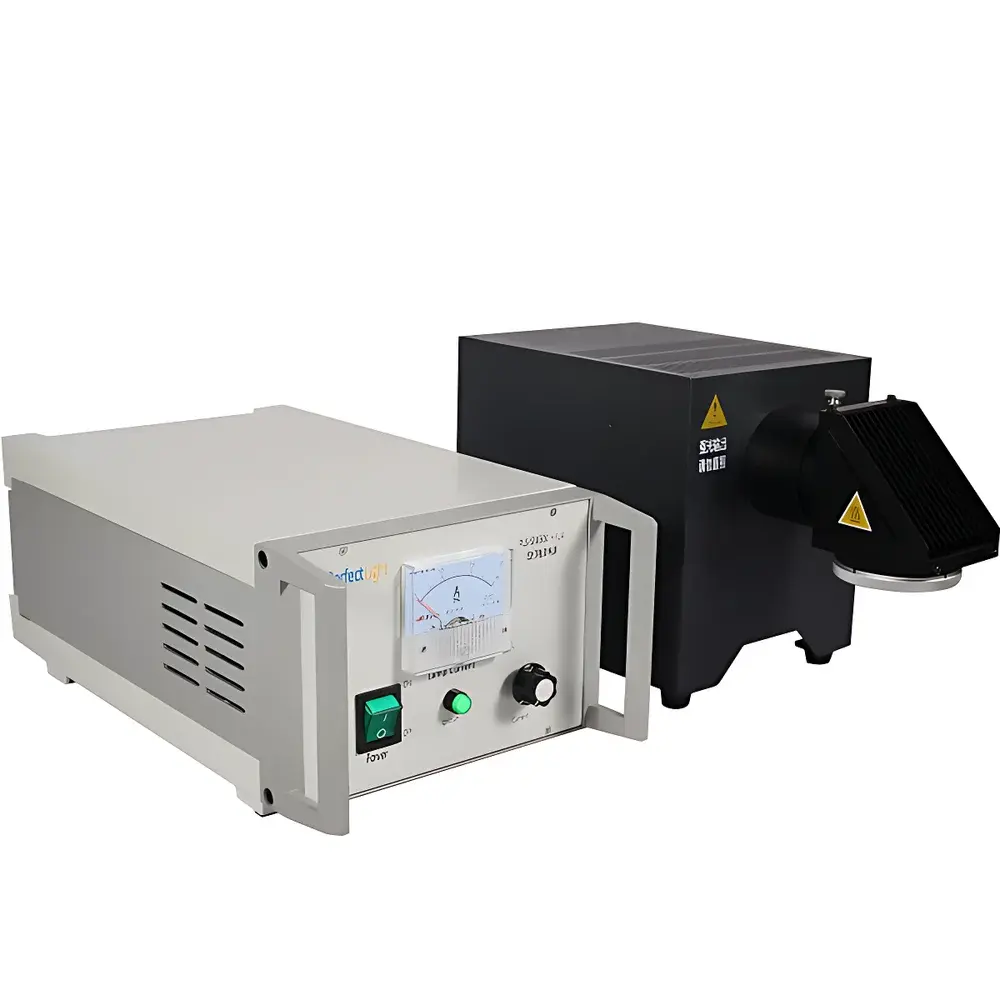
PLS-SXE300/300UV Stable Xenon Light Source
| Brand | PerfectLight (PerkinElmer-compatible architecture) |
|---|---|
| Origin | Beijing, China |
| Model | PLS-SXE300/300UV |
| Light Source Type | DC-powered short-arc xenon lamp |
| Illumination Mode | External irradiation configuration |
| Total Optical Output Power | 50 W |
| Spectral Range | 320–780 nm (extendable to 2500 nm with optional optics) |
| Beam Divergence | ~6° (FWHM) |
| Spot Diameter | 30–60 mm (adjustable via working distance) |
| Long-term Irradiance Stability | ≤ ±3% over 8 h |
| Lamp Power Rating | 300 W (adjustable 150–300 W) |
| Lamp Lifetime | >1000 h (under photoreactor-relevant irradiance conditions) |
| Current Limit | 21 A |
| Ignition Method | Integrated dual-stage high-voltage trigger (no HV cabling between power supply and lamp housing) |
| Thermal Management | Passive aluminum finned heat sink |
| EMI Shielding | Fully enclosed grounded metal lamp housing |
| Control Interface | Microprocessor-based digital power management with programmable operation mode |
| Safety Compliance | No high-voltage transmission in interconnect cable |
Overview
The PLS-SXE300/300UV is a laboratory-grade, digitally regulated DC-driven xenon arc light source engineered for reproducible, long-duration optical excitation in photochemical and photocatalytic research. It operates on the principle of thermal blackbody radiation from a stabilized short-arc xenon plasma, delivering continuous broadband emission spanning the near-UV through visible spectrum (320–780 nm), with spectral extension into NIR (up to 2500 nm) achievable using external monochromators or broadband IR-transmissive optics. Unlike pulsed or LED-based alternatives, this source provides steady-state irradiance essential for kinetic studies, quantum yield determination, and time-resolved surface reaction monitoring. Its external irradiation geometry enables flexible integration with custom-built reactors—including top-irradiated slurry photoreactors, gas-phase flow cells, and electrochemical photoelectrochemical (PEC) cells—while maintaining strict separation between power electronics and optical path.
Key Features
- Stable DC power delivery with microprocessor-controlled current regulation ensures irradiance consistency ≤ ±3% over 8-hour continuous operation—critical for multi-day catalytic turnover number (TON) assessments.
- Passive thermal management via oversized extruded aluminum heat sink enables uninterrupted 300-W operation without forced air or liquid cooling—reducing acoustic noise and mechanical vibration that may interfere with sensitive optical alignment or interferometric measurements.
- Integrated dual-stage ignition eliminates high-voltage cabling between power supply and lamp housing, complying with IEC 61000-6-3 for conducted emissions and enhancing user safety during lamp replacement and system maintenance.
- Fully shielded all-metal lamp enclosure provides effective electromagnetic interference (EMI) suppression—essential when operating alongside lock-in amplifiers, potentiostats, or low-noise photodetectors in hybrid photoelectrochemical setups.
- Adjustable output power (150–300 W) allows precise control of photon flux density without spectral shift—enabling comparative studies across irradiance intensities while preserving spectral fidelity.
- Standardized mechanical interface (M6 threaded mounting holes, Ø50 mm clear aperture) supports rapid coupling to commercial filter wheels, collimators, fiber-optic couplers, and monochromator input slits.
Sample Compatibility & Compliance
The PLS-SXE300/300UV is compatible with standard quartz, fused silica, and CaF2 optical components for UV-VIS-NIR spectral manipulation. Its external irradiation configuration permits direct illumination of heterogeneous catalysts (e.g., TiO2, g-C3N4, perovskites), liquid-phase dye solutions, gas-phase VOC mixtures in flow reactors, and solid-state photoelectrodes in three-electrode PEC cells. The system meets general-purpose laboratory equipment requirements per IEC 61010-1 (Safety Requirements for Electrical Equipment for Measurement, Control, and Laboratory Use) and conforms to RoHS Directive 2011/65/EU. While not certified to ISO/IEC 17025 or GLP Annex 11, its digital logging capability supports traceable irradiance history for internal method validation under ASTM E2937-22 (Standard Practice for Photocatalytic Activity Testing) and ISO 22197-1 (Photocatalytic Air Purification).
Software & Data Management
Operation is managed via embedded firmware with RS-232/USB virtual COM port interface. A cross-platform command-line utility (Windows/macOS/Linux) enables scriptable control of power setpoint, ramp rate, dwell time, and fault logging. All operational parameters—including real-time current/voltage, cumulative lamp-on hours, and thermal sensor readings—are timestamped and exportable as CSV for integration into LIMS or ELN platforms. Audit trail functionality records user-initiated changes with UTC timestamps, satisfying basic data integrity expectations aligned with FDA 21 CFR Part 11 principles for non-GxP academic and industrial R&D environments.
Applications
- Photocatalytic water splitting: Quantitative H2/O2 evolution studies under AM1.5G-simulated irradiance using calibrated Si or GaInP reference cells.
- CO2 photoreduction: Product distribution analysis (CH4, CO, CH3OH) via GC-TCD/FID under controlled gas-phase irradiation.
- Air/water pollutant degradation: First-order kinetic modeling of VOC (formaldehyde, NOx) or aqueous dye (methylene blue, rhodamine B) decay under defined photon flux.
- Photoelectrochemical characterization: Incident-photon-to-current-efficiency (IPCE) mapping and transient photocurrent response in semiconductor electrodes.
- Spectral responsivity calibration: Broadband source for spectroradiometer validation and detector linearity testing across UV-VIS-NIR bands.
FAQ
What is the recommended lamp replacement interval?
Lamp lifetime exceeds 1000 hours under stable 300-W operation with adequate thermal management; however, spectral drift (especially UV output attenuation) should be monitored using a calibrated spectroradiometer every 200 hours for quantitative work.
Can the PLS-SXE300/300UV be synchronized with pulsed measurement systems?
No native TTL sync output is provided; however, the RS-232 command interface supports external triggering via software polling or time-stamped command sequences for quasi-synchronous acquisition.
Is ozone generation a concern during UV irradiation?
Yes—significant ozone forms below 240 nm; while the base spectral output starts at 320 nm, use of optional deep-UV filters (e.g., UG11 + WG320) or operation in ventilated enclosures is advised for extended UV-rich experiments.
Does the system support automated filter wheel integration?
Yes—the mechanical footprint and aperture alignment are compatible with standard 25-mm filter wheels (e.g., Thorlabs FW102C); control sequencing requires external TTL or USB coordination via third-party motion controller.
How is irradiance uniformity characterized across the beam profile?
Spatial uniformity is measured at the target plane using a NIST-traceable CCD-based imaging radiometer; typical flatness is ±8% over central 80% of the 30–60 mm spot diameter, consistent with ASTM E2937-22 field homogeneity requirements.




