
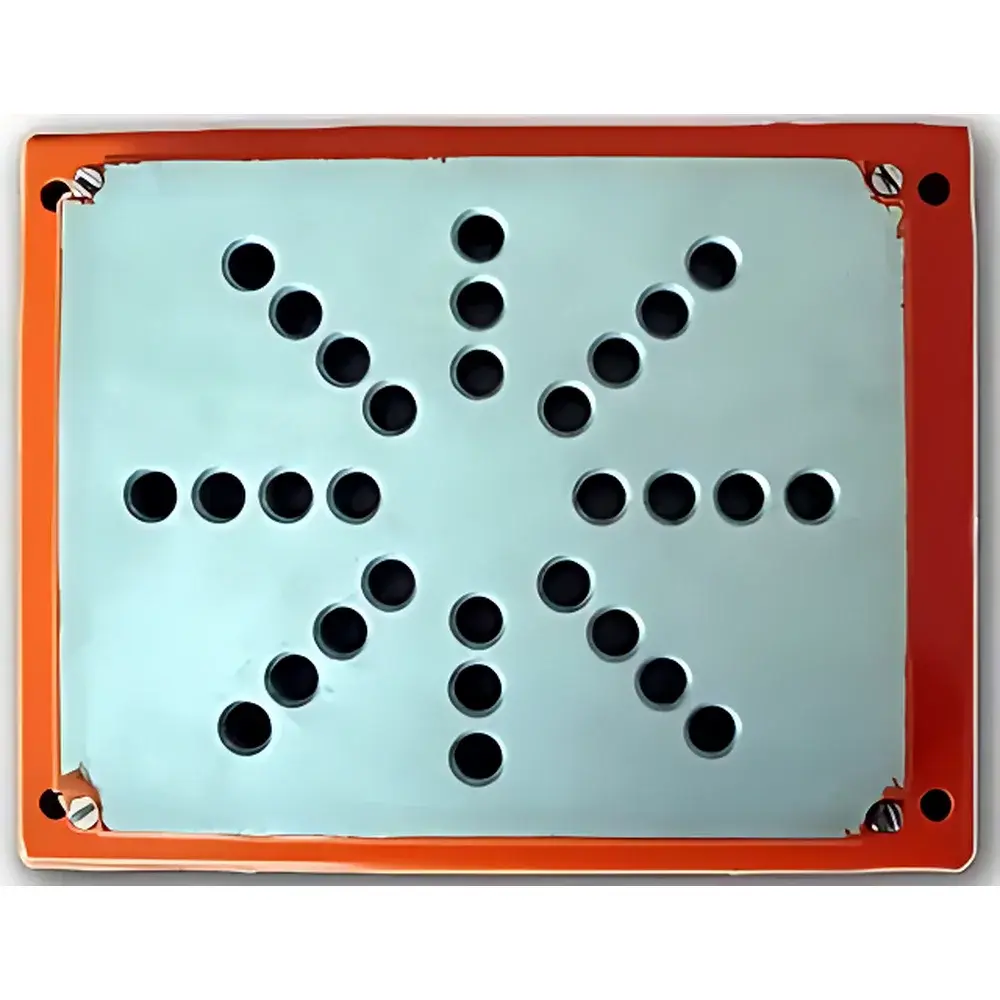
PM10–1000 Ambient Inhalable Particulate Matter Size-Selective Inlet
| Key | da₅₀ = 10 ± 1 µm |
|---|---|
| Compliance | GB 6921–1986 |
Overview
The PM10–1000 Ambient Inhalable Particulate Matter Size-Selective Inlet is a precision-engineered inertial impactor-based size-separation device designed to isolate airborne particulate matter with an aerodynamic diameter ≤10 µm (PM10) from ambient air streams. It operates on the principle of sharp-cut cyclonic separation and calibrated inertial impaction, conforming strictly to the performance criteria defined in GB 6921–1986 — China’s national standard for determination of atmospheric suspended particulates (inhalable fraction). The inlet achieves a 50% cut-point (da50) of 10 ± 1 µm and a geometric standard deviation (σg) ≤ 1.5, ensuring high fidelity in defining the respirable fraction relevant to human health assessment and regulatory monitoring. Designed for integration with high-volume total suspended particulate (TSP) samplers, the PM10–1000 enables gravimetric and chemical analysis of PM10 mass concentration in ambient air, supporting compliance with national ambient air quality standards and long-term environmental trend evaluation.
Key Features
- Calibrated size-selective performance meeting GB 6921–1986 requirements: da50 = 10 ± 1 µm and σg ≤ 1.5
- Optimized flow path geometry minimizing particle bounce and re-entrainment, enhancing collection efficiency reproducibility
- Robust aluminum alloy housing with corrosion-resistant surface treatment for extended field deployment under variable climatic conditions
- Precision-machined internal nozzles and impactor stages ensuring consistent aerodynamic behavior across operational lifetime
- Fixed nominal sampling flow rate of 1.05 m³/min (±5% tolerance), compatible with standardized high-volume sampler platforms
- Flow stability maintained within ±3% over continuous operation, verified via traceable calibration protocols
- Standardized filter support configuration accommodating 180 × 230 mm² rectangular quartz fiber or PTFE membrane filters
Sample Compatibility & Compliance
The PM10–1000 inlet is validated for use with gravimetric, ion chromatographic, and elemental analysis workflows following EPA Method IO-3.2, ISO 7708:1995 (Air quality — Particle size fraction definitions for health-related sampling), and GB/T 15432–1995 (Ambient air — Determination of total suspended particulates — Gravimetric method). Its mechanical design supports seamless coupling to certified high-volume samplers (e.g., TH-150C, KC-120H, or equivalent) without flow disruption or pressure drop-induced bias. All dimensional interfaces comply with national metrological verification procedures administered by authorized institutions including the Institute of Environmental Health and Engineering, Chinese Center for Disease Control and Prevention. The unit carries documented verification reports issued by CNAS-accredited laboratories, confirming conformance to GB 6921–1986 and enabling traceable data submission to provincial and national environmental monitoring networks.
Software & Data Management
As a passive mechanical inlet, the PM10–1000 does not incorporate embedded electronics or firmware. However, it is fully interoperable with digital high-volume samplers equipped with integrated flow controllers, temperature/pressure sensors, and audit-trail-capable data loggers compliant with GLP and ISO/IEC 17025 requirements. When deployed with such systems, raw volumetric flow data, ambient temperature, barometric pressure, and sampling duration are automatically recorded with timestamped metadata. These datasets support post-sampling correction of PM10 mass concentrations to standard reference conditions (25°C, 101.3 kPa), in accordance with ISO 12103-1 and US EPA QA/G-5 guidance. Calibration certificates and performance verification records are maintained in electronic format aligned with 21 CFR Part 11-compliant document management systems used by accredited environmental laboratories.
Applications
- Ambient air quality monitoring networks (national, provincial, urban)
- Source apportionment studies requiring speciated PM10 filter samples for XRF, ICP-MS, or GC-MS analysis
- Long-term trend analysis of coarse-mode particulate pollution in industrial, traffic, and rural zones
- Validation and intercomparison of low-cost sensor networks against reference-grade measurements
- Indoor-outdoor exposure assessment in epidemiological cohort studies
- Compliance testing for construction site dust control and landfill perimeter monitoring
FAQ
What is the physical basis for the PM10–1000’s size-selective cutoff?
It relies on inertial impaction dynamics governed by Stokes’ law and particle relaxation time, calibrated to achieve a 50% theoretical collection efficiency at 10 µm aerodynamic diameter under specified flow conditions.
Can the PM10–1000 be used for PM2.5 sampling?
No — it is specifically engineered and validated for PM10 fractionation per GB 6921–1986; PM2.5 measurement requires a separate cyclone or virtual impactor meeting ISO 10977 or EPA PM2.5 reference method specifications.
Is field recalibration required between deployments?
Routine recalibration is not necessary if mechanical integrity is preserved and no physical damage occurs; however, annual verification against reference impactors or wind tunnel testing is recommended per ISO/IEC 17025 quality assurance protocols.
Does the inlet meet international equivalency standards such as EN 12341 or ISO 7708?
While optimized for GB 6921–1986, its da50 and σg performance falls within the acceptance limits of ISO 7708:1995 for the inhalable convention, though formal EN 12341 equivalence requires additional third-party validation under EU harmonized test conditions.
Related Products







