
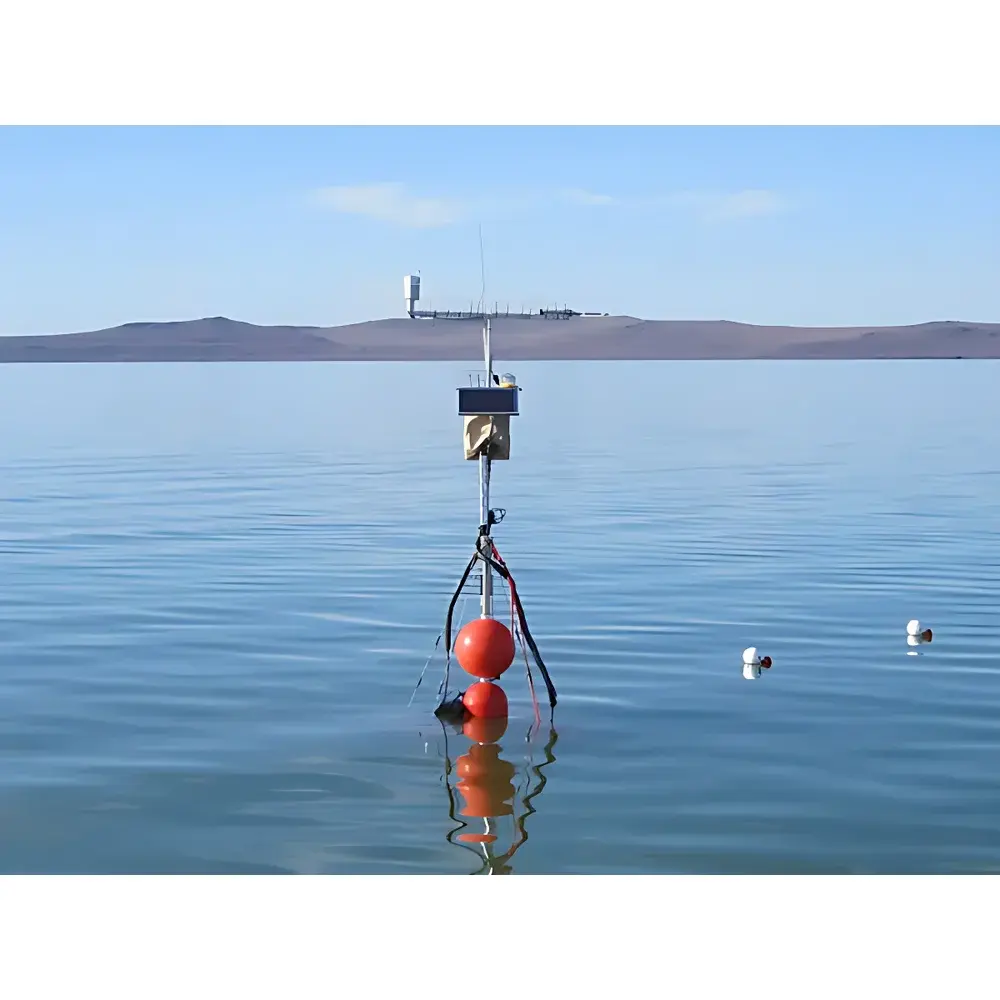

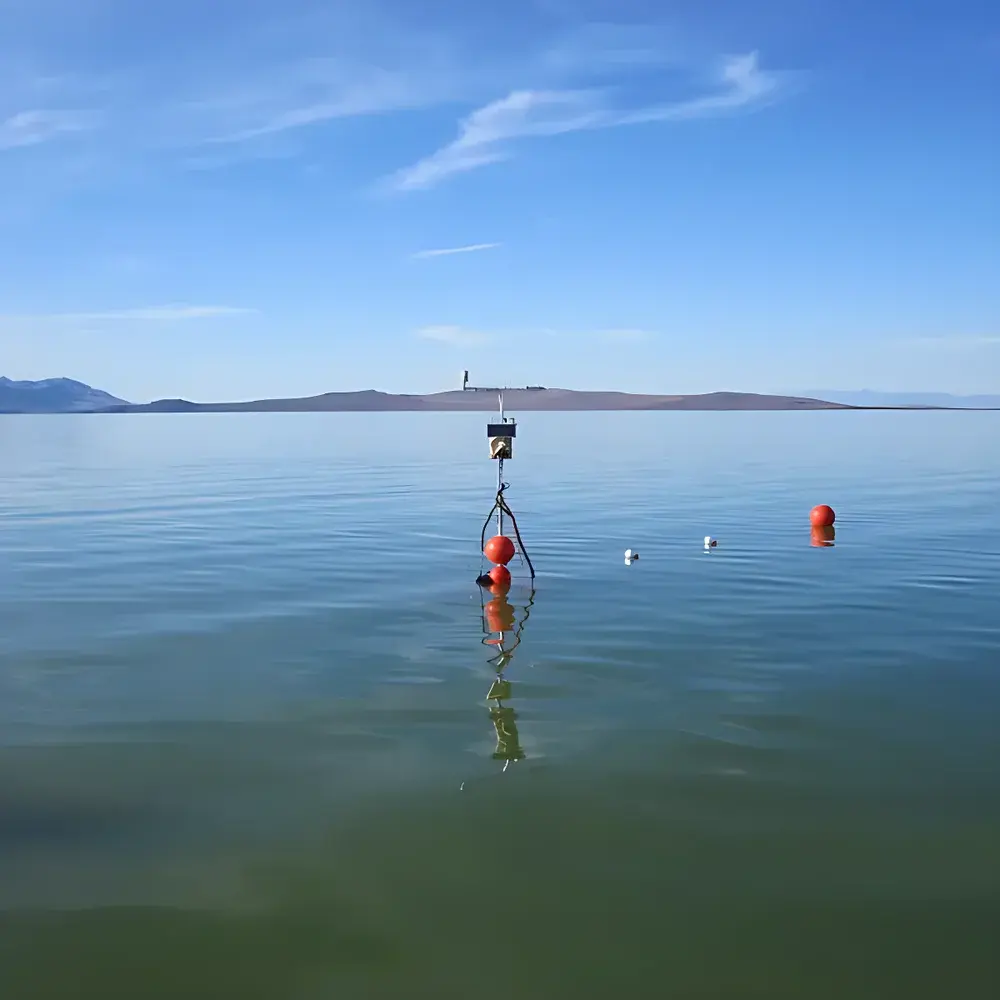
PME LakeESP Lake Surface Buoy System
| Brand | PME |
|---|---|
| Origin | USA |
| Manufacturer Type | Authorized Distributor |
| Import Status | Imported |
| Model | LakeESP |
| Price | USD 96,000 |
| Data Logger Resolution | 20-bit |
| Internal Storage | 2 GB SD card |
| Sampling Interval | 1 minute |
| Communication Options | GSM, VHF/UHF Radio, Iridium Satellite |
| Structural Material | 316 Stainless Steel |
| Temperature Accuracy | ±0.010 °C |
| Dissolved Oxygen Sensor | Optical (8 µm or ±5% of reading) |
| PAR Sensor | LI-192SA |
| Pressure Ranges | 5 / 10 / 20 bar |
| Meteorological Sensors | Vaisala or R.M. Young (humidity, precipitation, wind speed/direction) |
| Radiation Sensors | Hukseflux or Kipp & Zonen (net longwave/shortwave) |
| Water Quality Probes | Chlorophyll-a, Turbidity, Phycocyanin (cyanobacteria), CDOM, Hydrocarbon (oil-in-water) |
Overview
The PME LakeESP Lake Surface Buoy System is a fully integrated, autonomous environmental monitoring platform engineered for long-term, in-situ observation of limnological and meteorological dynamics in lakes and reservoirs. Designed around Couette-flow-stable buoyancy and marine-grade structural integrity, the system operates continuously across seasonal thermal stratification cycles—capturing vertical water column profiles alongside co-located atmospheric forcing parameters. Its core measurement architecture combines high-fidelity optical, electrochemical, and radiometric sensing with synchronized time-series acquisition, enabling rigorous analysis of lake heat budgets, mixing regime transitions, and biogeochemical response to climate drivers. The LakeESP is not a telemetry-only relay device; it functions as a calibrated, traceable field laboratory—meeting foundational requirements for GLP-aligned data collection in regulatory and research-grade applications.
Key Features
- Modular, field-replaceable sensor suite supporting simultaneous deployment of up to six water quality probes—including factory-calibrated optical sensors for chlorophyll-a fluorescence, turbidity (NTU), phycocyanin (for cyanobacterial biomass quantification), CDOM absorption at 350 nm, and hydrocarbon fluorescence (oil-in-water detection)
- Integrated meteorological mast with dual radiation balance capability: net shortwave (0.3–3.0 µm) and net longwave (4–50 µm) irradiance measured via Hukseflux NR01 or Kipp & Zonen CNR4 radiometers
- High-resolution water column profiling using thermistor chains (±0.010 °C accuracy), optical dissolved oxygen (8 µm membrane or ±5% full-scale), and pressure-compensated PAR (LI-192SA, 400–700 nm)
- 20-bit analog-to-digital data logger with 2 GB internal SD storage, timestamped at UTC microsecond precision, generating binary .RAW files compliant with PME RDV software ingestion protocols
- Multi-path communication architecture: configurable GSM/GPRS for cellular coverage zones; license-free VHF/UHF radio (up to 20 km line-of-sight); or global Iridium satellite uplink for remote or offshore deployments without terrestrial infrastructure
- 316 stainless steel buoy frame with anti-fouling coating, designed per ASTM D6386 for marine corrosion resistance and rated for operational stability in wave heights ≤1.5 m (significant wave height)
Sample Compatibility & Compliance
The LakeESP is validated for continuous immersion in freshwater systems ranging from oligotrophic alpine lakes to eutrophic reservoirs with suspended solids concentrations up to 100 NTU. All wetted components comply with NSF/ANSI Standard 61 for drinking water system components. Sensor calibration traceability follows NIST-traceable procedures, with documented uncertainty budgets provided per probe type. Data integrity meets FDA 21 CFR Part 11 requirements when deployed with PME’s optional audit-trail-enabled RDV v5.2+ software configuration. The system supports ISO 5667-3 (water sampling) and ISO 10523 (pH measurement) ancillary validation workflows through synchronized metadata tagging of sensor drift, cleaning events, and battery voltage thresholds.
Software & Data Management
Raw .RAW files are ingested into PME’s RDV (Real-time Data Viewer) desktop application, which performs automated unit conversion, sensor-specific temperature compensation, and QA/QC flagging based on user-defined validity windows (e.g., DO saturation >120% triggers manual review). RDV exports time-aligned CSV/NetCDF datasets compatible with MATLAB, Python (xarray/pandas), and R statistical environments. Cloud synchronization via PME’s secure HTTPS API enables role-based access control (RBAC), automated alerting (SMS/email on parameter threshold breach), and integration with third-party SCADA platforms via Modbus TCP or MQTT brokers. All firmware updates are cryptographically signed and delivered over TLS 1.2+.
Applications
- Quantifying epilimnetic warming rates and metalimnetic gradient erosion during spring turnover
- Validating 1D/3D hydrodynamic-biogeochemical models (e.g., DYRESM-CAEDYM, GOTM-ERSEM) with vertically resolved temperature, DO, and PAR profiles
- Monitoring cyanobacterial bloom initiation through real-time phycocyanin:chlorophyll-a ratio trends and associated thermal/mixing anomalies
- Deriving lake-atmosphere energy exchange terms—net radiation, sensible/latent heat fluxes—using coupled meteorological and surface water temperature time series
- Supporting reservoir operation decisions under drought stress by tracking hypolimnetic oxygen depletion kinetics and thermal refuge availability
FAQ
What is the maximum deployment duration without maintenance?
With standard lithium-thionyl chloride batteries (12 Ah), the LakeESP operates autonomously for ≥12 months in temperate climates; solar-assisted configurations extend this to ≥24 months.
Can the buoy be configured for ice-covered winter operation?
Yes—optional ice-piercing mast extensions and low-temperature-rated sensors (−30 °C operating range) are available for boreal lake deployments.
Is raw sensor voltage output accessible for custom calibration?
Yes—RDV software includes “Engineering Units Bypass” mode, exporting unprocessed ADC counts with documented gain/offset coefficients per channel.
How is sensor biofouling mitigated?
All optical probes feature integrated wiper mechanisms cycled every 24 hours; copper-alloy antifouling collars are mounted at the waterline interface.
Does the system support external actuation (e.g., triggering a water sampler)?
Yes—the data logger provides two opto-isolated digital outputs (0–5 V) programmable via RDV for TTL-triggered peripheral devices.







