
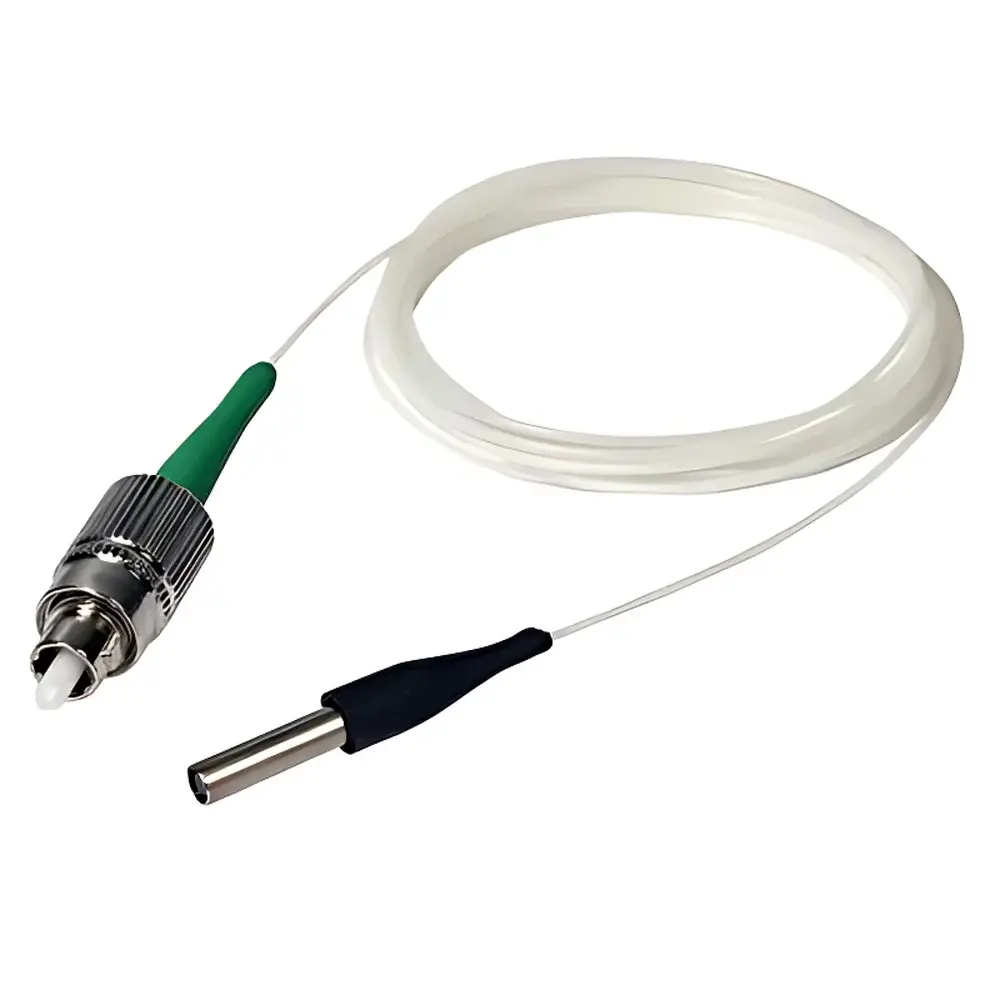
PMIWDM Hybrid Polarization-Maintaining Isolator and Wavelength Division Multiplexer
| Brand | AOE Tech |
|---|---|
| Model | PMIWDM |
| Category | Polarization-Maintaining Optical Component |
| Type | Integrated Passive Fiber-Optic Device |
| Construction | Monolithic Hybrid Assembly |
| Operating Principle | Polarization-Selective Non-Reciprocal Isolation + Wavelength-Dependent Directional Coupling |
| [Key | Value] |
| Brand | AOE Tech |
| Origin | Shanghai, China |
| Model | PMIWDM |
| Component Type | Polarization-Maintaining Hybrid Optical Device |
| Signal Wavelength Range | 1530–1565 nm |
| Pump Wavelength Options | 960–990 nm (for 980 nm band) or 1460–1490 nm (for 1480 nm band) |
| Typical Peak Isolation | 40 dB (single-stage), 55 dB (dual-stage) |
| Isolation at 23 °C (Signal Path) | ≥30 dB (single-stage), ≥48 dB (dual-stage) |
| Insertion Loss (Signal Path, 23 °C) | ≤0.9 dB (single-stage, 1550/980), ≤1.2 dB (double-stage, 1550/1480) |
| Insertion Loss (Reflection Band) | ≤0.6 dB |
| Extinction Ratio | ≥22 dB (F-type, fast-axis blocked), ≥20 dB (B-type, both axes active) |
| Directivity | ≥55 dB |
| Return Loss | ≥50 dB |
| Thermal Stability of IL | ≤0.005 dB/°C |
| Max Optical Power Handling | 300 mW (CW) |
| Operating Temperature | −5 to +70 °C |
| Storage Temperature | −40 to +85 °C |
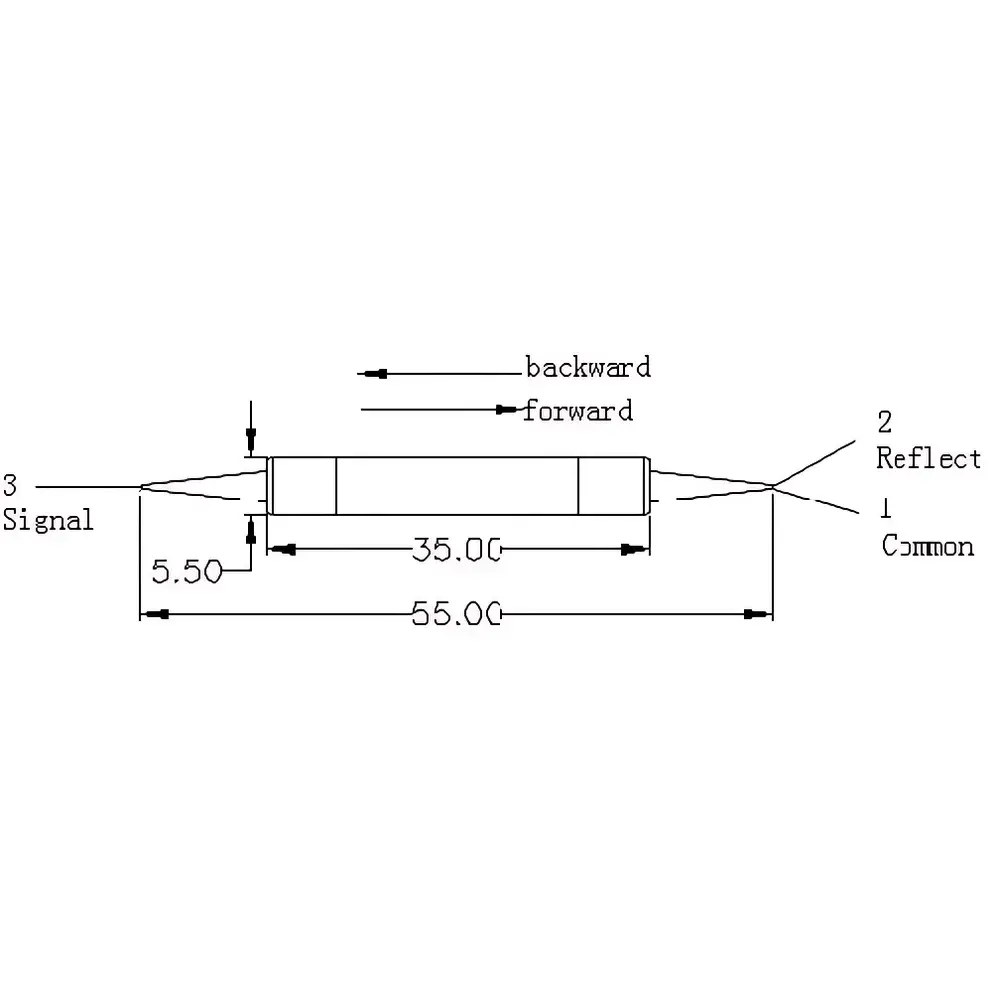
| Package Dimensions | Ø5.5 × L35 mm |
| Input/Output Fiber Options | PM1550 (transmit path), PM1550 / PM980 / HI1060 / SMF-28 (reflect path) |
| Alignment | Slow-axis aligned to connector key |
| Connector Options | FC/APC, FC/UPC, SC/APC, SC/UPC, LC/UPC, or bare fiber (250 µm or 900 µm) |
Overview
The PMIWDM Hybrid Polarization-Maintaining Isolator and Wavelength Division Multiplexer is a monolithically integrated passive fiber-optic component engineered for high-stability operation in polarization-sensitive laser and amplifier systems. It combines two fundamental functions—non-reciprocal optical isolation and wavelength-selective signal routing—within a single compact package, eliminating alignment drift and inter-component coupling losses common in discrete cascaded assemblies. Its core operation relies on the Faraday magneto-optic effect for polarization-dependent unidirectional transmission (isolation), and fused-fiber or micro-optic wavelength-selective interference for bidirectional spectral separation (WDM). Designed specifically for pump-signal multiplexing in erbium-doped fiber amplifiers (EDFAs), ytterbium-doped fiber lasers (YDFLs), and Raman pump modules, the PMIWDM maintains strict polarization extinction across both signal and pump paths while enforcing stringent optical return loss and thermal stability requirements mandated by industrial-grade photonic subsystems.
Key Features
- Integrated dual-function architecture: polarization-maintaining isolator + wavelength division multiplexer in one hermetically sealed Ø5.5 × 35 mm housing
- High isolation performance: ≥48 dB (dual-stage) at 1550 nm signal band with <0.005 dB/°C thermal coefficient of insertion loss
- Polarization fidelity preservation: slow-axis alignment guaranteed to connector key; extinction ratio ≥22 dB (F-type) ensures minimal depolarization in critical sensing and interferometric applications
- Low-insertion-loss design: ≤0.9 dB typical IL in signal path (1550 nm), ≤0.6 dB in reflection band (980/1480 nm), enabling >90% optical power throughput
- Robust environmental tolerance: qualified over −5 to +70 °C operating range with >300 mW continuous-wave power handling and ≥50 dB return loss
- Flexible configuration options: supports 1550/980 nm and 1550/1480 nm band pairs; selectable stage count (single/dual), working axis mode (fast-axis blocked or dual-axis), and fiber type per port (PM1550, PM980, HI1060, SMF-28)
Sample Compatibility & Compliance
The PMIWDM is compatible with industry-standard polarization-maintaining fibers (e.g., Fujikura PM1550, OZ Optics PM980) and single-mode delivery fibers (SMF-28e+, HI1060). All devices undergo 100% end-face inspection (IEC 61300-3-35 compliant), IL/RL/ER verification per Telcordia GR-1209-CORE, and thermal cycling validation (−40/+85 °C, 500 cycles). While not certified to ISO 17025 or FDA 21 CFR Part 11 (as it is a passive component), its performance specifications align with subsystem-level requirements defined in ITU-T G.692 (DWDM), IEC 61290-1-3 (optical amplifier testing), and IEEE 1627 (high-reliability photonics for industrial environments). Documentation includes full traceable test reports with serial-numbered calibration data.
Software & Data Management
As a passive optical component, the PMIWDM does not incorporate embedded firmware or digital interfaces. However, its metrological characterization data—including wavelength-dependent IL, isolation, ER, and RL curves—is provided in standardized CSV and PDF formats compatible with LabVIEW, MATLAB, and Python-based optical system modeling workflows (e.g., using PyOptica or OptiSystem libraries). For integration into automated test platforms, mechanical drawings (STEP, DXF), fiber orientation maps, and connector key alignment schematics are supplied to support robotic fiber docking and AOI-based alignment verification in production line setups.
Applications
- Bi-directional pump-signal combiners in high-power EDFA and YDFA modules where polarization state preservation is essential for gain flatness and noise figure control
- Seed laser protection circuits in ultrafast fiber oscillators requiring simultaneous isolation from back-reflections and spectral multiplexing of pump diodes
- Interferometric fiber sensor front-ends (e.g., Michelson or Sagnac configurations) demanding >20 dB extinction ratio and sub-0.01 dB/°C thermal drift
- Test instrumentation for characterizing polarization-dependent loss (PDL) and polarization mode dispersion (PMD) in DWDM networks
- Raman amplifier pump combiners operating at 14xx nm bands with co-propagating 1550 nm signals under high optical power density
FAQ
What does “F-type” vs. “B-type” mean in the working axis specification?
F-type denotes fast-axis blocked configuration—only the slow axis propagates, maximizing extinction ratio (>22 dB) for polarization-critical applications. B-type allows both axes to transmit, offering higher power handling but lower ER (~20 dB); selected when polarization diversity is required.
Can this device be used in a 1310/1550 nm WDM configuration?
No—the PMIWDM is optimized exclusively for 1550/980 nm and 1550/1480 nm band pairs. Its thin-film or fused-taper spectral response is not broadband; alternative hybrid isolators must be specified for 1310 nm compatibility.
Is slow-axis alignment verified and documented per unit?
Yes—each unit is measured via polarimetric scanning and receives a certificate indicating slow-axis angular deviation relative to the connector key (±0.5° max), traceable to NIST-traceable reference standards.
Does adding connectors affect the extinction ratio specification?
Yes—connectorized versions exhibit ≥2 dB reduction in ER versus bare-fiber variants due to angular misalignment and stress-induced birefringence; this is factored into the “with connector” performance envelope (ER ≥20 dB F-type, ≥18 dB B-type).
What is the maximum pulse energy this device supports in pulsed laser applications?
While rated for 300 mW CW, peak power handling depends on pulse width and repetition rate. For nanosecond pulses (<10 ns), damage threshold is ~1 MW/cm² at 1550 nm; users must verify fluence against fiber core area and coating integrity—consult AOE Tech’s pulsed-power application note (Doc #AOE-PMIWDM-PULSE-2024).



