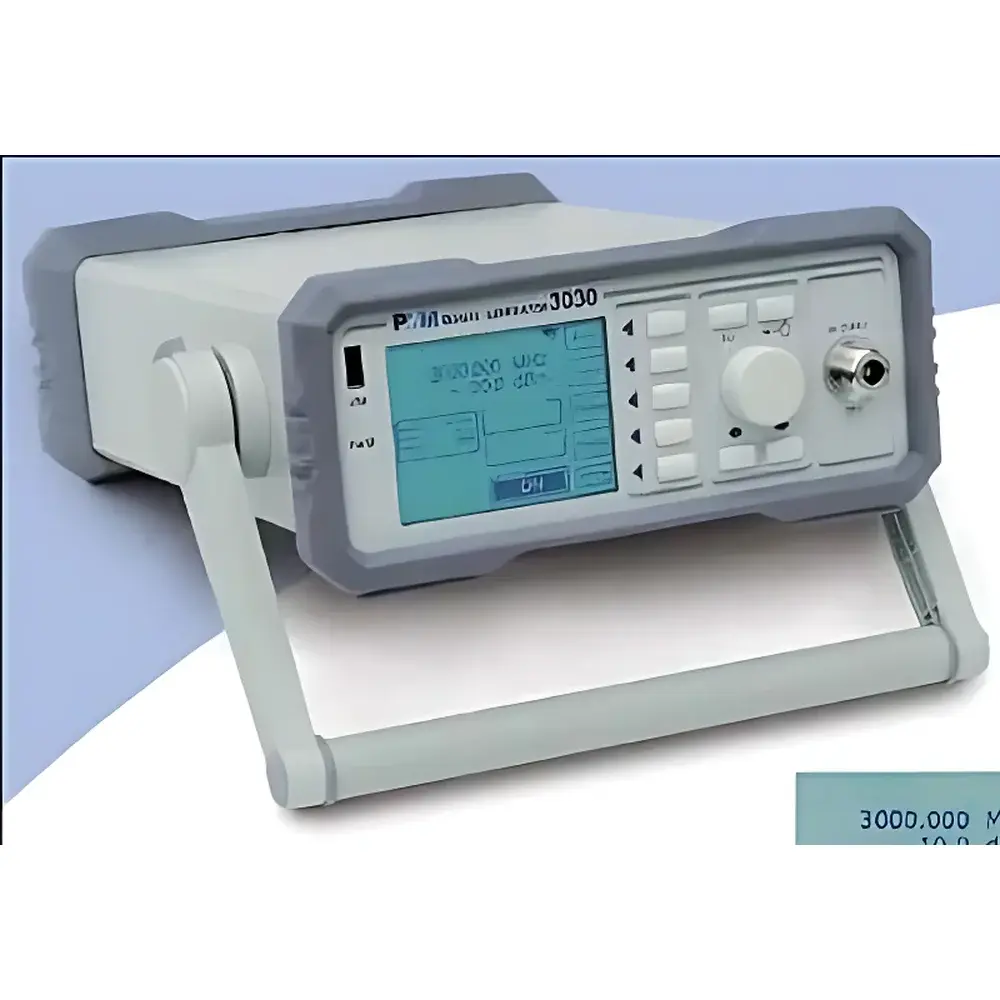
PMM 3010 / PMM 3030 RF Signal Generator
| Frequency Range | 9 kHz–1 GHz (PMM 3010) / 9 kHz–3 GHz (PMM 3030) |
|---|---|
| Output Level | –107 to +10 dBm |
| Level Resolution | 0.1 dB |
| Level Accuracy | ±1 dB (for levels > –30 dBm) |
| Frequency Resolution | 1 kHz |
| Frequency Accuracy | ±10 ppm |
| AM Modulation (Internal) | 2–400 Hz & 1 kHz, 10–90% depth |
| Pulse Modulation (Internal) | 1 Hz & 200 Hz, ON/OFF ratio >40 dB @ 0 dBm |
| Harmonics | < –30 dBc @ 0 dBm, f > 1 MHz |
| Output Impedance | 50 Ω |
| Interface | RS-232, USB 2.0, User I/O port (RF ON/OFF, Start/Stop) |
| Display | 340 × 240 pixels, 16 gray levels |
| Power Supply | DC 10–15 V / AC adapter (115–230 V, 50/60 Hz) |
| Optional Li-ion Battery (PMM 3030-02 only) | ~3 h runtime |
| Dimensions (W×H×D) | 235 × 105 × 335 mm |
| Compliance | IEC 61000-4-3, IEC 61000-4-6 |
Overview
The PMM 3010 and PMM 3030 RF Signal Generators are compact, portable instrumentation-grade sources engineered for electromagnetic compatibility (EMC) immunity testing in accordance with IEC 61000-4-3 (radiated immunity) and IEC 61000-4-6 (conducted immunity). Designed and manufactured in Italy by PMM, these generators operate on the principle of direct digital synthesis (DDS) combined with analog upconversion stages to deliver stable, low-phase-noise RF output across two distinct frequency bands: 9 kHz–1 GHz (PMM 3010) and 9 kHz–3 GHz (PMM 3030). Their architecture integrates internal modulation capability—AM and pulse—eliminating the need for external modulators in standard immunity test setups. The instruments support both manual operation via front-panel controls and full remote programmability, making them suitable for standalone bench use or integration into automated test systems requiring traceable, repeatable stimulus generation.
Key Features
- Integrated AM and pulse modulation engines—no external modulation source required for compliance-level testing
- High-resolution output control: 0.1 dB level resolution and ±1 dB amplitude accuracy above –30 dBm
- Stable frequency reference with ±10 ppm accuracy and 1 kHz frequency resolution
- Front-panel interface with monochrome graphical LCD (340 × 240 pixels, 16 gray levels) supporting dual units (dBm/dBµV)
- Dual power options: universal AC/DC adapter (115–230 V, 50/60 Hz) and optional rechargeable Li-ion battery pack (PMM 3030-02 variant only; ~3 h typical runtime)
- Robust mechanical design: aluminum chassis, compact footprint (235 × 105 × 335 mm), and EMI-shielded enclosure optimized for lab and field deployment
- User-accessible I/O port for hardware-triggered test sequencing (RF ON/OFF, Start/Stop signals)
- Programmable correction tables downloadable to internal memory for amplitude and frequency calibration compensation
Sample Compatibility & Compliance
The PMM 3010/3030 series is purpose-built for EMC pre-compliance and full-compliance immunity validation across industrial, automotive, and medical electronics sectors. Its output interface features a standard N-type female connector (50 Ω), compatible with coaxial cables, coupling clamps, CDN networks, and antenna feed systems used in IEC 61000-4-6 conducted immunity and IEC 61000-4-3 radiated immunity test configurations. Harmonic suppression exceeds –30 dBc at 0 dBm output above 1 MHz, ensuring minimal spectral contamination during sensitive receiver testing. The instruments meet essential requirements for test equipment traceability under ISO/IEC 17025-accredited laboratories and support audit-ready documentation workflows when deployed in GLP or GMP environments. While not certified as safety-class equipment, they comply with CE marking directives for EMC and low-voltage operation.
Software & Data Management
Remote operation is supported via industry-standard interfaces: RS-232 (3-wire), USB 2.0 (back-panel), and optional GPIB through an external adapter. Native SCPI command sets enable seamless integration with LabVIEW, MATLAB, Python (PySerial), or custom C/C++ test executive frameworks. All instruments store user-defined correction tables in non-volatile memory, allowing per-frequency-point amplitude offset compensation without host dependency. Firmware updates are performed via USB mass-storage mode. No proprietary software installation is required—only standard virtual COM port drivers (Windows/Linux/macOS). Audit trails for calibration events and configuration changes are maintained internally but do not include FDA 21 CFR Part 11-compliant electronic signatures; users implementing such regulatory requirements must layer external logging solutions.
Applications
- Radiated and conducted immunity testing per IEC 61000-4-3 and IEC 61000-4-6
- Pre-scan diagnostics for EMI troubleshooting and filter characterization
- Functional verification of RF front-ends, receivers, and wireless modules under controlled stimulus
- Education and training in EMC fundamentals and RF measurement techniques
- Portable field testing of installed equipment where mains power is unavailable (PMM 3030-02 with battery)
- Integration into turnkey immunity test systems using external amplifiers, antennas, and monitoring receivers
FAQ
What is the difference between the PMM 3010 and PMM 3030 models?
The primary distinction lies in frequency coverage: the PMM 3010 operates from 9 kHz to 1 GHz, while the PMM 3030 extends to 3 GHz—enabling higher-frequency immunity testing relevant to modern wireless standards including UWB, LTE Band 42/43, and 5G NR n78.
Can the instrument be used without a computer?
Yes. Both models feature intuitive front-panel controls and a built-in display, enabling fully autonomous operation for basic sweep, level, and modulation setup.
Is the internal battery option available for the PMM 3010?
No. The rechargeable Li-ion battery pack is exclusive to the PMM 3030-02 variant.
Does the generator support external AM modulation sources?
Yes. A BNC female input (600 Ω impedance) accepts analog AM signals from 2 Hz to 10 kHz, with modulation depth adjustable from 10% to 90%.
How is calibration traceability ensured?
Each unit ships with a factory calibration certificate referencing national metrology institutes (e.g., INRIM, Italy). Users may perform periodic verification using calibrated power meters and spectrum analyzers; correction tables can be updated to maintain long-term amplitude fidelity.