
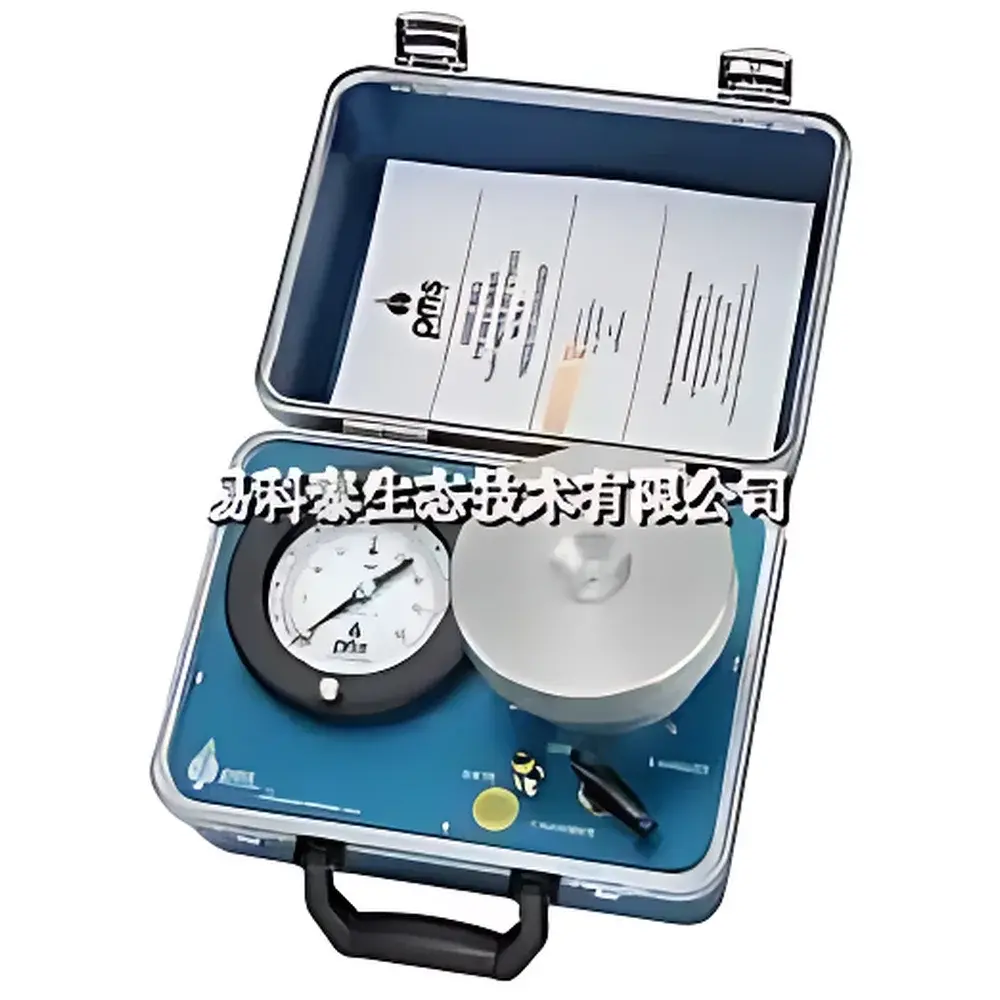
PMS Instruments Model 670 Plant Pressure Chamber
| Key | Origin: USA |
|---|---|
| Manufacturer Type | Authorized Distributor |
| Origin Category | Imported |
| Model | Model 670 |
| Maximum Operating Pressure | 40 bar |
| Sample Chamber Dimensions | 10.2 cm (4 in) diameter × 17.8 cm (7 in) depth |
| Pressure Gauge | Analog dial, 40 bar range, ±0.5% full-scale accuracy, 11.4 cm (4.5 in) face diameter |
| Overall Dimensions | 33 × 28 × 24 cm |
| Weight | 7.5 kg |
| Included Accessories | Sealing gaskets (10 pcs, solid), O-ring lubricant, 3/16″ insertion tool, 1.83 m (6 ft) inflation hose, valve adjustment tool, technical manual |
| Optional Accessories | 22 ft³ aluminum high-pressure gas cylinder (4.4 kg), illuminated handheld magnifier, gasket set (1/16″, 1/8″, 3/16″, solid), aluminum-frame backpack (1.8 kg) |
Overview
The PMS Instruments Model 670 Plant Pressure Chamber is a field-deployable, gas-driven instrument engineered for the direct measurement of plant tissue water potential (Ψw) via the pressure chamber method—based on the thermodynamic equilibrium principle between xylem sap and ambient gas phase. When pressurized nitrogen or compressed air is applied to excised leaf or stem tissue sealed within the chamber, the external pressure required to force the first drop of xylem sap to the cut surface corresponds to the negative water potential of the sample at time of excision. This method, standardized under ASTM D5219-18 (Standard Test Method for Determination of Water Potential of Plant Tissue by Pressure Chamber) and widely adopted in plant ecophysiology research, provides rapid, non-destructive quantification of plant water status under drought stress, irrigation scheduling, or physiological phenotyping protocols.
Key Features
- Optimized large-bore sample chamber (10.2 cm diameter × 17.8 cm depth) accommodates oversized leaves, woody stems, and intact branch segments unsuitable for standard chambers such as the Model 600.
- Robust anodized aluminum chamber body ensures corrosion resistance, thermal stability, and long-term dimensional integrity under repeated pressurization cycles up to 40 bar.
- High-visibility analog pressure gauge with 11.4 cm face diameter and ±0.5% full-scale accuracy enables precise visual interpolation during critical endpoint detection.
- Modular sealing system includes ten solid rubber gaskets, adjustable O-rings with proprietary silicone-based lubricant, and a dedicated 3/16″ insertion tool for consistent gasket seating—minimizing leakage risk and improving inter-operator reproducibility.
- Integrated valve assembly with fine-thread adjustment allows controlled, stepwise pressure increments—critical for accurate endpoint determination in low-water-potential samples (e.g., < −2.5 MPa).
- Compact footprint (33 × 28 × 24 cm) and 7.5 kg mass support routine transport to remote field sites; compatible with optional 22 ft³ lightweight aluminum gas cylinder (4.4 kg) and ergonomic aluminum-frame backpack (1.8 kg).
Sample Compatibility & Compliance
The Model 670 accepts intact leaves, petioles, small branches, and herbaceous stems up to 17 cm in length and ≤9.5 cm in maximum cross-sectional dimension. Gasket options—including 1/16″, 1/8″, and 3/16″ bore diameters—enable secure sealing of narrow-diameter stems while maintaining uniform pressure transmission. The system complies with core requirements of ISO 10932:2012 (Plant physiology — Determination of water potential by pressure chamber method) and supports GLP-aligned documentation when used with calibrated pressure gauges traceable to NIST standards. All metallic components meet RoHS Directive 2011/65/EU restrictions on hazardous substances.
Software & Data Management
As a manually operated analog instrument, the Model 670 does not incorporate embedded electronics or digital data logging. However, it integrates seamlessly into structured experimental workflows requiring audit-trail compliance: users may record pressure readings alongside metadata (sample ID, time of excision, ambient RH/T, operator initials) in paper-bound lab notebooks or validated electronic lab notebooks (ELNs) compliant with FDA 21 CFR Part 11. Optional illuminated handheld magnifiers facilitate reliable endpoint identification during low-light conditions (e.g., pre-dawn measurements), reducing observer bias—a key consideration in ISO/IEC 17025-accredited plant physiology laboratories.
Applications
- Drought tolerance screening in crop breeding programs (e.g., maize, wheat, grapevine)
- Irrigation scheduling validation in orchards and vineyards using midday stem water potential thresholds
- Comparative ecophysiology studies across species or genotypes under controlled-environment or field conditions
- Calibration and validation of indirect water potential proxies (e.g., thermal infrared imaging, stomatal conductance models)
- Long-term monitoring of plant water status in ecological restoration sites and climate change impact assessments
- Teaching laboratory use for undergraduate plant physiology courses—demonstrating fundamental concepts of water movement, osmotic potential, and turgor loss point
FAQ
What gas is recommended for operation?
Nitrogen (N₂) is strongly recommended over compressed air to eliminate moisture contamination and prevent oxidation of internal seals. A regulated supply from a portable aluminum cylinder (22 ft³, Grade 5.0 N₂) is optimal.
Can the Model 670 measure root or soil water potential?
No—the pressure chamber method is validated only for aboveground plant tissues. Root or soil water potential requires tensiometric, thermocouple psychrometric, or vapor pressure deficit-based instrumentation.
How often should the analog pressure gauge be recalibrated?
Annual calibration against a NIST-traceable deadweight tester is recommended; field verification using a certified reference gauge before each intensive sampling campaign is advised.
Is the Model 670 suitable for ISO/IEC 17025 accreditation?
Yes—when operated within documented SOPs, with traceable gauge calibration records, trained personnel, and controlled environmental monitoring (e.g., sample equilibration time, ambient temperature), it meets technical requirements for accredited testing laboratories.
What maintenance is required for long-term reliability?
O-rings must be inspected and replaced annually or after 500 pressurization cycles; gaskets should be rotated per-use to avoid compression set; chamber interior must be wiped dry after each use to prevent residual moisture accumulation.




