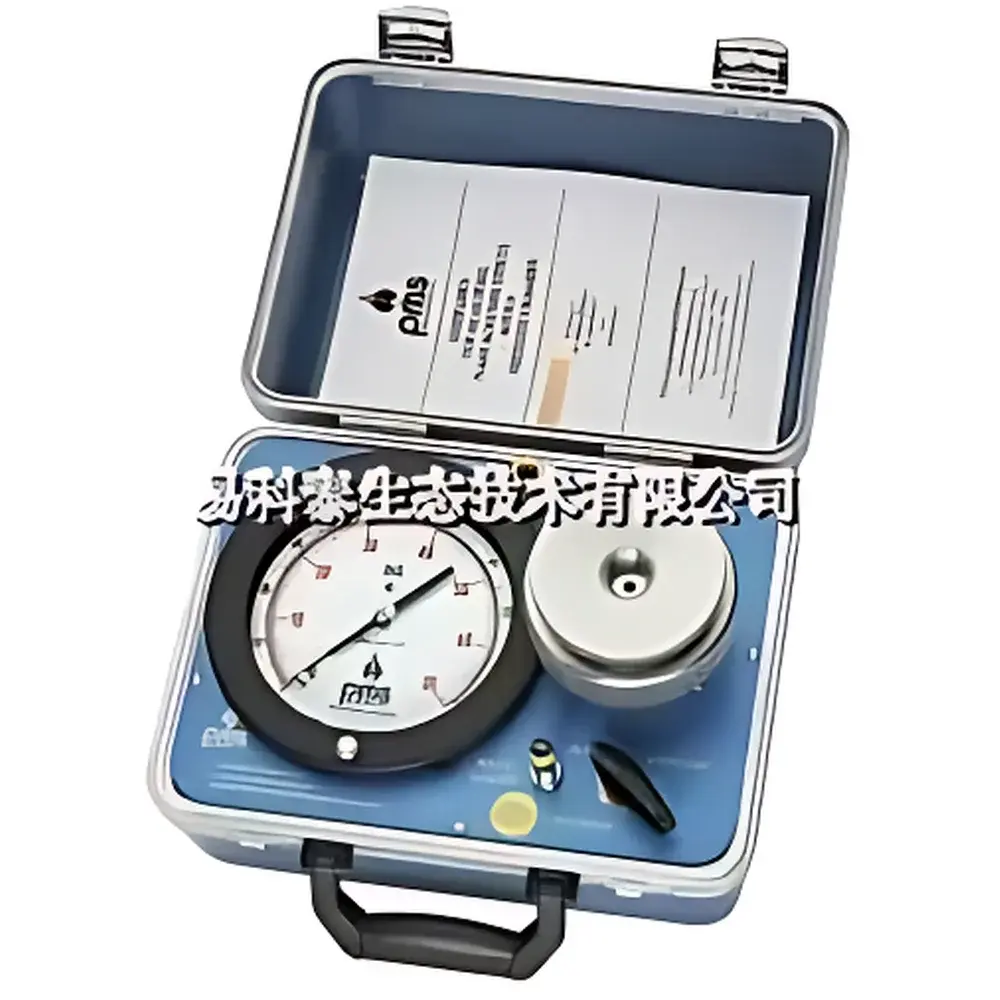
PMS Model 1000 Plant Pressure Chamber
| Key | Origin: USA |
|---|---|
| Manufacturer Type | Authorized Distributor |
| Origin Category | Imported |
| Model | Model 1000 |
| Quotation | Available Upon Request |
| Max Operating Pressure | 70 bar |
| Sample Chamber | Stainless Steel, 2.5 in (63.5 mm) diameter × 5 in (127 mm) depth |
| Pressure Gauge | Analog dial, 70 bar range, ±0.5% full-scale accuracy, 6 in (152 mm) face diameter |
| Dimensions (W×D×H) | 33 × 28 × 24 cm |
| Weight | 9.5 kg |
Overview
The PMS Model 1000 Plant Pressure Chamber is a field-deployable, high-pressure gas-driven instrument engineered for direct measurement of plant water potential (Ψw) via the pressure chamber technique—based on the thermodynamic principle that water potential in excised plant tissue equilibrates with applied external gas pressure at the point of xylem sap exudation. This method, standardized under ASTM D7623 and widely adopted in plant ecophysiology, provides rapid, non-destructive quantification of whole-leaf or stem water status under both controlled and natural environmental conditions. Designed for rigorous research applications—including drought physiology, irrigation scheduling, and comparative studies of xerophytic species—the Model 1000 delivers reliable measurements across an extended operational range up to 70 bar (7 MPa), enabling accurate assessment of species with exceptionally high water potentials (e.g., succulents, desert shrubs, and irrigated crops) as well as low-water-potential stress responses in arid-zone ecosystems.
Key Features
- Robust stainless-steel sample chamber (63.5 mm × 127 mm) ensures long-term corrosion resistance and pressure integrity during repeated field use.
- Analog pressure gauge with 6-inch face diameter and ±0.5% full-scale accuracy enables precise visual reading without reliance on battery-powered electronics—critical for remote or low-infrastructure environments.
- Modular sealing system compatible with interchangeable rubber septa (four bore sizes: 1/16″, 1/8″, 3/16″, solid) and high-performance O-rings (five inner-diameter options: 3/32″, 1/4″, 3/8″, 1/2″, and strip-type 1/8″ × 1/2″) to accommodate diverse stem diameters and leaf petiole morphologies.
- Integrated 6-foot reinforced inflation hose with 1/4″ NPT sealing fittings and included valve adjustment tool ensures leak-tight pressurization and consistent operator control.
- Optional accessories—including lightweight aluminum 22-ft³ compressed gas cylinder (4.4 kg), gas-conserving chamber inserts, illuminated handheld magnifier for pre-dawn exudate detection, and ergonomic aluminum-frame backpack (1.8 kg)—extend operational flexibility for multi-site field campaigns.
Sample Compatibility & Compliance
The Model 1000 accommodates intact leaves, cut stems, and herbaceous or woody twigs up to 5 inches in length and ≤2.5 inches in maximum cross-sectional dimension. Its modular septum design supports reproducible sealing across taxonomically diverse species—from narrow-stemmed grasses to thick-barked shrubs—while minimizing tissue compression artifacts. The system complies with standard protocols outlined in ISO 10933 (Plant physiology — Determination of water potential by pressure chamber method) and aligns with GLP-aligned data collection practices when paired with documented operator training and calibrated pressure gauge verification logs. Though not inherently electronic, the analog readout avoids regulatory constraints associated with digital data acquisition systems under FDA 21 CFR Part 11; however, manual logbook entries remain fully audit-ready for peer-reviewed publication and institutional review board (IRB) submissions.
Software & Data Management
The Model 1000 operates independently of software or digital interfaces. All measurements are recorded manually in field notebooks or laboratory logbooks, supporting traceability through handwritten timestamps, observer initials, sample identifiers, ambient temperature/humidity annotations, and pressure readings. Users may integrate results into LIMS or statistical platforms (e.g., R, JMP, SAS) via structured CSV import after transcription. For laboratories requiring electronic records, optional third-party digital pressure transducers (NIST-traceable, 0–100 bar, ±0.25% FS) can be retrofitted with analog-to-digital converters compliant with ISO/IEC 17025 calibration requirements—though such modifications fall outside factory warranty scope.
Applications
- Drought tolerance screening in breeding programs for cereals, legumes, and perennial bioenergy crops.
- Validation of soil-plant-atmosphere continuum (SPAC) models in semi-arid agroecosystems.
- Diurnal water potential profiling to assess stomatal regulation dynamics under varying VPD conditions.
- Irrigation threshold determination for precision viticulture and orchard management.
- Ecophysiological comparisons among native vs. invasive species in riparian restoration projects.
- Long-term monitoring of hydraulic failure risk in forest stands experiencing climate-induced moisture stress.
FAQ
What is the typical measurement time per sample?
Each measurement requires 30–90 seconds from pressurization initiation to first xylem sap appearance, depending on species-specific hydraulic conductivity and ambient temperature.
Can the Model 1000 be used with nitrogen instead of compressed air?
Yes—any dry, inert, non-reactive gas (e.g., N₂, CO₂, or filtered compressed air) may be used; nitrogen is preferred for long-term seal integrity and avoidance of moisture condensation.
Is calibration required before each use?
The analog gauge should be verified annually against a NIST-traceable deadweight tester; daily zero-checks are recommended prior to field deployment.
How does chamber size affect measurement accuracy?
The fixed 2.5-inch diameter minimizes edge effects and ensures uniform pressure distribution across most angiosperm and gymnosperm samples; oversized tissues may require trimming to fit within the chamber’s axial depth limit.
What safety certifications apply to the pressure chamber system?
The chamber body meets ASME B31.4 pressure vessel design guidelines for low-volume, intermittent service; all high-pressure components carry CE marking per PED 2014/68/EU and are rated for 1.5× maximum operating pressure (105 bar burst rating).