
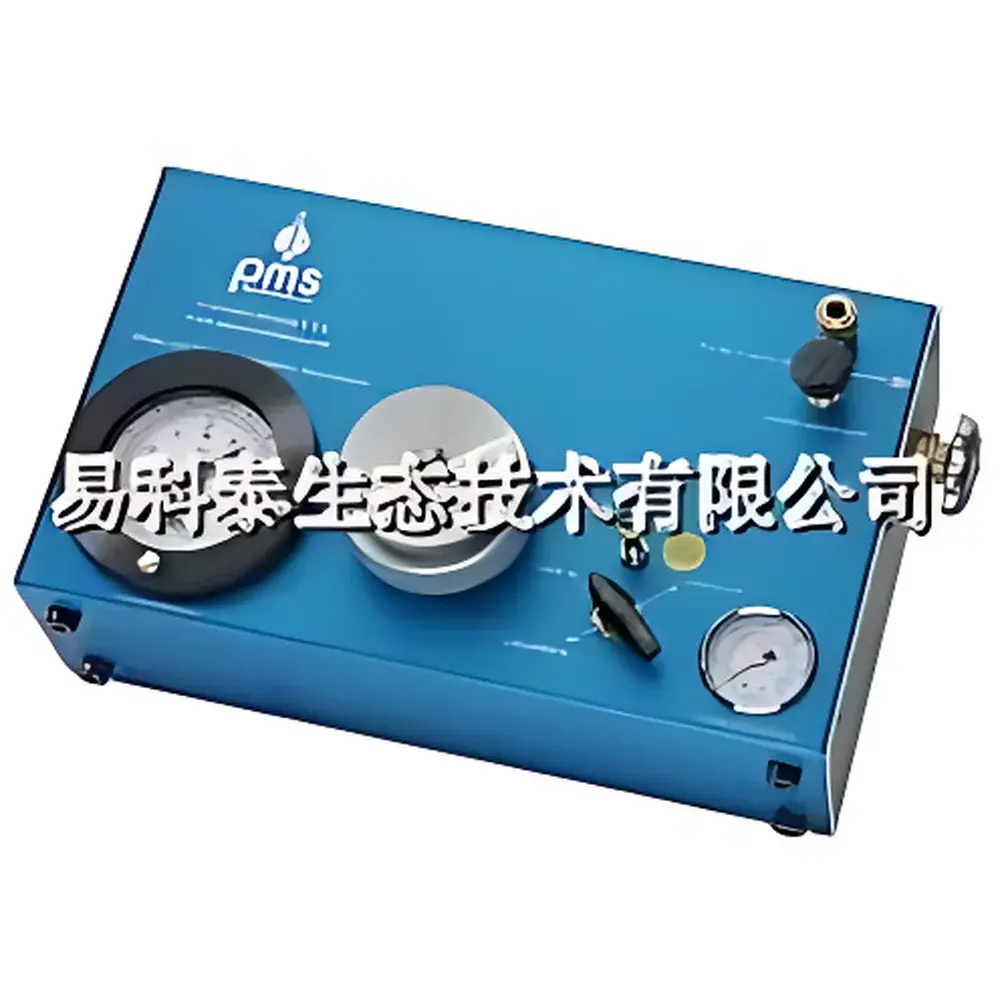
PMS Model 610 Plant Pressure Chamber
| Key | Origin: USA |
|---|---|
| Manufacturer Type | Authorized Distributor |
| Origin Category | Imported |
| Model | Model 610 |
| Price | Upon Request |
| Max Operating Pressure | 40 bar |
| Sample Chamber | Aluminum, 2.5 in (63.5 mm) diameter × 5 in (127 mm) depth |
| Pressure Gauge | Analog dial, 40 bar range, ±0.5% full-scale accuracy, 4.5 in (114 mm) face diameter |
| Dimensions (L×W×H) | 53 × 31 × 22 cm |
| Weight | 12.3 kg |
Overview
The PMS Model 610 Plant Pressure Chamber is a field-deployable, gas-pressure-based instrument engineered for direct measurement of plant water potential (Ψleaf or Ψstem) via the pressure-balance technique. Rooted in the fundamental principle that water potential equals the external pressure required to induce xylem sap exudation from a cut surface, the Model 610 applies regulated nitrogen or compressed air to a sealed sample chamber containing a leaf or stem segment. When the first droplet of xylem sap emerges at the cut end—visually confirmed under ambient or low-light conditions—the corresponding chamber pressure is recorded as the sample’s water potential, expressed in megapascals (MPa) or bars (1 bar ≈ 0.1 MPa). Designed for robustness and operational simplicity in diverse agroecological and ecological field settings, the system integrates a high-integrity aluminum chamber, precision analog pressure instrumentation, and modular sealing components to ensure repeatable, operator-independent measurements compliant with established plant hydraulics protocols (e.g., Tyree & Hammel, 1972; Nobel, 2005).
Key Features
- Field-optimized mechanical architecture: Integrated four-wheel transport cart with reinforced tie-down straps enables stable positioning on uneven terrain; compact footprint (53 × 31 × 22 cm) and 12.3 kg mass support rapid relocation between plots or canopy zones.
- High-fidelity analog pressure sensing: 40 bar full-scale gauge with ±0.5% accuracy and 4.5-inch dial face ensures unambiguous visual reading under variable lighting—critical for pre-dawn measurements when stomatal conductance is minimized and water potential reflects soil-plant-atmosphere continuum equilibrium.
- Modular sealing system: Includes five high-durometer O-rings, one solid standard rubber seal, lubricant for O-ring longevity, and a 6-ft reinforced inflation hose with 1/4-inch NPT fittings compatible with standard industrial nitrogen cylinders (CGA-580).
- Configurable sample interface: Standard rubber seals available in four bore diameters (1/16″, 1/8″, 3/16″, solid) and five sealing gasket sizes (3/32″, 1/4″, 3/8″, 1/2″, and strip 1/8″ × 1/2″) accommodate stems ranging from herbaceous monocots to mature woody dicots.
- Accessory ecosystem: Optional accessories—including chamber fill material (to reduce dead volume and extend cylinder usage), illuminated handheld magnifier (for low-light sap detection), insertion tools (for precise sample placement), and lightweight aluminum backpack frame (1.8 kg, supports chamber + portable cylinder)—enhance protocol fidelity and operator ergonomics.
Sample Compatibility & Compliance
The Model 610 accommodates intact leaves, petioles, and terminal branches up to 5 inches in length and ≤2.5 inches in maximum cross-sectional dimension. Its aluminum chamber resists corrosion from repeated exposure to humidity, dust, and mild organic residues. While not certified to ISO/IEC 17025 for accredited testing laboratories, the instrument conforms to methodological standards cited in ASTM D5540 (Standard Practice for Sampling Water for Microbiological Analysis) for field-sampling integrity and aligns with USDA ARS and FAO irrigation scheduling guidelines requiring water potential thresholds for deficit irrigation management. Data acquisition adheres to GLP principles through documented operator calibration checks, seal integrity verification prior to each run, and manual logbook entries traceable to sample ID, time, location, and environmental conditions.
Software & Data Management
The Model 610 operates as a stand-alone, analog measurement platform with no embedded electronics or digital output. All data are manually recorded in field notebooks or spreadsheet templates. This design eliminates firmware dependencies, battery constraints, or cybersecurity vulnerabilities—advantages critical for long-term deployments in remote research stations or resource-limited agricultural extension programs. Users may integrate readings into LIMS or statistical analysis workflows using standardized CSV import protocols. Though lacking FDA 21 CFR Part 11-compliant electronic signatures, the system supports audit-ready documentation when paired with controlled logbooks, timestamped photographs of gauge readings, and chain-of-custody annotations per ISO 14001 environmental monitoring frameworks.
Applications
- Irrigation scheduling in viticulture, orchards, and row crops by correlating midday leaf water potential with soil moisture status and evapotranspiration models.
- Drought stress phenotyping in breeding programs evaluating genotypic variation in hydraulic conductance and stomatal regulation.
- Ecohydrological studies quantifying plant-water relations across gradients of elevation, soil texture, or atmospheric vapor pressure deficit.
- Validation of non-invasive sensors (e.g., thermal infrared, dendrometers) where ground-truth water potential references are required.
- Undergraduate and graduate teaching labs demonstrating core concepts in plant water relations, osmotic adjustment, and xylem cavitation resistance.
FAQ
What gas is recommended for operation?
Nitrogen (N₂) is strongly recommended due to its inertness, consistent compressibility, and absence of moisture or hydrocarbon contaminants that could affect seal integrity or introduce condensation artifacts.
Can the Model 610 measure root or soil water potential?
No—it is specifically designed for aboveground plant tissues. Root or soil water potential requires thermocouple psychrometry, tensiometry, or gypsum block sensors.
Is calibration required before each use?
Yes—users must verify zero-pressure baseline and confirm gauge linearity against a certified reference manometer at least once per field season, or after any impact event or gauge replacement.
How many measurements can be performed per standard 20-cu-ft nitrogen cylinder?
With chamber fill material installed and typical 15–25 bar operating pressures, >120 measurements are achievable per cylinder; without fill material, yield drops to ~60–80 depending on sample size and target pressure.
Does the instrument comply with international shipping regulations for pressurized equipment?
The Model 610 itself is non-pressurized during transit; however, accompanying nitrogen cylinders must be shipped separately in accordance with IATA Dangerous Goods Regulations (Class 2.2, UN1002) and local DOT requirements.




