
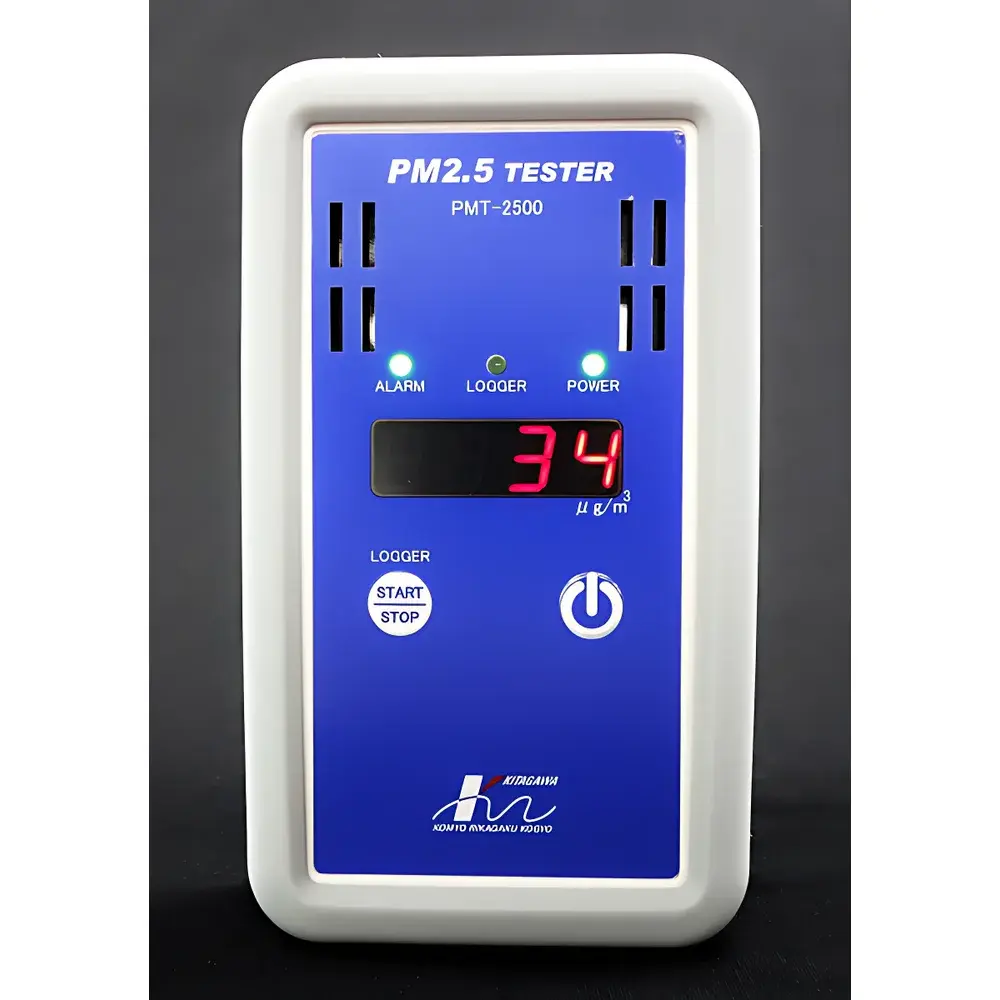
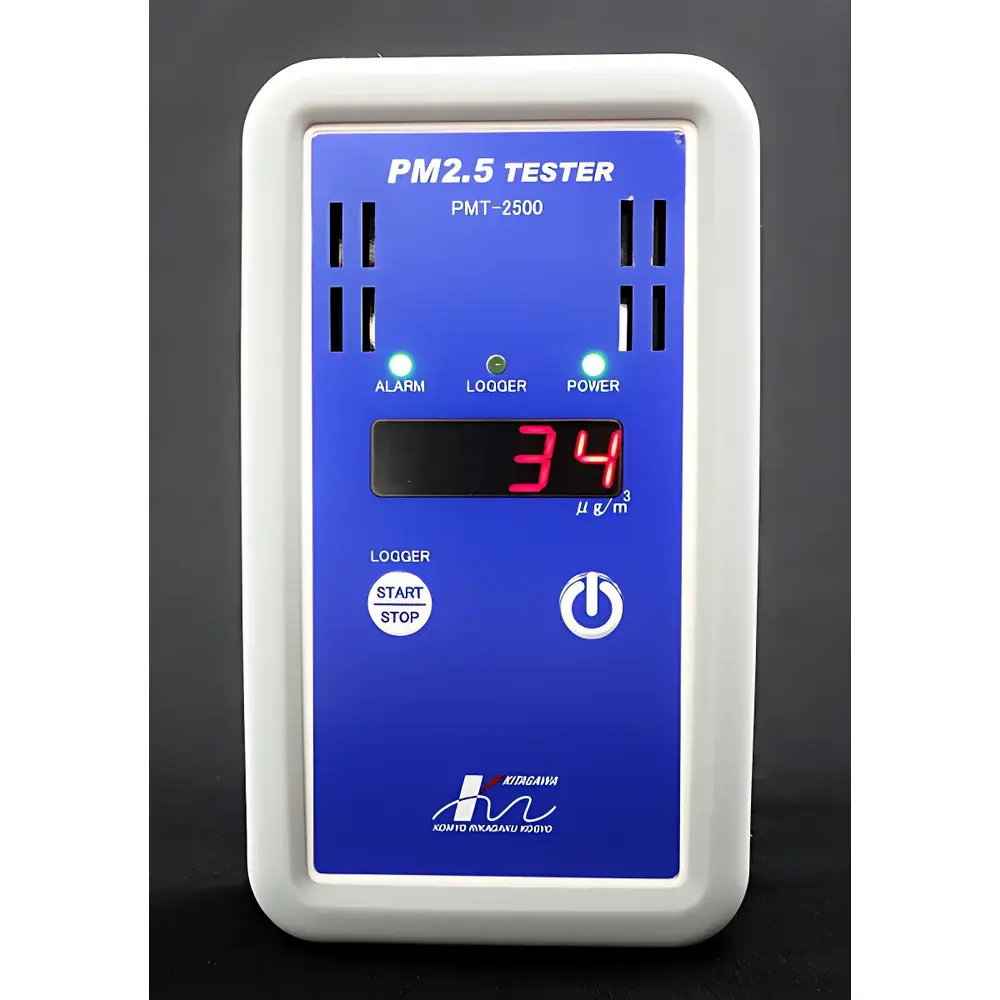
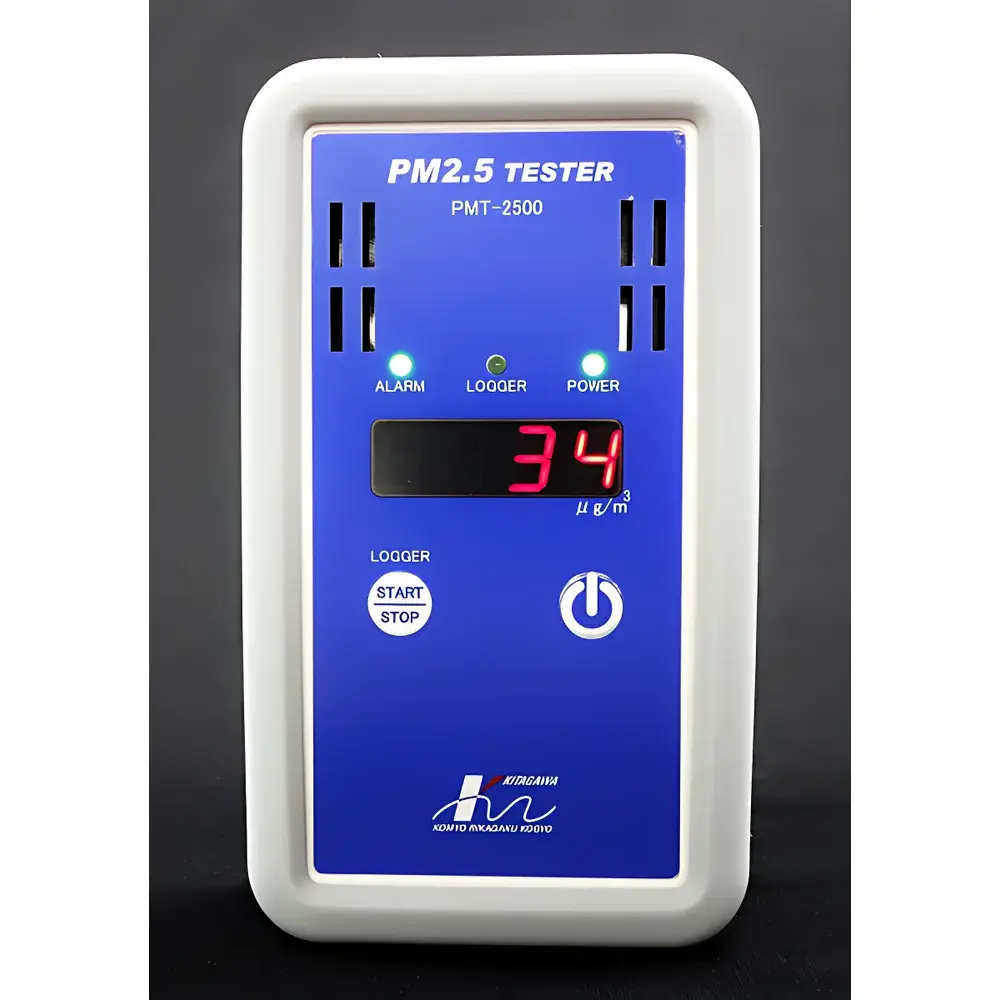
PMT-2500 Handheld PM2.5 Aerosol Monitor
| Brand | — |
|---|---|
| Origin | Beijing, China |
| Manufacturer Type | Authorized Distributor |
| Origin Category | Domestic (China) |
| Model | PMT-2500 |
| Pricing | Available Upon Request |
| Detection Principle | Laser Light Scattering (90° scattering geometry) |
| Alarm Indicator | Tri-color LED (Green/Yellow/Red) with stepwise activation based on PM2.5 concentration thresholds |
| Power Supply | 3× AA alkaline batteries (internal) or DC 5 V via included USB cable |
| Display | 4-digit 7-segment LED |
| Accuracy | ±15 µg/m³ (for concentrations <100 µg/m³), ±15% (for ≥100 µg/m³) |
| Response Time | ≤6 seconds (T90) |
| Operating Temperature | −10 °C to +50 °C |
| Operating Humidity | 0–95% RH (non-condensing) |
| Power Consumption | 0.6 W (active), 0.1 W (standby) |
| Data Logging | User-selectable intervals (1/5/10/30/60 min) |
| Dimensions | 81(W) × 40(H) × 141(D) mm |
| Weight | ≈345 g (including batteries and silicone rubber cover) |
| Accessories | USB cable (15 cm), AA batteries, protective silicone cover |
Overview
The PMT-2500 Handheld PM2.5 Aerosol Monitor is a portable, real-time particulate matter analyzer engineered for rapid, field-deployable assessment of ambient airborne fine particulates (PM2.5). It employs a calibrated laser diode light scattering principle—specifically side-scatter detection at approximately 90°—to quantify mass concentration in micrograms per cubic meter (µg/m³). This optical method relies on Mie scattering theory, where particle size distribution within the respirable range (≤2.5 µm aerodynamic diameter) modulates scattered light intensity in a reproducible manner. The instrument’s compact form factor, low-power architecture, and battery-operated design enable continuous monitoring across diverse environmental contexts: urban roadside surveys, indoor air quality audits, construction site boundary assessments, school campus evaluations, and occupational hygiene spot checks. Its measurement range spans typical ambient conditions—from background levels (~5 µg/m³) up to heavily polluted episodes (>300 µg/m³)—with traceable performance validated against reference gravimetric methods under controlled laboratory conditions.
Key Features
- Real-time PM2.5 concentration readout with ≤6-second response time (T90), supporting dynamic exposure assessment.
- Tri-color LED alarm system (green/yellow/red) provides immediate visual feedback aligned with WHO interim guidelines and China’s GB 3095-2012 ambient air quality standards.
- Integrated data logger stores up to 32,000 records; five programmable logging intervals (1/5/10/30/60 minutes) accommodate short-term diagnostics or multi-day trend analysis.
- Low-power consumption (0.6 W active, 0.1 W standby) ensures >20 hours of continuous operation on standard AA alkaline cells.
- Ruggedized housing with IP54-rated silicone rubber cover resists dust ingress and incidental moisture—suitable for outdoor use in non-rainy conditions.
- USB interface enables direct connection to Windows/macOS systems for raw data retrieval, timestamped CSV export, and post-processing in Excel or statistical software.
Sample Compatibility & Compliance
The PMT-2500 is designed exclusively for ambient and indoor air sampling of suspended solid and liquid aerosols—primarily combustion-derived soot, secondary sulfate/nitrate particles, crustal dust, and bioaerosol fragments. It does not discriminate chemical composition or particle morphology but delivers mass-concentration estimates traceable to EN 12341:2014 (ambient air quality—standard reference method for PM10/PM2.5) and ISO 29463-3:2011 (high-efficiency filter testing, relevant to calibration protocol alignment). While not certified as a regulatory-grade reference monitor, its accuracy specification (±15 µg/m³ below 100 µg/m³; ±15% above) meets requirements for indicative monitoring per EU Directive 2008/50/EC Annex XI. Device firmware supports GLP-compliant audit trails when used with documented calibration logs and operator metadata.
Software & Data Management
No proprietary software installation is required. The PMT-2500 appears as a CDC-class USB device; exported data files are plain-text CSV with columns: Timestamp (YYYY-MM-DD HH:MM:SS), PM2.5 (µg/m³), Battery Voltage (V), and Temperature (°C). Timestamps are generated by the internal RTC, synchronized during USB connection. For enterprise deployments, data can be ingested into LIMS platforms or cloud-based environmental dashboards via automated scripts (Python/PowerShell examples available upon request). Firmware updates—delivered as signed HEX binaries—are applied via bootloader mode, preserving user-configured logging parameters.
Applications
- Urban air quality mapping by municipal environmental departments during high-pollution episodes.
- Indoor IAQ verification in offices, schools, and healthcare facilities prior to HVAC commissioning.
- Construction site compliance monitoring near demolition or earthwork zones.
- Educational demonstrations of aerosol physics and environmental health linkages in university laboratories.
- Personal exposure tracking for epidemiological cohort studies using standardized protocols.
- Pre-screening tool prior to deployment of gravimetric or beta-attenuation reference monitors.
FAQ
Is the PMT-2500 suitable for regulatory compliance reporting?
No—it is designated as an indicative monitor per ISO 29463 and EN 12341. Regulatory submissions require certified reference methods (e.g., TEOM, BAM, or gravimetric filters).
Can it measure PM1.0 or PM10?
No. The optical cutoff and inlet design are optimized specifically for PM2.5 cutpoint performance per ISO/CIE 21501-4:2019.
What calibration standards are supported?
Factory calibration uses NIST-traceable polystyrene latex (PSL) spheres and verified against TSI 8520 DustTrak reference units. Field recalibration requires accredited service centers.
Does it meet FDA 21 CFR Part 11 requirements?
No—electronic records lack digital signature, audit trail, or role-based access control. It is not intended for GxP-regulated environments.
How often should the optical chamber be cleaned?
Visual inspection recommended every 30 days; cleaning with lens-grade tissue and isopropyl alcohol advised if condensation residue or dust accumulation is observed.







