
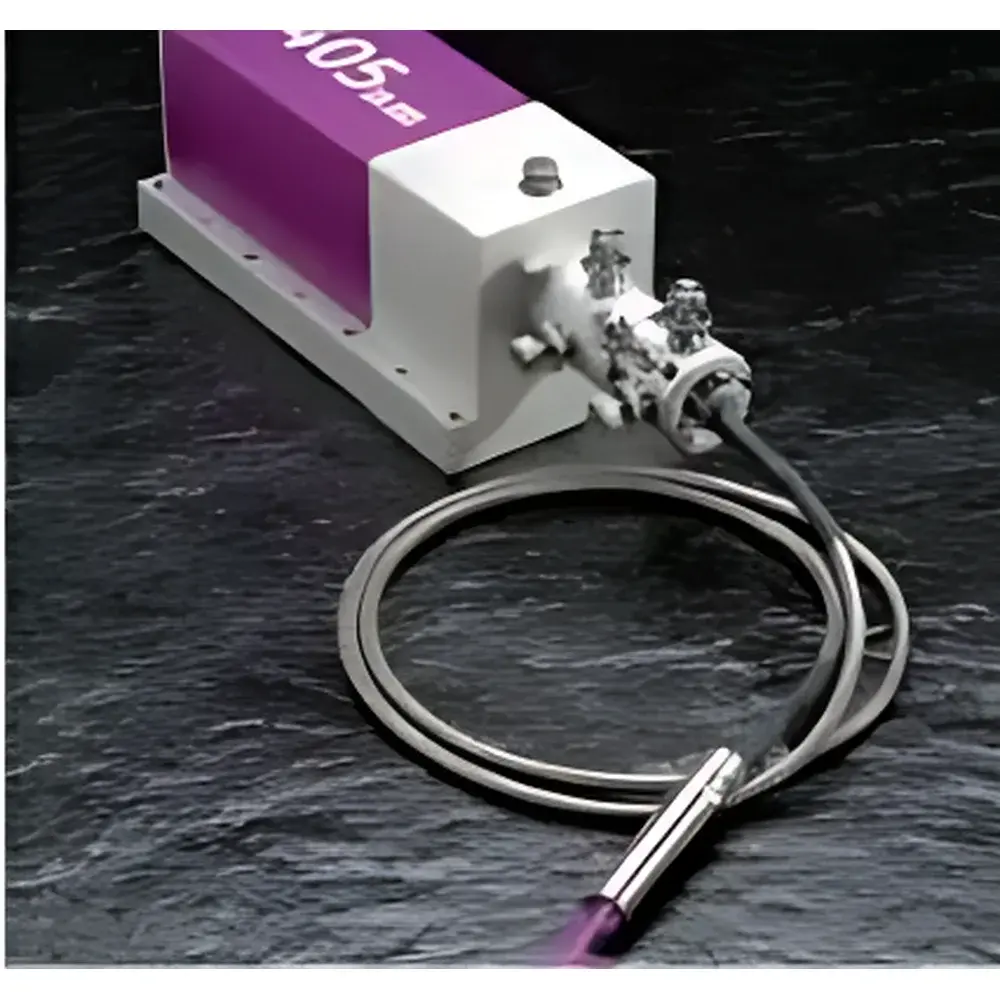
Point-Source iFLEX-Q3 Fiber-Coupled Semiconductor Laser Module
| Brand | Point-Source |
|---|---|
| Origin | UK |
| Model | iFLEX-Q3 |
| Wavelengths | 375, 405, 445, 473, 640, 660, 670, 780, 830 nm |
| Output Power | 8–100 mW (model-dependent) |
| Polarization Extinction Ratio | ≤−27 dB |
| Beam Profile | TEM₀₀, M² ≤ 1.2 |
| Power Stability | <2% over 8 h |
| Intensity Noise | <0.1% RMS (20 Hz–2 MHz) |
| Wavelength Stability | ±5 nm |
| Beam Dimensions (typ.) | 0.7–2.2 mm × 0.7–0.9 mm |
| Beam Divergence | Diffraction-limited |
| Pointing Stability | ≤5 µrad/°C |
| Operating Temperature | 10–40 °C |
| Storage Temperature | 10–50 °C |
| Laser Head Dimensions | 36 × 36 × 58 mm |
| Remote Driver Dimensions | 126 × 81 × 30 mm |
| Electrical Supply | 12 VDC / 0.5 A (laser), 5 VDC / max 3 A (TEC) |
| Max Thermal Load | 12.5 W |
| Fiber Output | Single-mode, FC/PC, FC/APC or FCP connector options |
| Compliance | CE, RoHS, IEC 60825-1 Class 3B Laser Product |
Overview
The Point-Source iFLEX-Q3 is a compact, fiber-coupled semiconductor laser module engineered for integration into high-precision optical instrumentation used in life science, semiconductor metrology, and analytical systems. Based on stabilized diode laser technology, the iFLEX-Q3 employs active temperature control via thermoelectric cooling (TEC) and closed-loop photodiode feedback to deliver exceptional wavelength stability (±5 nm) and long-term power stability (<2% over 8 hours). Its near-diffraction-limited output (M² ≤ 1.2) and high polarization extinction ratio (≤−27 dB) make it suitable for applications demanding spatial coherence, low noise, and polarization fidelity—such as reflectometric biosensors, dynamic light scattering (DLS), ellipsometry, and interference-based wafer inspection. The modular architecture separates the miniature laser head (36 × 36 × 58 mm) from the remote driver unit (126 × 81 × 30 mm), enabling thermal decoupling and simplified OEM integration within space-constrained platforms.
Key Features
- Stabilized diode laser platform with integrated TEC and analog/digital monitoring of current and temperature
- Fiber-coupled single-mode output with standard FC/PC, FC/APC, or FCP connectors; compatible with polarization-maintaining (PM) fiber upon request
- TEM₀₀ beam profile with low astigmatism, diffraction-limited divergence, and pointing stability ≤5 µrad/°C
- Low-intensity noise performance: <0.1% RMS (20 Hz–2 MHz), supporting high-sensitivity detection in confocal and fluorescence systems
- Factory-aligned, repeatable coupling mechanism ensures sub-micron positional repeatability and micro-radian angular stability across repeated fiber insertions
- Comprehensive safety architecture including hardware interlock circuitry, real-time fault reporting, and compliance with IEC 60825-1 Class 3B laser safety requirements
- Configurable wavelengths spanning UV to NIR (375–830 nm); standard offerings at 375 nm and 405 nm; custom wavelengths available under OEM agreement
Sample Compatibility & Compliance
The iFLEX-Q3 is designed for use with standard single-mode fibers (SMF-28 or equivalent) and polarization-maintaining fibers (e.g., PANDA or bow-tie PMF), supporting both free-space and fiber-delivered optical architectures. Its output characteristics meet critical requirements for ISO/IEC 17025-accredited laboratories performing optical calibration, as well as for instruments operating under GLP and GMP frameworks where traceable, stable illumination sources are mandated. The module complies with CE marking directives (EMC Directive 2014/30/EU and Low Voltage Directive 2014/35/EU), RoHS 2011/65/EU, and laser safety standards per IEC 60825-1:2014. All units undergo full burn-in and 24-hour power stability validation prior to shipment.
Software & Data Management
While the iFLEX-Q3 operates as a stand-alone analog-controlled module, it supports optional digital interface modules (USB or RS-232) for integration into automated test environments. These interfaces enable remote readback of monitored parameters—including laser diode current, TEC voltage, and photodiode output—and allow for programmable setpoint adjustment of output power and temperature. When deployed in regulated environments (e.g., FDA 21 CFR Part 11-compliant manufacturing lines), the system can be configured with audit-trail-capable controllers that log operational events, user actions, and calibration timestamps. Firmware updates and configuration backups are supported via secure USB protocols, ensuring version control and data integrity throughout instrument lifecycle management.
Applications
- Confocal and super-resolution fluorescence microscopy requiring stable, low-noise excitation at discrete UV–visible wavelengths
- Dynamic light scattering (DLS) and nanoparticle sizing systems dependent on high-coherence, polarized illumination
- Ellipsometric thin-film metrology tools used in semiconductor fab process control
- Flow cytometry and DNA sequencing platforms integrating multi-wavelength excitation sources
- Optical coherence tomography (OCT) reference arms and swept-source calibration subsystems
- OEM instrumentation for Raman spectroscopy, surface plasmon resonance (SPR), and interferometric displacement sensing
FAQ
Is the iFLEX-Q3 compatible with polarization-maintaining fiber?
Yes—custom configurations support PM fiber coupling with extinction ratios exceeding 20 dB, subject to specified alignment tolerances and connector type (e.g., FC/APC-PM).
What is the typical lifetime under continuous operation?
Rated for ≥5,000 hours MTBF at nominal output power and controlled ambient conditions (25 °C, 40% RH).
Can output power be modulated?
Analog modulation up to 5 MHz is supported via direct current injection; TTL-compatible digital modulation is available with optional driver add-ons.
Does the module include built-in diagnostics?
Yes—integrated photodiode monitoring, TEC voltage/current sensing, and thermal protection circuits provide real-time health telemetry via analog outputs or digital interface.
Are calibration certificates provided?
NIST-traceable power calibration reports are available upon request; spectral characterization (wavelength, linewidth, SMSR) may be added as an optional service.




