
PolyPen RP-400 Handheld Plant Spectral Reflectometer
| Origin | Czech Republic |
|---|---|
| Manufacturer Type | Authorized Distributor |
| Origin Category | Imported Instrument |
| Model | RP-400 |
| Spectral Range (UVIS) | 380–780 nm |
| Spectral Range (NIR) | 640–1050 nm |
| Light Source | Pulsed Xenon Lamp (380–1050 nm) |
| Spectral Resolution (FWHM) | 8 nm |
| Stray Light Rejection | −30 dB |
| Display | 2.4″ Color TFT Touchscreen (240 × 320 px, 65,535 colors) |
| Memory | 32 MB Flash (≥8,000 measurements) |
| ADC | 16-bit |
| Dynamic Range | 1:4,300 (high gain), 1:13,000 (low gain) |
| Interface | USB 2.0 |
| Dimensions | 150 × 75 × 40 mm |
| Weight | 300 g |
| Enclosure | Splash-resistant IP54-rated housing |
| Power | Rechargeable Li-ion battery (USB charging) |
| Operating Time | Up to 48 h continuous measurement |
| Operating Temperature | 0–50 °C |
| Storage Temperature | −20–70 °C |
Overview
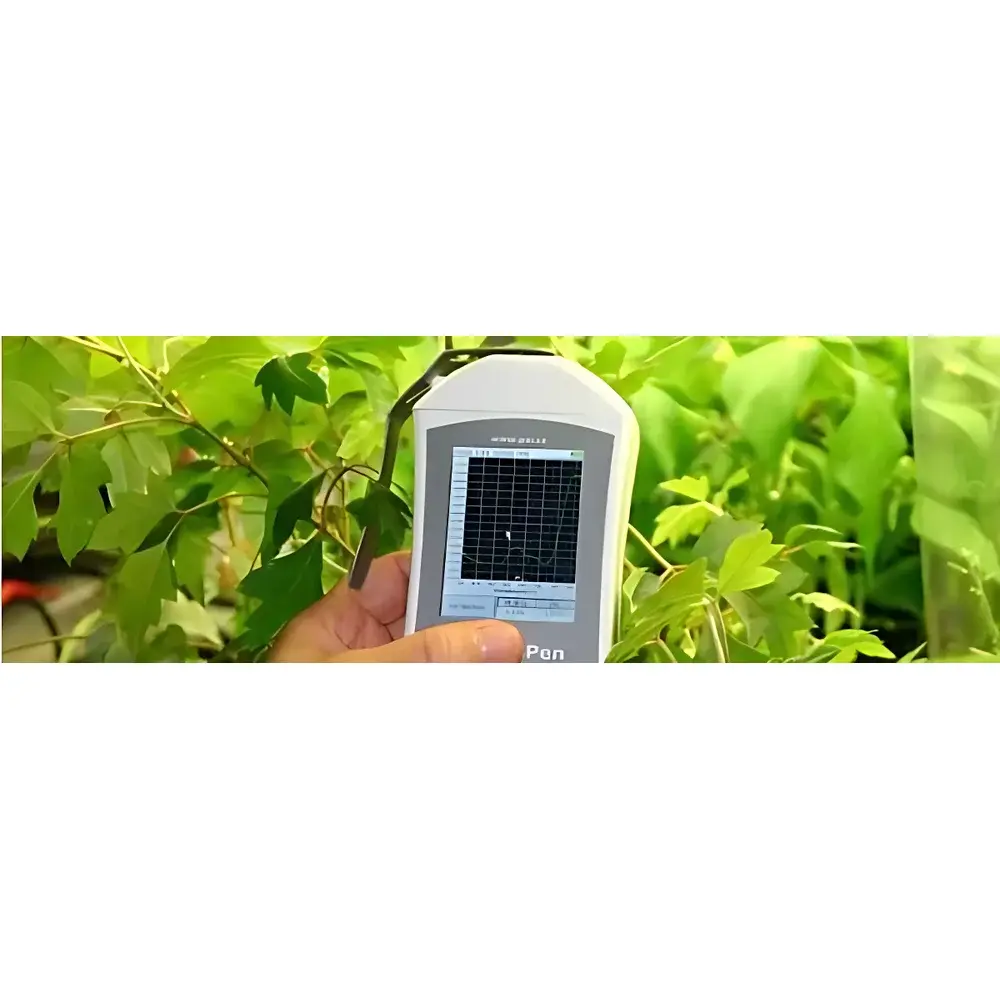
The PolyPen RP-400 Handheld Plant Spectral Reflectometer is a field-deployable, self-contained optical instrument engineered for rapid, non-destructive acquisition of leaf-level spectral reflectance and transmittance data across the visible and near-infrared (VIS-NIR) spectrum. It operates on the principle of contact-based spectral reflectometry: an integrated pulsed xenon lamp illuminates a defined leaf area via a precision-machined leaf clip, while a high-stability linear CCD spectrometer captures the reflected (or transmitted) light intensity at discrete wavelength intervals. The system’s optical architecture—featuring 8 nm spectral resolution and <−30 dB stray light rejection—ensures high-fidelity spectral sampling suitable for quantitative vegetation index derivation and pigment-related physiological inference. Designed for plant ecophysiologists, agronomists, and crop phenotyping researchers, the RP-400 delivers laboratory-grade spectral fidelity in a portable form factor, eliminating dependency on external power or host computers during data collection.
Key Features
- Two interchangeable spectral configurations: UVIS (380–780 nm) and NIR (640–1050 nm), optimized for distinct biophysical parameter sets and compliant with ASTM E308 and ISO/CIE spectral measurement standards.
- Integrated leaf clip serving dual functions—as sample holder and factory-calibrated reference standard for real-time source/detector stability monitoring.
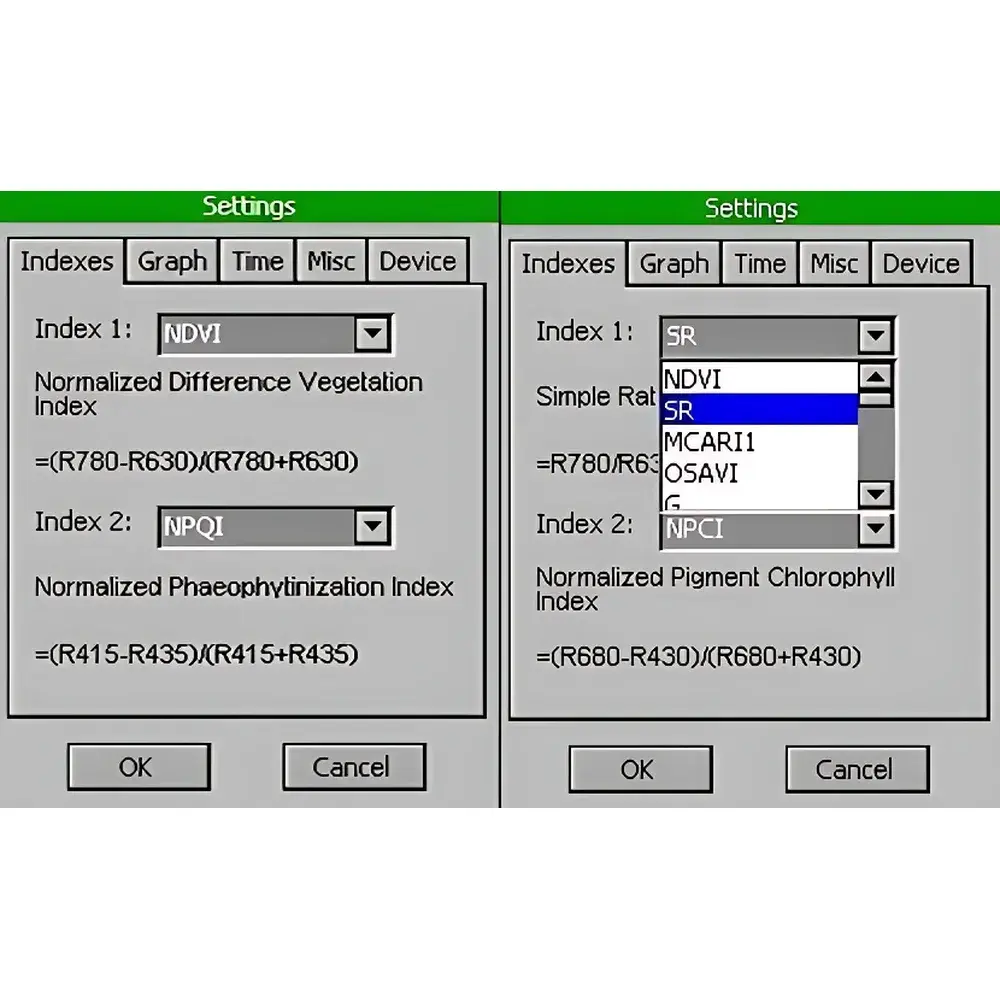
- Onboard computation engine preloaded with 20 peer-reviewed vegetation and pigment indices, including NDVI, PRI, MCARI, OSAVI, TCARI, ZMI, GM1/GM2, and NPQI—each implemented per original publication formulas without interpolation or approximation.
- Full-color touchscreen interface with real-time spectral plot overlay, index value display, and interactive data navigation—enabling immediate field assessment without post-processing delay.
- 32 MB internal flash memory supporting ≥8,000 full-spectrum acquisitions; data export via USB 2.0 to Windows/macOS platforms using vendor-neutral CSV and XML formats.
- Splash-resistant (IP54) magnesium-alloy enclosure, 300 g mass, and 48-hour battery endurance—validated for extended deployment in humid tropical canopies, arid field trials, and controlled-environment growth chambers.
Sample Compatibility & Compliance
The RP-400 accepts intact, unmodified leaves from angiosperms, gymnosperms, ferns, and bryophytes with thicknesses ≤3 mm and surface areas ≥1 cm². Its leaf clip applies consistent, low-pressure contact (≤15 kPa) to minimize pressure-induced chloroplast reorientation artifacts. For calibration traceability, optional Spectral Reflectance Standard (99% Lambertian reflectance, NIST-traceable) enables user-performed validation against ISO 2859-1 sampling plans. The instrument complies with IEC 61000-6-3 (EMC emissions) and IEC 61000-6-2 (immunity), and its firmware supports audit-ready logging per GLP requirements—including timestamped operator ID, GPS coordinates (when paired with external GNSS), and environmental metadata (ambient temperature/humidity via optional sensor module).
Software & Data Management
PolyPen Control Suite (v4.2+) provides cross-platform desktop analysis, supporting batch processing, spectral derivative calculation (first/second order), Savitzky-Golay smoothing, and custom index scripting in Python-compatible syntax. All raw spectra are stored with embedded EXIF-like metadata: integration time, gain setting, clip status, and calibration epoch. The software enforces FDA 21 CFR Part 11 compliance through electronic signatures, role-based access control, and immutable audit trails for all data modification events. Export options include ASCII tab-delimited files compatible with R (hyperspectral package), MATLAB, ENVI, and CropScan™ workflows. No cloud upload or telemetry is enabled by default—data sovereignty remains fully under user control.
Applications
- High-throughput phenotyping of photosynthetic efficiency, photoprotective capacity (via PRI dynamics), and nitrogen status across breeding populations.
- Monitoring stress-induced shifts in pigment composition (chlorophyll a/b, carotenoids, anthocyanins) under drought, salinity, or pathogen challenge.
- Validation of satellite- and UAV-derived vegetation indices through ground-truth spectral libraries (e.g., SPECCHIO-compliant datasets).
- Light quality characterization in vertical farms—quantifying PAR distribution, phytochrome-active R:FR ratios, and cryptochrome-weighted UV-A irradiance.
- Non-invasive assessment of canopy structural properties (LAI estimation via gap fraction modeling) when combined with hemispherical photography protocols.
- Teaching applications in plant physiology labs—demonstrating spectral signature plasticity across ontogeny, acclimation, and species divergence.
FAQ
Does the RP-400 require external calibration before each measurement session?
No. The integrated leaf clip serves as a built-in reference standard; automatic dark/light calibration occurs at power-on and after every 100 measurements. Optional NIST-traceable reflectance standards are recommended for inter-instrument comparability in multi-site studies.
Can the RP-400 measure transmittance as well as reflectance?
Yes—by rotating the leaf clip 180°, the instrument switches to transmission mode, enabling quantification of internal light attenuation for mesophyll structure analysis and chloroplast layering studies.
Is spectral data export compatible with third-party statistical platforms?
All exported spectra use UTF-8 encoded CSV format with wavelength (nm) in column one and reflectance (%) in subsequent columns—directly ingestible by R’s ‘prospectr’ package, Python’s ‘scikit-learn’, and JMP Pro spectral modeling modules.
How is thermal drift managed during prolonged field operation?
The spectrometer incorporates a thermoelectrically stabilized detector stage, maintaining CCD junction temperature within ±0.5 °C across the full operating range (0–50 °C), ensuring wavelength registration stability better than ±0.3 nm over 8-hour sessions.
Are firmware updates provided free of charge for the lifetime of the instrument?
Yes—registered users receive automatic notifications and signed firmware binaries via secure download portal, with version-controlled changelogs documenting algorithmic refinements and regulatory compliance enhancements.




