
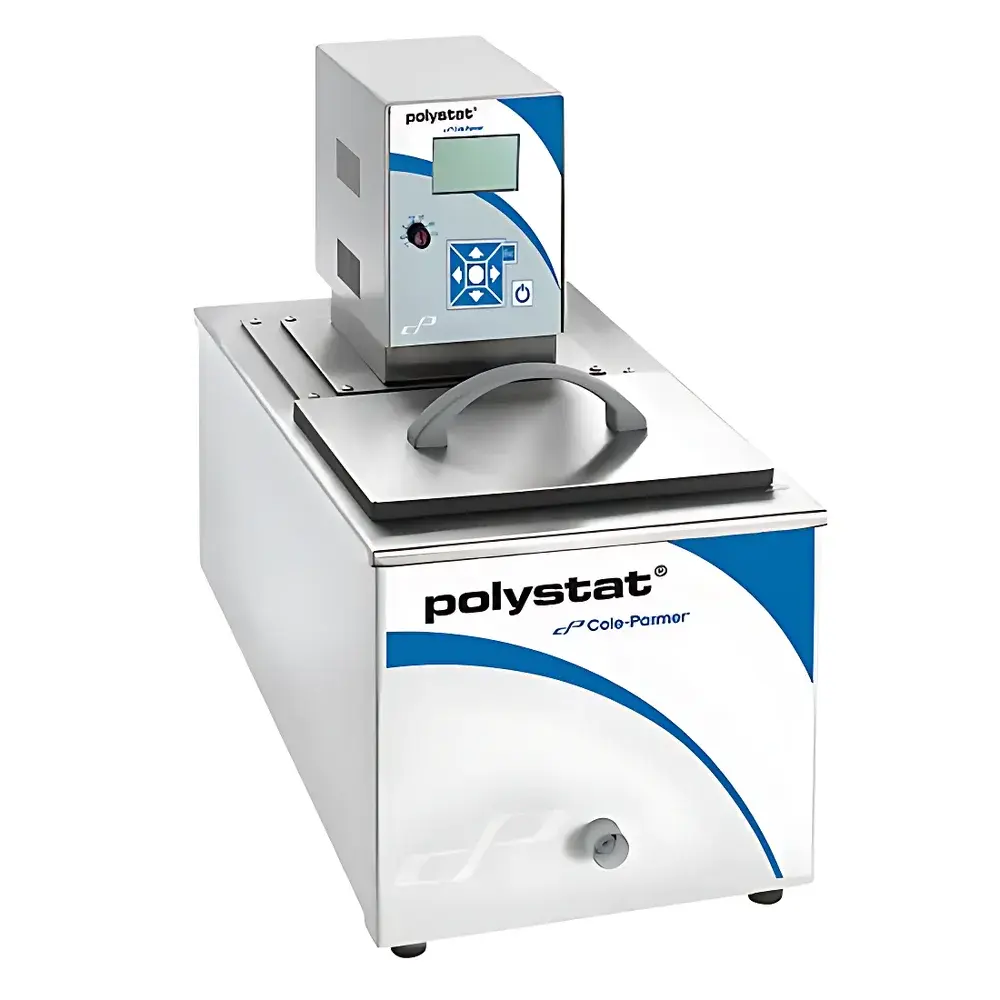
Polystat 12134-66 Stainless Steel Heated Circulating Bath
| Brand | Polystat |
|---|---|
| Origin | USA |
| Model | 12134-66 |
| Bath Capacity | 7 L |
| Temperature Range | Ambient +13 °C to 100 °C |
| Temperature Stability | ±0.1 °C |
| Circulation Type | Internal & External |
| Control Mode | Heating-Only PID Digital Controller |
| Pump Type | Pressure Pump |
| Max. Pump Pressure | 300 mbar |
| Max. Flow Rate | 15 L/min |
| Heater Power | 1200 W |
| Wetted Materials | Stainless Steel, Polymer |
| Temperature Sensor | Platinum RTD (Pt100) |
| Display | Multilingual LCD (English, French, German), 0.01 °C resolution |
| Safety Features | Adjustable Over-Temperature Cutoff, Audible Alarm |
| Warranty | 2 Years |
| Power Supply | 230 VAC, 50 Hz |
| Dimensions (Bath) | 15.2 × 12.4 × 11.2 cm |
| Overall Dimensions | 21.3 × 39.7 × 36.2 cm |
Overview
The Polystat 12134-66 is a precision-engineered, stainless steel heated circulating bath designed for laboratory applications requiring stable thermal control up to 100 °C. Built on a robust industrial platform, it employs a high-efficiency pressure circulation pump and a platinum resistance temperature detector (Pt100) coupled with a PID-based digital temperature controller to deliver exceptional thermal uniformity and reproducibility. Unlike basic immersion heaters or open-bath systems, the 12134-66 integrates closed-loop external circulation capability—enabling precise temperature conditioning of external reactors, viscometers, spectrophotometer cells, or jacketed glassware. Its compact footprint (21.3 × 39.7 × 36.2 cm overall) optimizes bench space without compromising performance, making it ideal for QC labs, polymer research, pharmaceutical stability testing, and materials science workflows where consistent heat transfer and long-term operational reliability are critical.
Key Features
- Stainless steel construction with chemically resistant polymer wetted components ensures durability against aqueous and mild organic media.
- Dual-speed pressure pump supports both internal bath homogenization and external recirculation at up to 15 L/min and 300 mbar maximum head pressure.
- Multilingual LCD interface (English, French, German) with 0.01 °C resolution displays real-time temperature, setpoint, and system status—no language barriers in multinational lab environments.
- PID-controlled heating system with 1200 W power delivers rapid thermal recovery after load changes, minimizing process downtime.
- Configurable safety protocols include user-defined upper/lower temperature limits and adjustable over-temperature cutoff with audible alarm—supporting GLP-compliant operation.
- Standard accessories include M16 × 1 threaded inlet/outlet ports, 8 mm and 12 mm barbed hose fittings, and a 1.8-m power cord with IEC 60320 C13 connector—ready for immediate integration into existing lab infrastructure.
Sample Compatibility & Compliance
The 12134-66 accommodates a wide range of sample vessels and external devices via its dual-port circulation manifold. It is routinely deployed with jacketed reaction flasks (50–1000 mL), rotary evaporator condensers, differential scanning calorimetry (DSC) cooling units, and rheometer temperature control modules. All wetted surfaces comply with USP Class VI biocompatibility standards for non-leaching polymer components. While not certified for hazardous location use, the unit meets IEC 61010-1:2010 requirements for electrical safety in laboratory equipment. Its temperature stability of ±0.1 °C (at setpoint) satisfies ASTM E1137/E1137M specifications for liquid-bath calibration accuracy and supports ISO/IEC 17025 method validation when used as part of a documented thermal management system.
Software & Data Management
This model operates independently via its onboard digital controller and does not include USB or network connectivity—intentionally designed for simplicity, reliability, and regulatory traceability in GxP environments where uncontrolled firmware updates or remote access could compromise audit integrity. All temperature setpoints, alarm thresholds, and pump configurations are manually entered and retained in non-volatile memory. The absence of embedded software eliminates vulnerabilities associated with OS dependencies or cybersecurity risks. For laboratories requiring electronic recordkeeping, analog output (0–10 V or 4–20 mA) is available as an optional upgrade—enabling connection to PLCs, SCADA systems, or validated LIMS platforms under FDA 21 CFR Part 11 compliance frameworks when paired with appropriate audit-trail-capable data acquisition hardware.
Applications
- Controlled-temperature solvent baths for reflux, extraction, and synthesis reactions in organic chemistry labs.
- Thermal conditioning of optical cells in UV-Vis and FTIR spectroscopy to minimize thermal drift during extended measurements.
- Temperature stabilization of capillary viscometers and rotational rheometers per ASTM D445 and ISO 3104 protocols.
- Accelerated stability testing of pharmaceutical formulations per ICH Q1A(R2) guidelines using defined thermal profiles.
- Calibration support for thermocouples, RTDs, and digital thermometers in metrology labs adhering to ISO/IEC 17025.
- Pre-heating and thermal equilibration of polymer melt samples prior to DSC or TGA analysis.
FAQ
Is the Polystat 12134-66 suitable for use with silicone oil or other high-boiling-point heat transfer fluids?
Yes—it is rated for operation up to 100 °C with water, glycol-water mixtures, or silicone oils meeting flash point and viscosity specifications compatible with its pump design (kinematic viscosity < 50 cSt at operating temperature).
Does this unit support external temperature feedback control (e.g., from a probe placed in a reactor)?
No—the 12134-66 uses only its integrated Pt100 sensor for control; external feedback requires the advanced controller variant (e.g., model 12121-08) with auxiliary input capability.
Can the pump speed be adjusted continuously, or only in discrete steps?
Pump speed is selectable between two fixed rates (low/high) via front-panel controls—optimized for either gentle circulation or high-flow external loops.
What maintenance is required to ensure long-term accuracy and reliability?
Annual verification of temperature sensor calibration against a NIST-traceable reference standard is recommended; pump seals and bath fluid should be inspected every 6 months in continuous-use environments.
Is the unit supplied with CE or UKCA marking for European or UK market use?
Yes—units shipped to EEA and UK markets carry CE/UKCA marking per Directive 2014/30/EU (EMC) and 2014/35/EU (LVD), with test reports available upon request.
Related Products



