
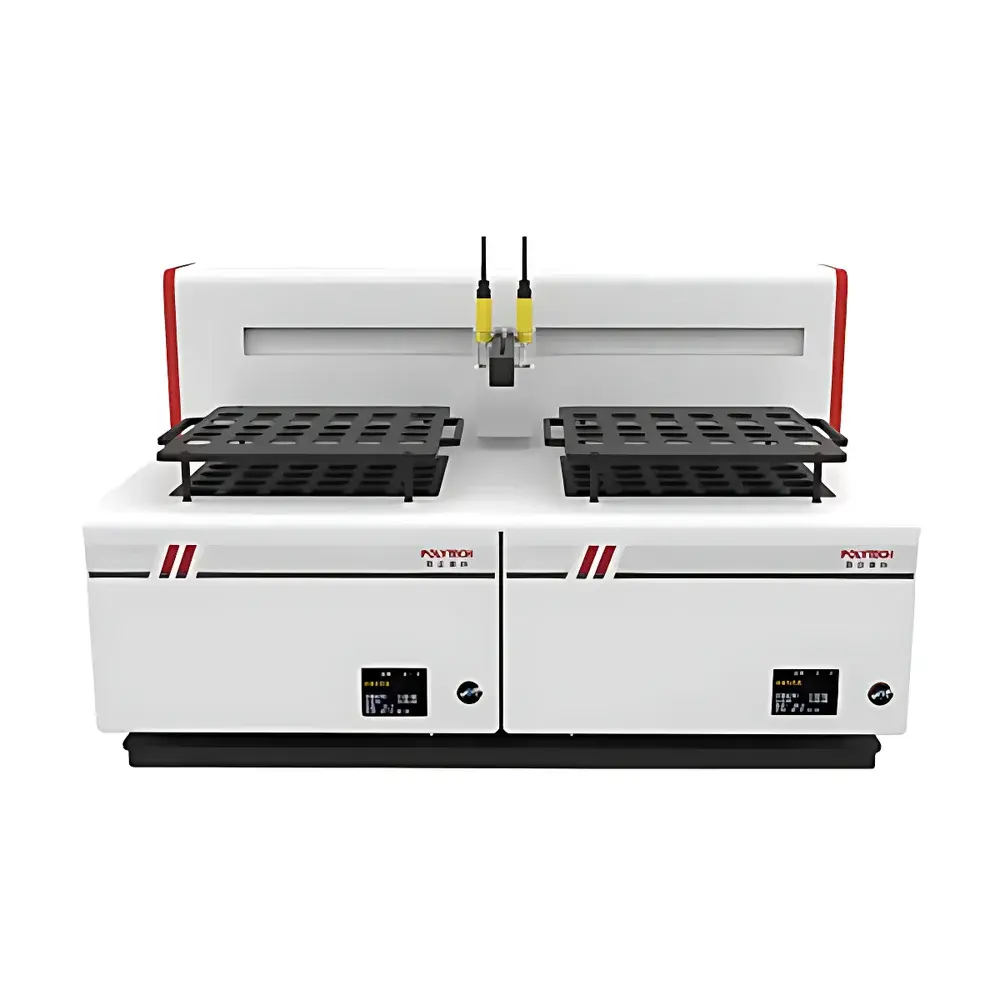
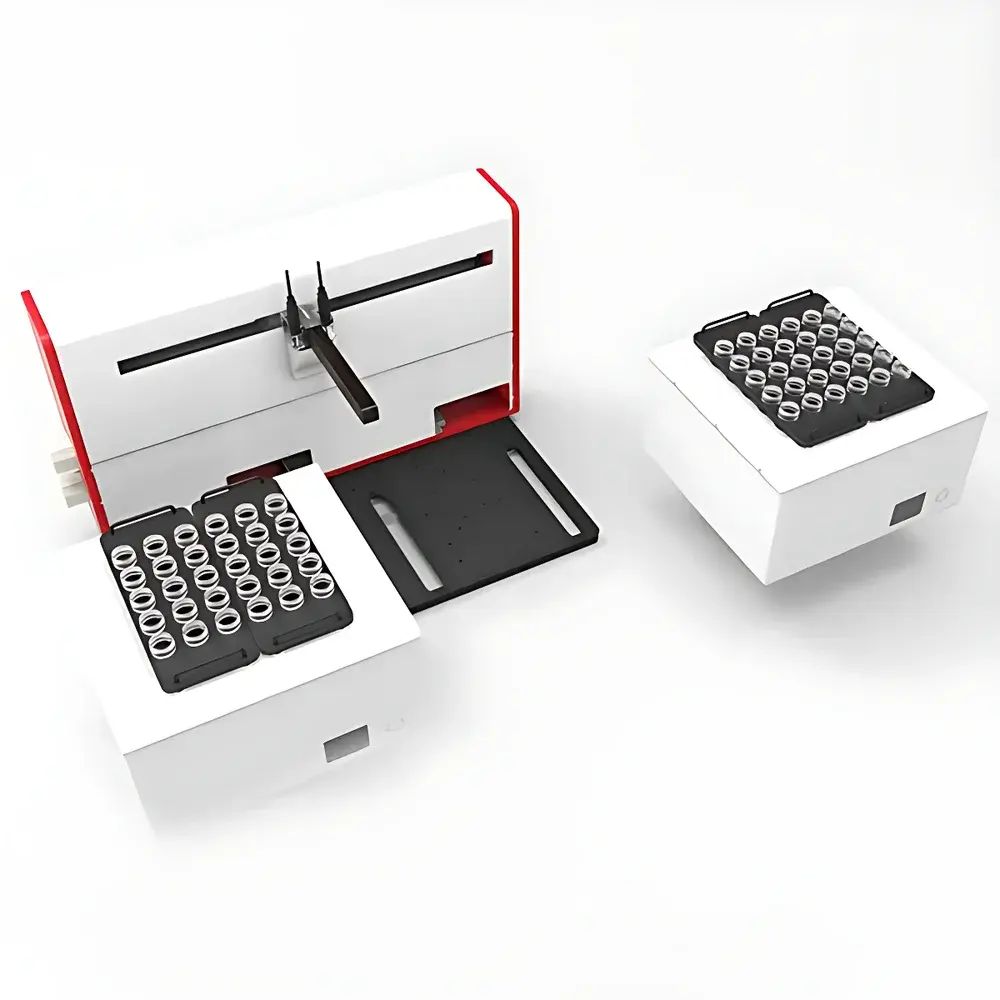
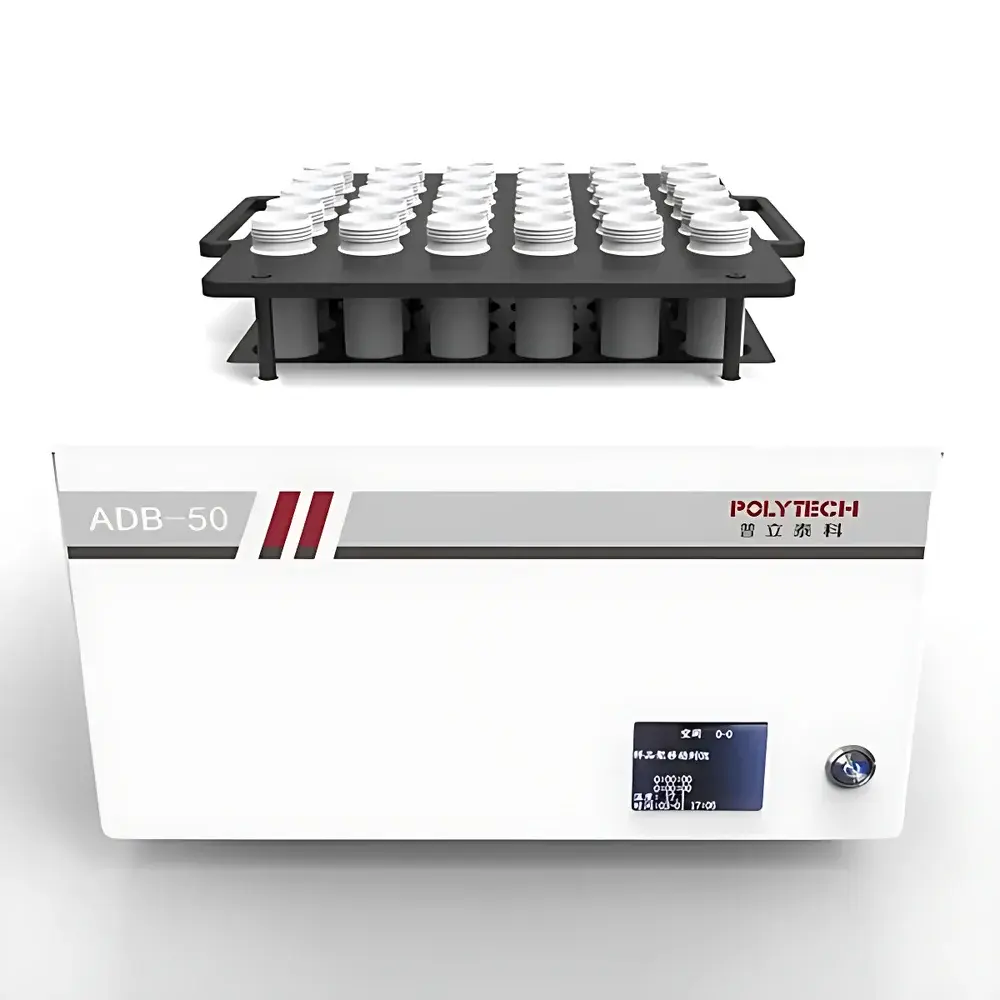
Polytech DigestLinc-ST60D Fully Automated Graphite Block Digestion System
| Brand | Polytech |
|---|---|
| Origin | Anhui, China |
| Manufacturer Type | Direct Manufacturer |
| Instrument Type | Graphite Block Digestion System |
| Automation Level | Fully Automated |
| Digestion Positions | 30 × 50 mL + 16 × 100 mL (configurable modular layout) |
| Max Heating Temperature | 230 °C |
| Temperature Uniformity | High spatial uniformity across graphite block |
| Reagent Channels | 8 independent peristaltic pump-driven channels |
| Sample Processing Workflow | Automated reagent addition, mixing, temperature-programmed digestion, acid evaporation (dry-down), cooling, and final volumetric定容 via ultrasonic sensor-based precision dispensing |
Overview
The Polytech DigestLinc-ST60D is a fully automated, modular graphite block digestion system engineered for high-throughput, reproducible sample preparation prior to elemental analysis by AAS, AFS, ICP-OES, and ICP-MS. It implements standardized wet-acid digestion protocols—primarily nitric, hydrochloric, and hydrogen peroxide-based chemistries—under precisely controlled thermal and fluidic conditions. Unlike open-vessel hot plates or microwave systems, the DigestLinc-ST60D utilizes a monolithic, high-density graphite heating block with integrated temperature sensors and PID-controlled zoning to ensure ±1.5 °C thermal stability and <±2 °C inter-position uniformity across all 46 digestion wells. The system executes complete digestion workflows—including sequential reagent dosing, orbital shaking (0–300 rpm), ramp-and-hold thermal programming, controlled acid evaporation (‘赶酸’), post-digestion air-cooling, and final dilution to fixed volume—without manual intervention. Its design conforms to the fundamental principles of EPA Method 3050B, 3051A, and 3052, as well as Chinese national standards GB 5009.11–2014, GB 5009.93–2010, and HJ 677–2013, ensuring regulatory traceability in food safety, environmental monitoring, and clinical toxicology laboratories.
Key Features
- Modular architecture: Independent reagent addition module and digestion module—each controllable via unified software; modules may operate separately or in tandem.
- Dual-channel reagent delivery & dual-volume dispensing: Two synchronized peristaltic pumps enable simultaneous acid addition and final dilution, reducing cycle time by up to 35% for heterogeneous sample batches.
- Configurable digestion capacity: 30 positions for 50 mL tubes and 16 positions for 100 mL vessels; interchangeable racks support custom tube geometries (e.g., PTFE, quartz, borosilicate).
- Patented reflux funnel assembly: Minimizes acid consumption and vapor loss—validated reductions of 4–20 mL HNO₃ per sample depending on matrix (soil, oil, plant tissue), directly supporting ISO 14001-compliant lab sustainability goals.
- Networked control interface: LAN/WiFi-enabled embedded controller with RESTful API; compatible with iOS/Android remote monitoring apps for real-time status alerts, pause/resume commands, and audit-log export.
- Graphite block integrity assurance: Built-in thermal runaway protection, overtemperature cutoff (<235 °C), and automatic power-down after completion or error detection.
Sample Compatibility & Compliance
The DigestLinc-ST60D accommodates solid, semi-solid, and liquid matrices including foodstuffs (oils, cereals, dairy), agricultural products (fruits, vegetables, grains), environmental samples (soils, sediments, sludges, wastewater solids), and biological tissues (hair, liver, blood). Its closed-graphite-block configuration prevents cross-contamination and ensures consistent heat transfer regardless of sample volume or density. All digestion methods implemented on this platform align with GLP documentation requirements: full electronic audit trail (user ID, timestamp, parameter set, execution log), password-protected method editing, and 21 CFR Part 11–compliant data integrity features (including electronic signatures and immutable log archiving). Validation reports confirm compliance with ISO/IEC 17025:2017 clause 5.4.2 (method validation) and ASTM D5681-16 (standard test method for determination of metals in waste oils by ICP-AES).
Software & Data Management
The Polytech DigControl™ v4.2 software provides a browser-based graphical interface supporting multi-module orchestration—up to ten DigestLinc units managed concurrently without performance degradation. Each run generates a structured .CSV and .PDF report containing raw temperature profiles, reagent volume logs, shake speed history, and endpoint volume confirmation (via ultrasonic meniscus detection ±0.05 mL accuracy). Data export supports LIMS integration via HL7 or ASTM E1384-compliant formats. Software updates are delivered over-the-air; version history and patch notes are digitally signed and archived for internal QA review. All user actions—including method creation, calibration, and emergency stop—are time-stamped and linked to authenticated accounts, satisfying FDA 21 CFR Part 11 Subpart B requirements for electronic records and signatures.
Applications
This system is routinely deployed in accredited testing laboratories performing heavy metal quantification in regulated matrices: Pb, Cd, As, Se, Hg, Cr, Ni, Cu, Zn, and Sb in edible oils (per GB/T 5009.11–2003), rice flour (GB 5009.12–2010), soil (GB/T 17141–1997), municipal sludge (HJ/T 299–2007), and drinking water (HJ 700–2014). Its programmable ramp-hold profiles enable optimization for refractory elements (e.g., Cr(VI) stabilization during HNO₃–HF digestion), while the dual-channel fluidics allow parallel processing of low- and high-acid-demand samples—critical for contract labs handling mixed client submissions. In research settings, it supports method development for emerging contaminants such as rare earth elements (REEs) and platinum group metals (PGMs) requiring extended digestion times at elevated temperatures.
FAQ
What safety certifications does the DigestLinc-ST60D hold?
It complies with IEC 61010-1:2010 for laboratory electrical equipment safety and carries CE marking under the EU Low Voltage Directive and EMC Directive.
Can the system be integrated into an existing LIMS?
Yes—via configurable CSV export, HTTP POST endpoints, or optional ASTM E1384-compliant middleware adapter.
Is method validation support provided?
Polytech supplies IQ/OQ documentation templates, certified reference material (CRM) digestion protocols, and third-party validation assistance through ISO 17025-accredited partners.
What maintenance is required for long-term reliability?
Annual calibration of temperature sensors and peristaltic pump tubing replacement (every 6–12 months depending on usage); graphite block surface inspection recommended after every 500 runs.
Does the system support HF digestion?
Yes—with optional PTFE-coated digestion blocks and HF-resistant reagent lines; requires separate fume hood integration per OSHA 1910.1200 guidelines.
Related Products



