
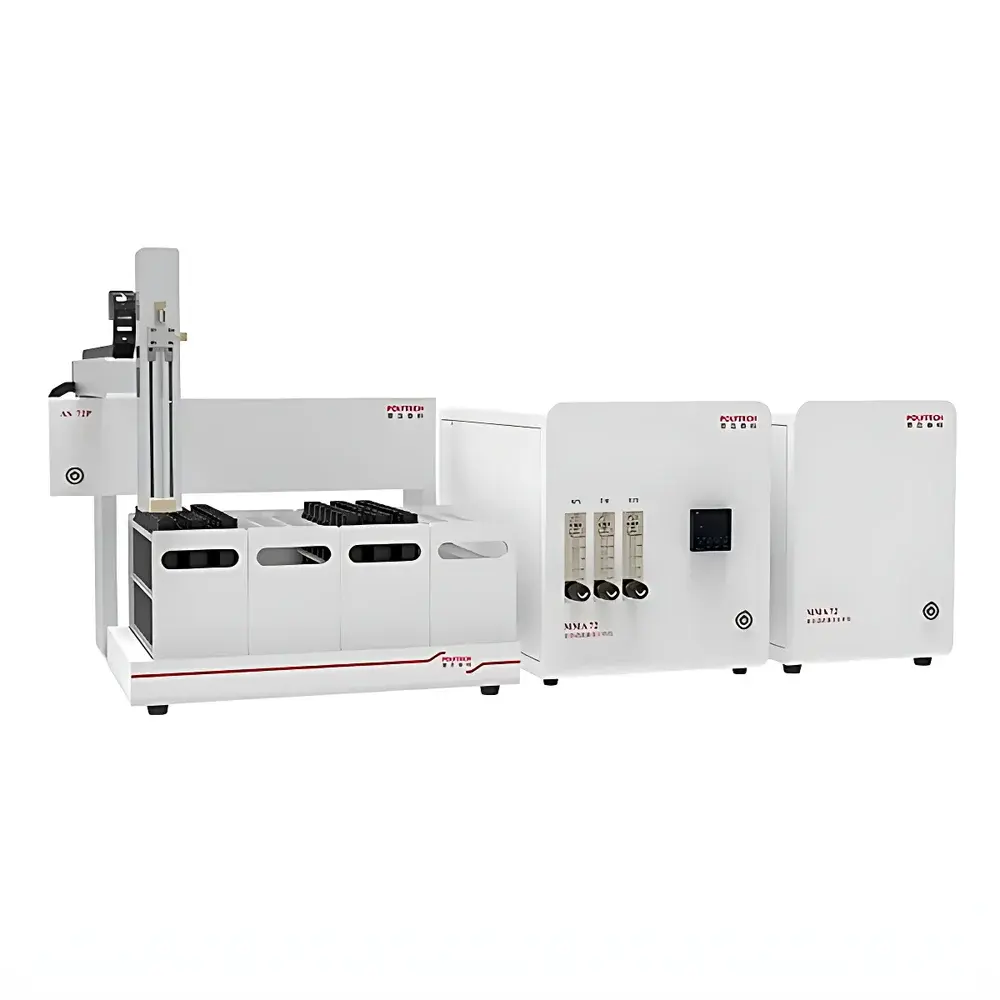
Polytech MMA72 Fully Automated Alkylmercury Analyzer
| Brand | Polytech |
|---|---|
| Origin | Anhui, China |
| Manufacturer | Yes |
| Instrument Type | Benchtop Laboratory Analyzer |
| Detection Principle | Cold Vapor Atomic Fluorescence Spectrometry (CVAFS) |
| Detection Limit | ≤0.002 ng/L (methylmercury), ≤0.002 ng/L (ethylmercury), ≤0.03 ng/L (total mercury) |
| Repeatability | ≤2% RSD |
| Linear Range | 0–40 ng/L (methylmercury), 0–40 ng/L (ethylmercury), 0–400 ng/L (total mercury) |
| Sample Capacity | 96 positions |
| Dimensions | 1200 × 400 × 400 mm |
| Weight | 43 kg |
| Power Supply | 220 VAC, 50 Hz, 5 A |
| Analysis Throughput | 9 samples/hour (methylmercury), 5 samples/hour (alkylmercury) |
| Sample Volume | 25 mL or 40 mL (aqueous) |
| Optional Total Mercury Module | Yes |
Overview
The Polytech MMA72 Fully Automated Alkylmercury Analyzer is an integrated benchtop system engineered for speciated mercury analysis in environmental, food safety, and clinical laboratories. It implements a validated multi-stage analytical workflow: purge-and-trap preconcentration, capillary gas chromatographic (GC) separation, high-temperature thermal decomposition (≥800 °C), and highly selective detection via Cold Vapor Atomic Fluorescence Spectrometry (CVAFS). This architecture conforms to U.S. EPA Method 1630 and China’s HJ 977–2018 standard for alkylmercury determination in water matrices. The instrument delivers sub-picomolar sensitivity with demonstrated detection limits of ≤0.002 ng/L for methylmercury and ethylmercury, and ≤0.03 ng/L for total mercury—enabling reliable quantification at regulatory compliance levels for drinking water, wastewater, sediment porewater, and biological extracts.
Key Features
- Modular dual-channel (or higher) purge-and-trap system: Enables parallel sample processing and independent channel operation to minimize cycle time without cross-contamination.
- Automated liquid handling: Precision syringe-driven injection supports two standardized aqueous sample volumes—25 mL and 40 mL—without manual intervention.
- Integrated GC-CVAFS coupling: On-line thermal desorption and catalytic pyrolysis ensure quantitative conversion of volatile organomercury species to atomic mercury vapor prior to fluorescence detection.
- Dual-data-processing software: Supports both least-squares regression (per draft environmental guidelines) and response factor calibration (EPA 1630 compliant), with simultaneous reporting for methylmercury and ethylmercury.
- Low solvent consumption: Optimized trap desorption and GC carrier flow reduce organic solvent usage by >60% versus conventional methods, aligning with green laboratory practices.
- Expandable configuration: Optional total mercury module allows seamless switching between speciation and total Hg analysis on the same platform, eliminating instrument duplication.
Sample Compatibility & Compliance
The MMA72 accommodates diverse aqueous and semi-solid matrices following standardized pretreatment protocols—including filtered surface water, wastewater effluent, soil leachates, fish tissue homogenates, blood plasma, hair digests, and cosmetic extracts. All operational parameters—including temperature ramp profiles, purge times, trap desorption rates, and CVAFS lamp modulation settings—are programmable and auditable. The system supports full traceability per GLP and ISO/IEC 17025 requirements, with electronic logs capturing method version, operator ID, calibration history, and raw spectral data. Data integrity complies with FDA 21 CFR Part 11 when deployed with validated LIMS integration and user-access controls.
Software & Data Management
The proprietary Polytech MercurySuite™ software provides method development, real-time chromatogram visualization, peak integration, and automated report generation in PDF and CSV formats. Each analysis session records complete metadata—including instrument status flags, lamp intensity decay trends, and trap breakthrough diagnostics—to support root-cause analysis during QA/QC review. Audit trails are immutable and timestamped; all modifications require dual authorization. Calibration curves retain slope, intercept, and correlation coefficient (r² ≥ 0.999) validation metrics. Exported datasets include raw fluorescence counts, retention time alignment markers, and internal standard recovery ratios—essential for inter-laboratory comparison under ISO 17043 proficiency testing schemes.
Applications
- Environmental Monitoring: Routine surveillance of municipal drinking water, industrial discharge, river sediments, and atmospheric deposition samples per national monitoring programs.
- Food Safety Testing: Quantification of methylmercury in seafood (tuna, swordfish), livestock feed, rice, and infant formula to verify compliance with Codex Alimentarius and EU Commission Regulation (EC) No 1881/2006 limits.
- Clinical & Biomonitoring: Speciation analysis in human hair, whole blood, and placental tissue for epidemiological studies on prenatal exposure and neurodevelopmental risk assessment.
- Research Laboratories: Method validation studies, kinetic modeling of mercury methylation/demethylation pathways, and intercomparison of extraction efficiency across solid-phase microextraction (SPME) and acid leaching protocols.
FAQ
Does the MMA72 require certified reference materials for daily calibration?
Yes—traceable alkylmercury CRM standards (e.g., NIST SRM 3133, ERM-CA713) are required for initial method validation and ongoing QC verification per ISO 80000-1 and EPA 1630 Section 9.2.
Can the system analyze seawater samples directly?
Seawater requires matrix-matched calibration and optional chelation pretreatment (e.g., dithizone complexation) to mitigate chloride interference; recommended protocols are documented in the HJ 977–2018 Annex B.
Is remote monitoring supported?
Yes—the system includes Ethernet connectivity and RESTful API endpoints for integration with enterprise LIMS or cloud-based instrument management platforms (e.g., LabWare, Thermo Fisher SampleManager).
What maintenance intervals are recommended for the CVAFS detector?
Quartz cell cleaning and mercury lamp output verification are scheduled every 200 runs; full optical alignment and photomultiplier tube gain calibration are performed annually or after transport-induced vibration.
How is data integrity ensured during power interruption?
The onboard UPS buffer maintains controller state and halts GC oven ramping within 50 ms; resumed analysis resumes from last stable checkpoint without data loss or peak distortion.





