
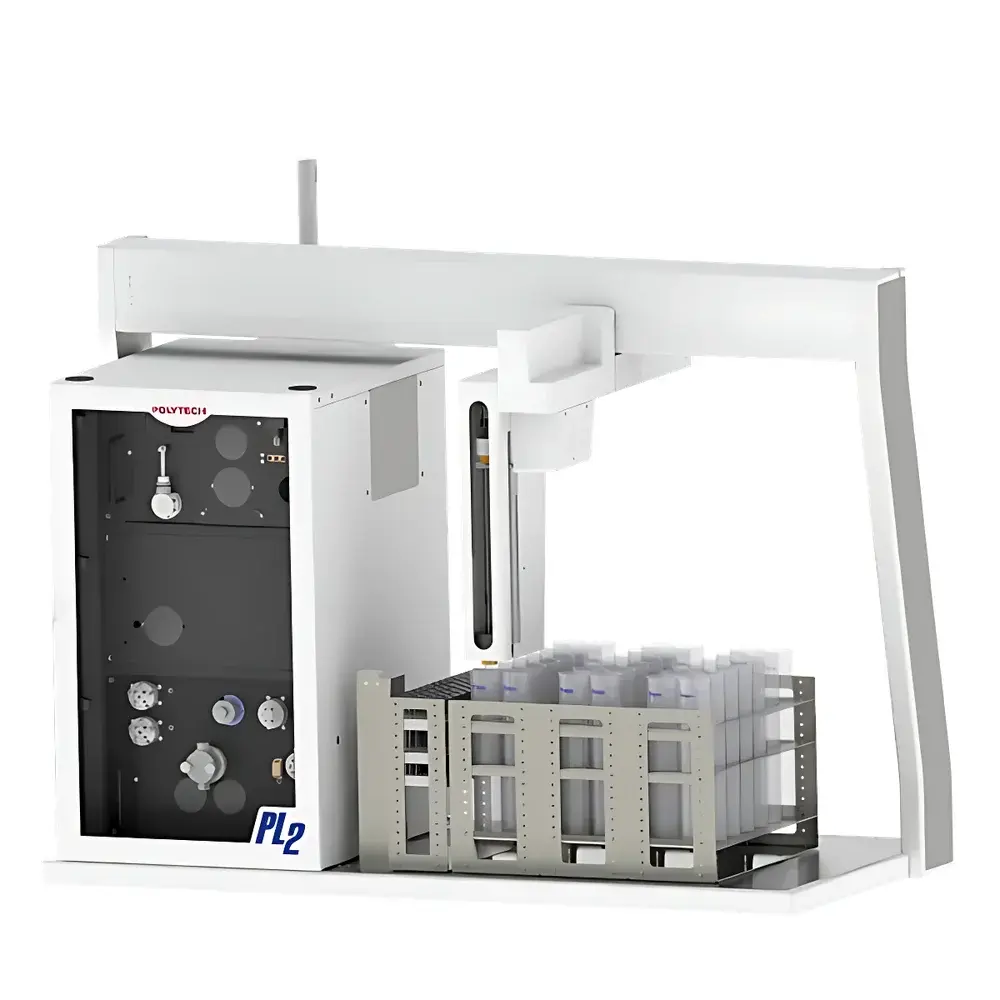
Polytech PL2 Automated Gel Permeation Chromatography System
| Brand | Polytech |
|---|---|
| Origin | Anhui, China |
| Manufacturer Type | Direct Manufacturer |
| Country of Origin | China |
| Model | PL2 |
| Flow Rate | 0.01–10.00 mL/min |
| Maximum Pressure | 2500 psi |
| Flow Stability | ±0.5% RSD |
| Auto-sampler Volume Range | 100 µL – 10 mL |
| Auto-sampler Capacity | 36 positions |
| Pump Precision | ≤0.01% RSD (accuracy ≤0.1%) |
| Injection Reproducibility | ≤1% RSD |
| Column Protection | Integrated bypass valve with automatic standby-mode hydration control |
| Detection | Built-in UV detector |
| System Architecture | Integrated piston pump, UV detector, autosampler, and column protection module |
Overview
The Polytech PL2 Automated Gel Permeation Chromatography (GPC) System is a dedicated sample cleanup platform engineered for high-reproducibility size-exclusion chromatographic purification of complex biological, environmental, and agricultural matrices prior to instrumental analysis. Operating on the principle of molecular size exclusion, the PL2 separates macromolecular interferences—including lipids, pigments, proteins, and humic substances—from target analytes (e.g., pesticides, PAHs, antioxidants, veterinary drug residues) based on hydrodynamic volume in an organic solvent mobile phase. Designed explicitly to protect downstream analytical instrumentation—such as GC, GC-MS, LC, and LC-MS/MS—the system minimizes column fouling, detector contamination, and signal suppression, thereby enhancing method robustness, sensitivity, and long-term instrument uptime. Its fully integrated architecture embeds a precision positive-displacement piston pump, a fixed-wavelength UV detector (254 nm), a compact 36-position autosampler, and an intelligent column protection module within a single chassis—eliminating external tubing, reducing system dead volume, and ensuring consistent hydraulic performance across extended operation cycles.
Key Features
- Integrated Hydraulic Architecture: All fluidic components—including dual-piston pump head, UV flow cell, and low-dead-volume injection valve—are housed internally to minimize extra-column dispersion and improve peak shape fidelity.
- High-Precision Autosampling: Supports direct syringe-based injection over a wide dynamic range (100 µL to 10 mL) with ≤1% RSD injection reproducibility; no dilution or transfer steps required.
- Column Preservation System: Equipped with an automated bypass valve that engages during idle or shutdown phases, maintaining solvent flow across the GPC column to prevent drying and irreversible adsorption—extending column lifetime by up to 3× versus non-protected operation.
- Real-Time Pressure Monitoring & Safety Protocol: Onboard pressure transducer triggers audible/visual alarms and initiates safe shutdown if pressure exceeds user-defined thresholds (up to 2500 psi), safeguarding both consumables and operator safety.
- Optimized Flow Control: Positive-displacement pump delivers flow stability of ≤0.5% RSD across the full 0.01–10.00 mL/min range; certified accuracy ≤0.1% at 0.33 mL/min per ISO 5725-2 traceability protocols.
Sample Compatibility & Compliance
The PL2 is validated for use with common GPC-compatible solvents (e.g., tetrahydrofuran, chloroform, dichloromethane) and accommodates standard analytical-grade styragel or bio-beads columns (7.8 × 300 mm). It supports extraction-ready samples from ASE®, QuEChERS, and Soxhlet workflows without pre-filtration. The system meets functional requirements of multiple national standards including GB/T 5009.161–2003, GB/T 20772–2006, GB 5009.32–2016, and SN/T 2430–2010. While not inherently 21 CFR Part 11 compliant out-of-the-box, its audit-trail-capable software architecture permits configuration for GLP/GMP environments when paired with validated electronic lab notebook (ELN) integration and user access controls.
Software & Data Management
Controlled via Polytech’s proprietary GPCStudio v3.2 software (Windows 10/11 compatible), the PL2 enables method-driven sequence programming, real-time UV chromatogram visualization, peak integration with baseline correction algorithms, and automated fraction collection triggering. Raw data are stored in vendor-neutral .csv and .dx formats; metadata—including injection time, pressure logs, UV absorbance, and pump status—is embedded in each acquisition file. Software supports IQ/OQ documentation templates aligned with ISO/IEC 17025 laboratory accreditation criteria and includes configurable electronic signature fields for multi-level review workflows.
Applications
The PL2 serves as a critical front-end purification tool in residue analysis laboratories conducting regulatory testing for food safety, environmental monitoring, and agrochemical research. Documented applications include: removal of co-extracted triglycerides prior to GC-MS analysis of organochlorine pesticides in animal tissues; lipid elimination from soil extracts prior to PAH quantification by GC-MS; cleanup of fruit/vegetable homogenates before LC-MS/MS detection of >380 pesticide residues; and isolation of low-molecular-weight antioxidants from fortified food matrices per GB 5009.32–2016. Its compatibility with standard 2-mL HPLC vials enables seamless handoff to autosamplers on Agilent, Thermo Fisher, Shimadzu, and Waters platforms.
FAQ
What solvent systems are compatible with the PL2 GPC system?
THF, chloroform, dichloromethane, and toluene are routinely used; solvent compatibility must be verified against column manufacturer specifications and pump wetted materials (stainless steel, PEEK, sapphire).
Can the PL2 interface directly with my GC-MS system?
Yes—the system outputs cleaned fractions into standard 2-mL autosampler vials; optional fraction collector modules support timed or UV-triggered collection for offline or online coupling.
Is column regeneration supported?
The built-in bypass function maintains column hydration, but full regeneration (e.g., solvent backflushing) requires manual intervention and adherence to column supplier guidelines.
Does the system support method validation per ICH Q2(R2)?
While the hardware provides the precision and repeatability required for validation, full ICH compliance depends on site-specific protocol development, system suitability testing, and documented OQ/IQ execution using certified reference standards.
What maintenance intervals are recommended?
Pump seals: every 6 months under continuous operation; UV lamp: 1,500 hours; inline filter cartridges: replaced after every 200 injections or when pressure rise exceeds 15% of baseline.



