
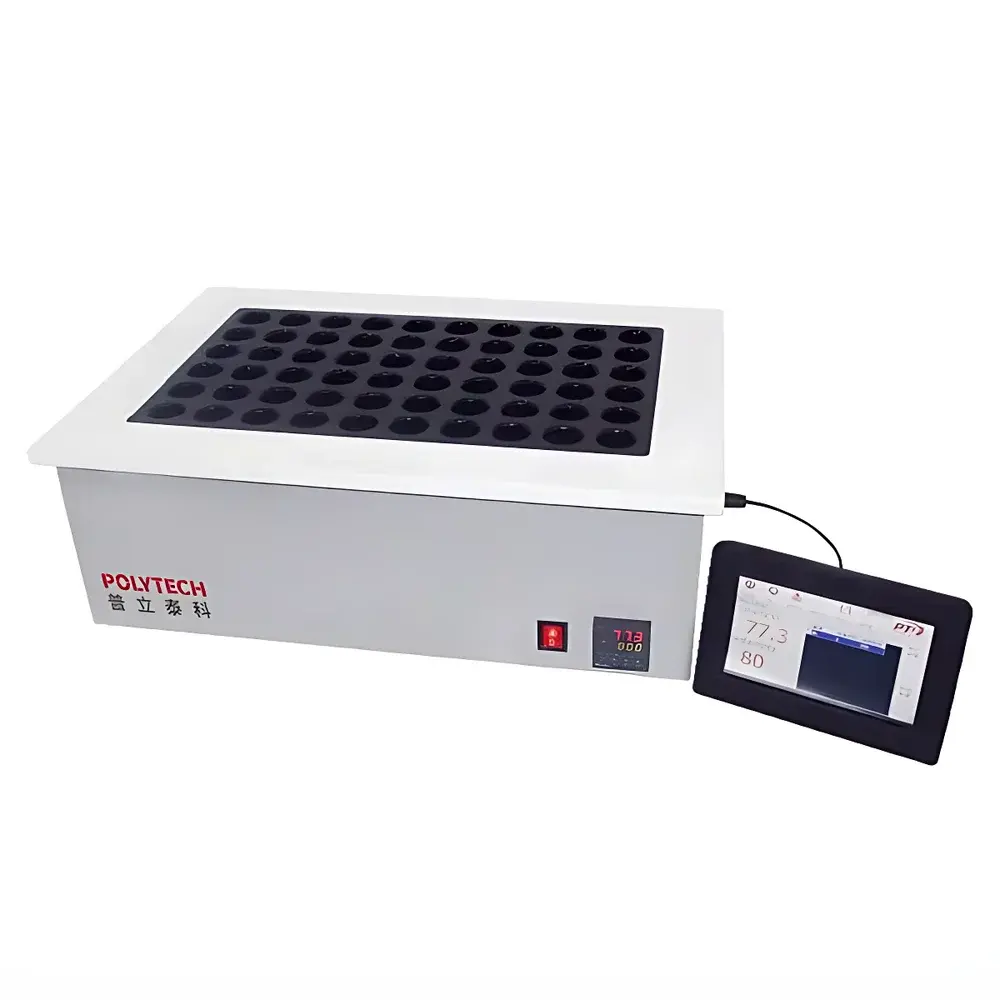
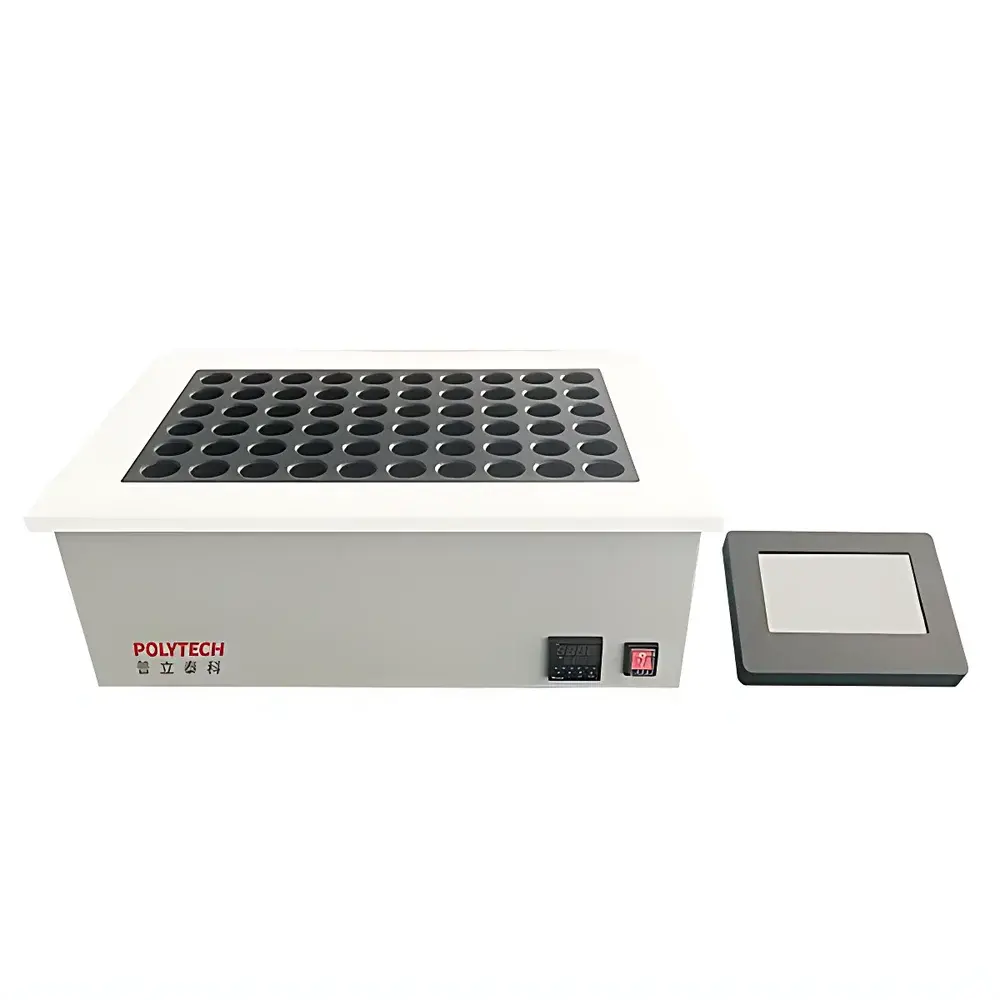
Polytech PT60 Graphite Block Digestion System
| Brand | Polytech |
|---|---|
| Origin | Anhui, China |
| Manufacturer Type | Direct Manufacturer |
| Model | PT60 |
| Heating Block Capacity | 60 positions |
| Temperature Range | Ambient to 230 °C (typical for graphite digestion) |
| Temperature Uniformity | ±1.5 °C across block |
| Programmable Ramp/Soak Profiles | Yes, multi-step gradient heating and cooling |
| Control Interface | Independent touchscreen controller with offline operation capability |
| Corrosion Protection | PTFE-coated front panel + multi-layer PTFE impregnation on graphite surface |
| Compliance | Designed for use in accordance with GB, HJ, SN/T, and ISO 11047:2021 (Determination of metals in environmental and food samples by atomic spectrometry after acid digestion) |
Overview
The Polytech PT60 Graphite Block Digestion System is a high-capacity, programmable electric heating digestion instrument engineered for reproducible, trace-metal–grade sample preparation prior to elemental analysis by Atomic Absorption Spectroscopy (AAS), Inductively Coupled Plasma Optical Emission Spectrometry (ICP-OES), and Inductively Coupled Plasma Mass Spectrometry (ICP-MS). Its core architecture employs a monolithic, high-density graphite heating block with integrated temperature sensors and PID-controlled resistive heating elements. Unlike open-vessel hot plates or microwave systems, the PT60 utilizes conductive heat transfer through precisely machined cavities—ensuring uniform thermal distribution and minimizing cross-contamination risk during batch processing. The system is optimized for closed-vessel acid digestion protocols using HNO₃, HCl, HF, and H₂O₂ under controlled ramp-and-hold conditions, delivering consistent decomposition of organic matrices while preserving volatile analytes such as As, Hg, Se, and Sb.
Key Features
- 60-position graphite block with standardized 50 mL digestion tube compatibility (e.g., borosilicate glass or quartz tubes with PTFE caps)
- Programmable gradient heating and cooling profiles: up to 10 user-defined steps with independent ramp rate (0.1–10 °C/min) and soak time (1–999 min) control
- Dedicated touchscreen controller with real-time temperature graphing, data logging (internal memory ≥10,000 records), and USB export functionality
- Offline operation mode: once a method is loaded, the instrument executes unattended without PC connection—critical for GLP-compliant routine labs
- Chemically inert construction: front panel fabricated from solid PTFE; graphite surface treated with triple-layer fluoropolymer impregnation to withstand prolonged exposure to concentrated mineral acids, including hydrofluoric acid (HF) at ≤5% v/v
- Integrated overtemperature protection and automatic shutdown upon lid removal or sensor failure
Sample Compatibility & Compliance
The PT60 supports a broad range of solid and semi-solid matrices—including foodstuffs (seafood, dairy powders, edible oils, cereals), botanicals (tea leaves, cereal grains, plant tissues), environmental solids (soils, sediments, fly ash, filter media), and regulatory specimens (cosmetics, pharmaceutical capsules, waste sludges). It is validated for use in procedures referenced in major national and industry standards, including GB 5009.x series (China Food Safety Standards), HJ 491–700 (China Environmental Monitoring Methods), and SN/T 1911–2288 (Customs Inspection Protocols). While not certified to ISO/IEC 17025 as a standalone testing device, its thermal performance and repeatability meet the pre-analytical requirements outlined in ISO 11047:2021 for metal determination workflows. All digestion methods are compatible with subsequent analysis under USP , EPA Method 3050B/3052, and ASTM D5686–22.
Software & Data Management
The PT60 operates independently via its embedded controller—no proprietary software installation required. Method parameters (target temperatures, ramp rates, hold durations, cooling thresholds) are stored locally with timestamped execution logs. Data export is supported via USB flash drive in CSV format, enabling direct import into LIMS or QA/QC tracking platforms. Audit trail functionality includes operator ID entry (optional alphanumeric tagging), method version stamping, and anomaly flags (e.g., “temp deviation >±2°C”). For laboratories operating under FDA 21 CFR Part 11 or EU Annex 11, external validation documentation—including IQ/OQ protocols and calibration certificates traceable to NIM (National Institute of Metrology, China)—is available upon request.
Applications
- Food safety labs performing routine monitoring of Pb, Cd, As, Hg, Cr, Cu, Zn, Ni, and Se in raw ingredients and finished products
- Environmental testing facilities executing soil heavy metal screening per GB 15618 and HJ 491–494
- Third-party certification bodies conducting CNAS-accredited analyses for export compliance (e.g., SN/T methods for tobacco paper and cosmetics)
- Research institutions preparing biological tissues and plant materials for multi-element ICP-MS quantification
- Water utility labs digesting suspended solids and sludge filters prior to total metal content assessment per HJ 677
FAQ
Is the PT60 compatible with hydrofluoric acid (HF) digestion?
Yes—the graphite block features multi-layer PTFE impregnation, and the front panel is solid PTFE, enabling safe use with HF concentrations up to 5% v/v when paired with appropriate digestion vessels.
Can digestion methods be exported and shared between multiple PT60 units?
Yes—methods and logs are saved in standard CSV format via USB and can be loaded onto other PT60 systems without software dependency.
Does the system support GLP-compliant audit trails?
It provides timestamped execution logs, operator tagging, and deviation alerts; full 21 CFR Part 11 compliance requires integration with validated LIMS and supplementary procedural controls.
What is the typical temperature stability across the 60-position block?
At 180 °C, uniformity is maintained within ±1.5 °C (measured per ISO 11047 Annex B guidelines using calibrated Pt100 probes in 9 representative wells).
Are replacement graphite blocks and PTFE components available?
Yes—Polytech supplies OEM-certified graphite blocks, PTFE-coated cavity inserts, and full front-panel assemblies with documented lot traceability.



