
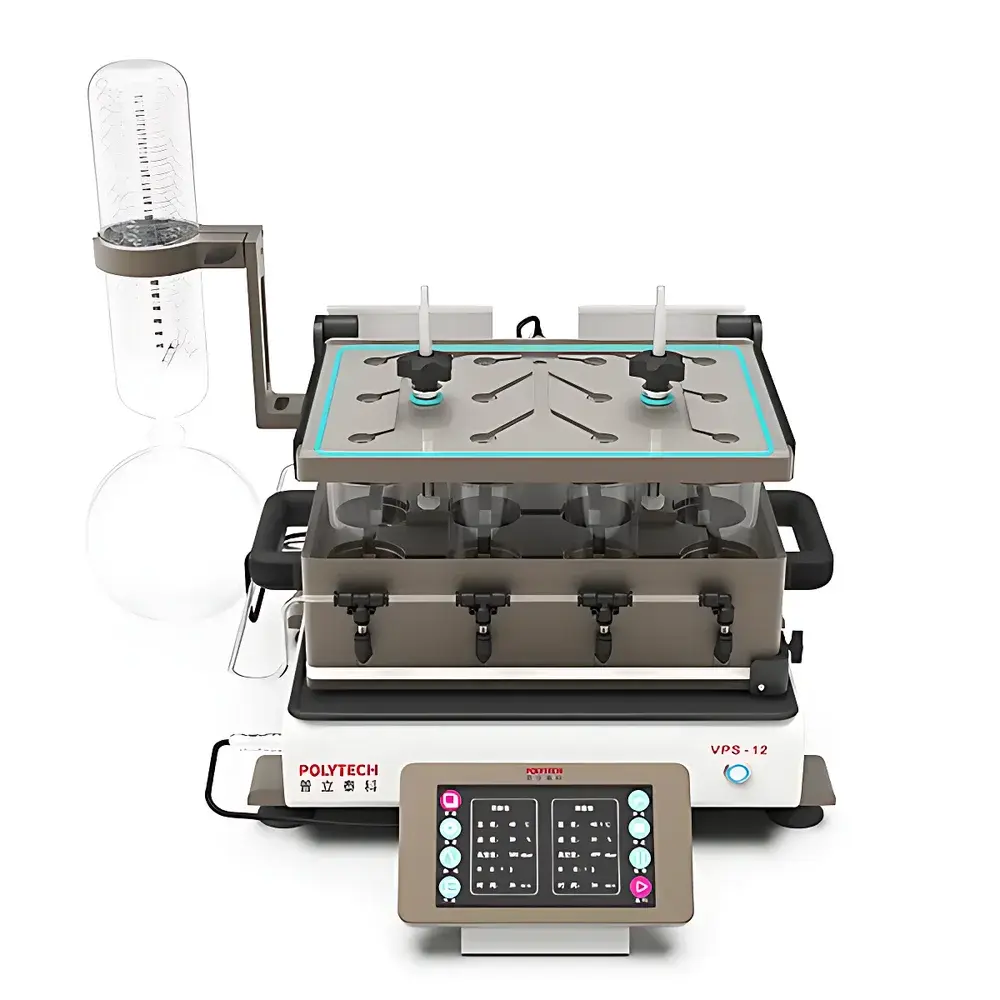
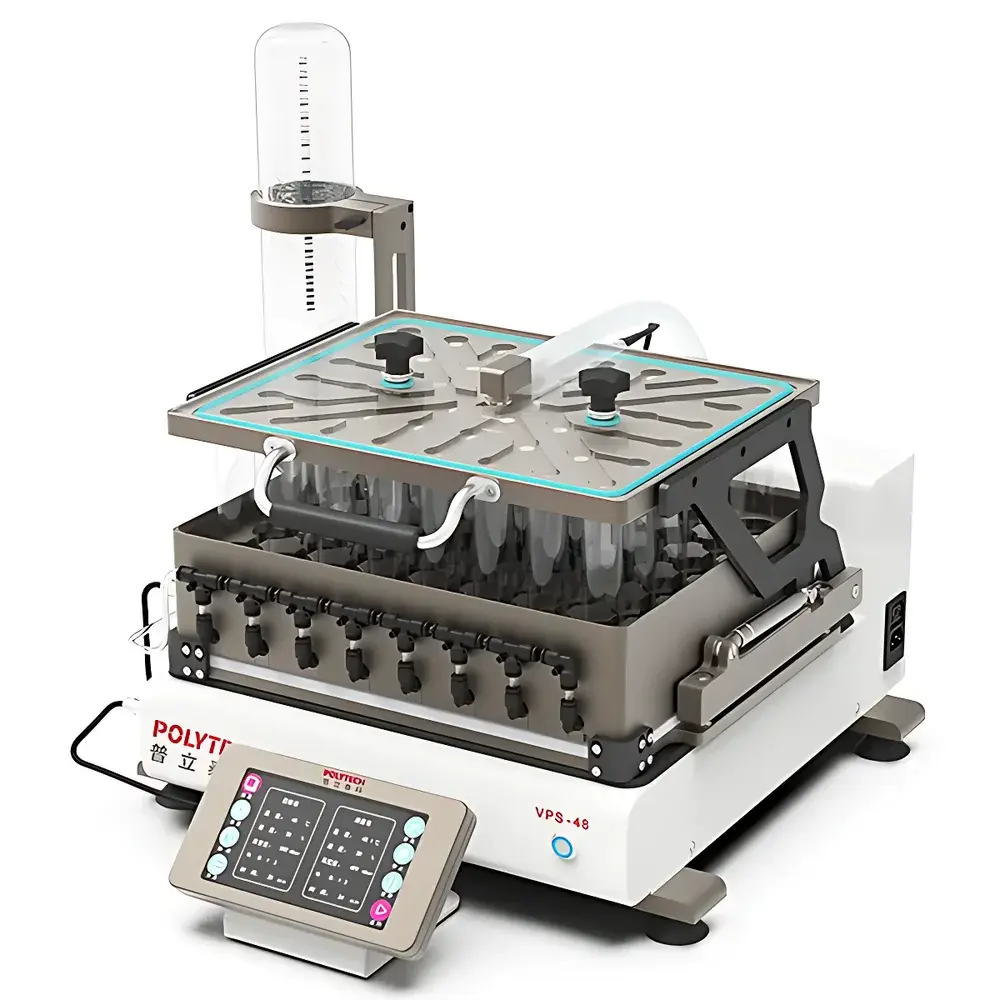
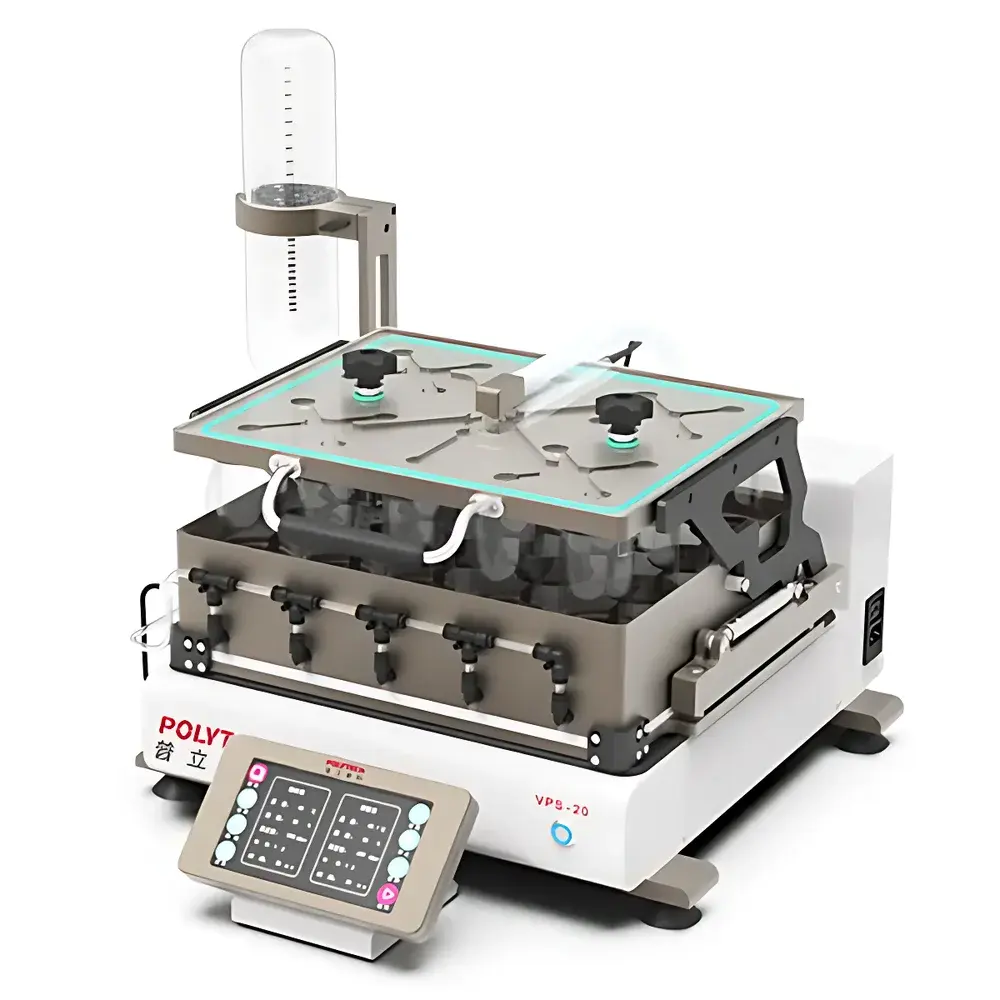
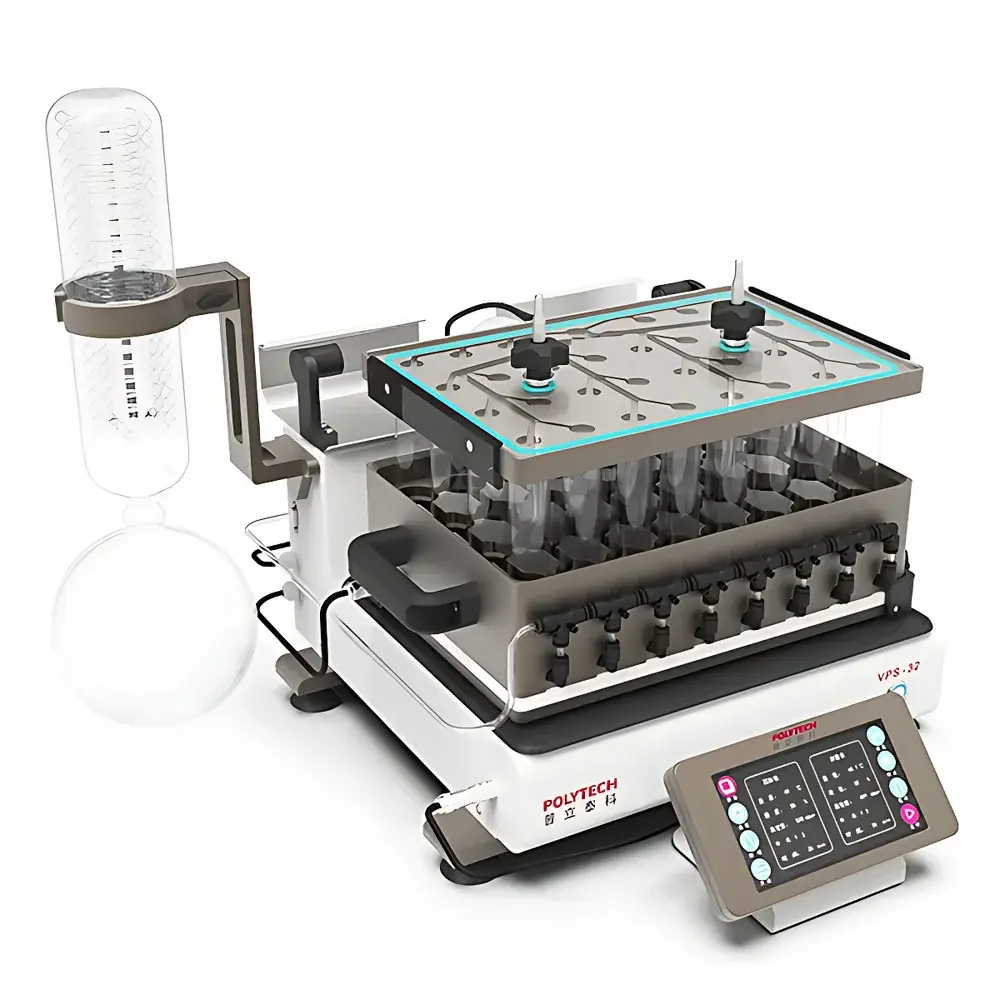
Polytech VPS-12/20/32/48 Vacuum Parallel Concentrator
| Brand | Polytech |
|---|---|
| Model | VPS-12/20/32/48 |
| Sample Capacity | 12/20/32/48 positions |
| Heating Method | Water-bath (uniform temperature control) |
| Vacuum Concentration Mode | Negative-pressure evaporation with condensate trap and end-point detection |
| Sample Volume Range | ≥65 mL (with optional low-volume kit) |
| Evaporation Endpoint Protection | Automatic pressure modulation at ~1 mL residual volume |
| Agitation | Adjustable orbital vortex shaking |
| Control Interface | 7-inch HD touchscreen, Chinese-language UI |
| Method Storage | Up to 100 pre-programmed protocols |
| Cooling Requirement | Compatible with standard laboratory recirculating chillers |
| Vacuum Source | External vacuum pump compatible |
| Concentration Lid | Heated lid to prevent condensate reflux and cross-contamination |
| Sealing Design | Quick-release individual well seals |
| Compliance | Designed for GLP-compliant sample preparation workflows |
Overview
The Polytech VPS-12/20/32/48 Vacuum Parallel Concentrator is an engineered solution for high-throughput, reproducible solvent removal in analytical laboratories. It operates on the principle of vacuum-assisted evaporation under controlled thermal and mechanical conditions—combining water-bath heating, orbital vortex agitation, and regulated negative pressure to accelerate solvent volatilization while preserving analyte integrity. Unlike nitrogen blow-down or rotary evaporation, this system processes multiple samples simultaneously in a sealed, parallel architecture, minimizing inter-sample variability and eliminating manual intervention during endpoint transition. The instrument is specifically designed for quantitative concentration of large-volume extracts (e.g., SPE eluates, QuEChERS supernatants, or LC-MS prep fractions), where consistency across replicates and trace-level recovery are critical. Its architecture supports method-driven operation, enabling standardized workflows aligned with ISO/IEC 17025 and FDA-regulated environments.
Key Features
- Modular sample capacity: Configurable platforms for 12, 20, 32, or 48 positions—scalable via interchangeable rotor assemblies and optional low-volume adapter kits.
- Heated concentric lid: Maintains elevated surface temperature to suppress condensation and prevent re-deposition of volatile analytes onto lid surfaces.
- Individual quick-release sealing: Each sample position features independent sealing mechanism to eliminate cross-contamination risks during multi-batch runs.
- Orbital vortex agitation: Programmable shaking speed ensures homogeneous mixing without foaming or splashing—critical for viscous or surfactant-containing matrices.
- Intelligent endpoint management: Pressure feedback loop modulates vacuum intensity when residual volume approaches ~1 mL, reducing evaporation rate to prevent over-drying and analyte degradation.
- Water-bath thermal uniformity: Precision-controlled bath delivers ±0.3 °C stability across all wells, verified per ASTM E2251 calibration guidelines.
- Open-system compatibility: Integrates seamlessly with existing lab infrastructure—accepts standard recirculating chillers (–10 °C to +5 °C) and industrial-grade vacuum pumps (≤5 mbar ultimate pressure).
Sample Compatibility & Compliance
The VPS series accommodates standard 12–20 mL glass test tubes, 15–50 mL centrifuge tubes, and custom-format vials with conical or flat-bottom geometries. It is validated for use with common organic solvents (acetonitrile, methanol, ethyl acetate, dichloromethane) and aqueous buffers across pH 2–10. All wetted parts comply with USP Class VI biocompatibility standards; sealing gaskets are FFKM-elastomer certified for chemical resistance. The system supports audit-ready documentation: method parameters—including setpoints, dwell times, agitation profiles, and vacuum ramp rates—are timestamped and stored locally with user ID logging. While not inherently 21 CFR Part 11 compliant, it provides raw data export (CSV/Excel) and method traceability suitable for GLP/GMP-aligned validation protocols.
Software & Data Management
The 7-inch capacitive touchscreen interface runs a deterministic real-time OS with localized Chinese language support. Users access pre-loaded templates or build custom methods using intuitive drag-and-drop logic: define heating ramp (0–95 °C), vacuum profile (stepwise or gradient), agitation sequence (on/off timing, RPM range 0–600), and hold conditions. Each method includes pre-heat activation, automatic cooldown post-run, and error-state logging (e.g., bath level low, vacuum leak detected). Up to 100 methods can be saved internally; USB export enables backup and cross-instrument synchronization. No cloud dependency or vendor-specific software license is required—data files retain full metadata including operator ID, start/stop timestamps, and environmental deviation alerts.
Applications
This concentrator is routinely deployed in environmental residue labs (EPA Method 1694, 525.3), food safety testing (AOAC 2007.01), clinical toxicology (SOP-driven urine drug screening prep), and pharmaceutical QC (ICH Q5A impurity profiling). It replaces labor-intensive nitrogen blow-down for high-volume extractions—reducing hands-on time by >70% while improving CVs (<3.5% RSD for spiked pesticide recoveries across 48-well batches). In metabolomics workflows, its gentle endpoint control preserves thermolabile compounds (e.g., prostaglandins, bile acids) better than forced-air systems. The heated lid and isolated wells also make it suitable for unstable isotope-labeled internal standards requiring strict matrix separation.
FAQ
Can the VPS system be used with corrosive solvents such as hydrochloric acid or trifluoroacetic acid?
No—only solvents listed in the validated compatibility matrix (acetonitrile, methanol, ethyl acetate, etc.) are supported. Corrosive or highly reactive solvents may degrade seals and chamber coatings.
Is external chiller cooling mandatory for operation?
Yes—the condensate trap requires active cooling between –5 °C and +5 °C to ensure efficient vapor capture; ambient air cooling is insufficient for reproducible endpoint control.
Does the instrument include built-in vacuum generation?
No—it requires connection to an external vacuum pump capable of sustaining ≤5 mbar base pressure with oil-free or diaphragm configuration recommended for solvent compatibility.
How is method validation performed for regulatory submissions?
Users conduct performance qualification per IQ/OQ/PQ protocols using reference standards (e.g., caffeine in methanol); Polytech provides hardware calibration certificates and traceable temperature/vacuum verification templates.
What maintenance intervals are recommended for long-term reliability?
Seals should be inspected quarterly; water-bath fluid replaced monthly; vacuum line filters cleaned after every 200 hours of cumulative runtime. Full service is advised annually by certified field engineers.



