
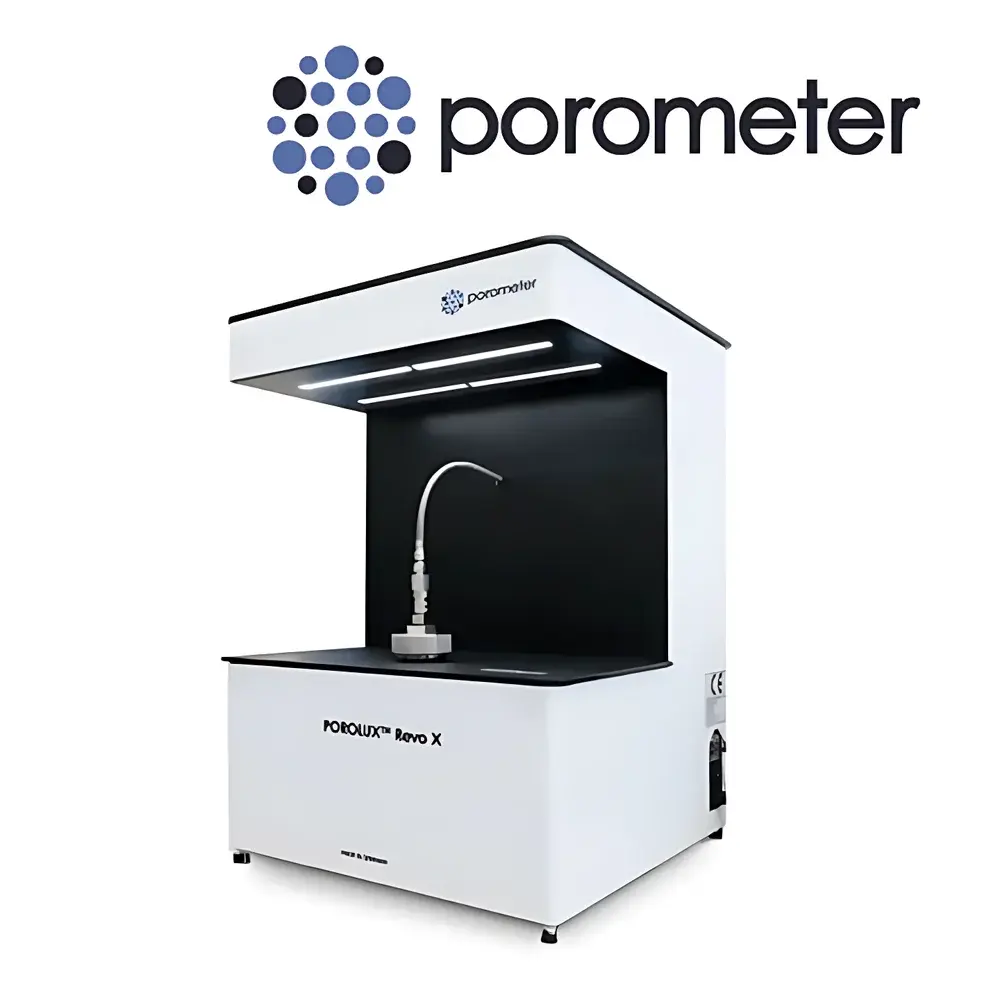
Porometer POROLUX™ Revo X Gas-Liquid Capillary Flow Porometer
| Brand | Porometer |
|---|---|
| Model | POROLUX™ Revo X |
| Origin | Germany |
| Measurement Principle | Gas-Liquid Capillary Flow (Capillary Flow Porometry, CFP) |
| Pore Size Range | 80 nm – 500 µm |
| Bubble Point Pressure Range | 0–8 bar (0–116 psi) |
| Max. Gas Flow Rate | 200 L/min |
| Dual Auto-Switching Flow Sensors | 0–10 L/min & 0–200 L/min |
| Dual Auto-Switching Pressure Sensors | 0–1 bar & 0–10 bar |
| Sample Holder Diameter | 25 mm |
| Max. Sample Thickness | 3 mm |
| Measurement Modes | Bubble Point (BP x-mL, BP pCF), Mean Flow Pore Size, Minimum Pore Size, Pore Size Distribution, Cumulative Flow Distribution, Gas Permeability |
| Optional Modules | Liquid Permeability, Fluid Source Integration |
| Software | PoreSmart™ with Curve Fitting, Statistical Pore Quantification (Total Pore Count, Total Pore Area [% & µm²], Open Porosity, Calculated Permeability in Darcy) |
| Patented Measurement Method | MP² (Multi-Step Pressure Progression) Technology |
| Compliance Ready | ASTM F316-22, ISO 15709:2022, USP <801>, GLP/GMP Data Integrity Support (Audit Trail, Electronic Signatures, 21 CFR Part 11 Ready) |
Overview
The Porometer POROLUX™ Revo X Gas-Liquid Capillary Flow Porometer is a high-precision, research-grade instrument engineered for the quantitative characterization of through-pore structure in porous membranes, filters, nonwovens, sintered metals, ceramics, and other anisotropic or asymmetric materials. It operates on the fundamental principle of capillary flow porometry (CFP), wherein a wetting liquid (typically isopropanol or water) is intruded into the pore network under controlled gas pressure. As pressure increases stepwise—enabled by the proprietary MP² (Multi-Step Pressure Progression) technology—the gas displaces the liquid from successively smaller pores. The resulting gas flow vs. pressure curve enables rigorous derivation of structural and transport-relevant parameters, including bubble point, mean flow pore size, minimum pore size, and full pore size distribution. Unlike optical or mercury intrusion techniques, CFP preserves sample integrity, avoids toxicity concerns, and delivers physiologically relevant data for filtration validation, quality control, and R&D in pharmaceutical, biotech, food & beverage, and advanced materials sectors.
Key Features
- Patented MP² pressure stepping algorithm ensures thermodynamic equilibrium at each pressure step, minimizing transient flow artifacts and maximizing reproducibility (RSD < 2% across replicate measurements).
- Dual-range, auto-switching flow sensors (0–10 L/min and 0–200 L/min) provide optimal resolution across low-flow microporous samples and high-flow macroporous media.
- Dual-range, auto-switching pressure transducers (0–1 bar and 0–10 bar) enable precise low-pressure measurement for sub-100 nm pores and robust high-pressure operation up to 8 bar (116 psi) for coarse structures.
- Standard 25 mm diameter sample holder accommodates flat, rigid, or semi-flexible specimens up to 3 mm thick; optional holders available for 47 mm and 90 mm diameters.
- Two independent bubble point determination methods: BP x-mL (bubble point at user-defined volumetric flow threshold) and BP pCF (bubble point at user-defined cumulative flow percentage), supporting both regulatory and application-specific definitions.
- PoreSmart™ software integrates real-time curve fitting, statistical pore quantification—including total pore count, total pore area (expressed as % open area and absolute µm²), open porosity, and Darcy-scale permeability calculations—directly from raw flow-pressure data.
Sample Compatibility & Compliance
The POROLUX™ Revo X is validated for use with hydrophilic, hydrophobic, and mixed-wettability materials, including polymeric membranes (PVDF, PTFE, nylon, cellulose esters), ceramic monoliths, sintered stainless steel, battery separators, fuel cell GDLs, and geotextiles. Its measurement methodology aligns with internationally recognized standards: ASTM F316-22 (Standard Test Methods for Pore Size Characteristics of Membrane Filters by Bubble Point and Mean Flow Pore Test), ISO 15709:2022 (Fine ceramics — Determination of pore-size distribution of ceramic powders and porous ceramics), and USP (Sterile Filtration). Instrument firmware and PoreSmart™ software support audit trail logging, user access control, electronic signatures, and data export formats compliant with FDA 21 CFR Part 11 and EU Annex 11 requirements—enabling direct integration into GLP and GMP quality systems.
Software & Data Management
PoreSmart™ is a Windows-based, modular software platform designed for traceable, compliant data handling. It provides real-time visualization of pressure ramps and flow responses, interactive curve fitting using nonlinear regression models (e.g., Washburn equation adaptation), and batch processing for multi-sample comparative analysis. All raw data, metadata (operator ID, timestamp, environmental conditions), and processing parameters are stored in encrypted SQLite databases with immutable audit trails. Export options include CSV, PDF reports (with customizable templates), and XML for LIMS integration. Validation documentation (IQ/OQ/PQ protocols) and 21 CFR Part 11 configuration guides are supplied with each system.
Applications
- Filtration membrane qualification per USP and , including pre-use post-sterilization integrity testing correlation.
- Development and QC of vent filters, breathers, and sterile barrier packaging materials.
- Characterization of catalyst supports, battery electrode coatings, and porous electrodes for electrochemical devices.
- Quality assessment of nonwoven medical fabrics, wound dressings, and air filtration media.
- Research into pore tortuosity, effective diffusivity, and structure–property relationships in functional porous composites.
- Supporting DOE and design space definition in QbD-based manufacturing processes.
FAQ
What wetting liquids are compatible with the POROLUX™ Revo X?
Isopropanol (IPA), water (with surfactant for low-surface-tension materials), and perfluoroether-based fluids are commonly used. Viscosity and surface tension values must be entered into PoreSmart™ for accurate pore size calculation.
Can the system measure liquid permeability?
Yes—liquid permeability is available as an optional module, enabling Darcy permeability measurement under controlled hydraulic pressure gradients using calibrated fluid delivery and differential pressure sensing.
Is calibration traceable to national standards?
All pressure and flow sensors are factory-calibrated against NIST-traceable references; certificate of calibration and uncertainty budgets are provided with each instrument.
How does MP² differ from traditional pressure ramp methods?
MP² applies discrete, dwell-stabilized pressure steps rather than continuous ramps, ensuring full equilibration of gas–liquid interface kinetics—critical for accurate minimum pore size and distribution fidelity in heterogeneous media.
Can I analyze asymmetric or gradient-pore membranes?
Yes—the directional gas flow measurement (inlet-to-outlet) combined with dual-sensor dynamic range allows robust characterization of skin-layer integrity and support-layer porosity in composite membranes.



